
Fanatec Podium Button Module Endurance : Test & Review | What it's really worth in 2026
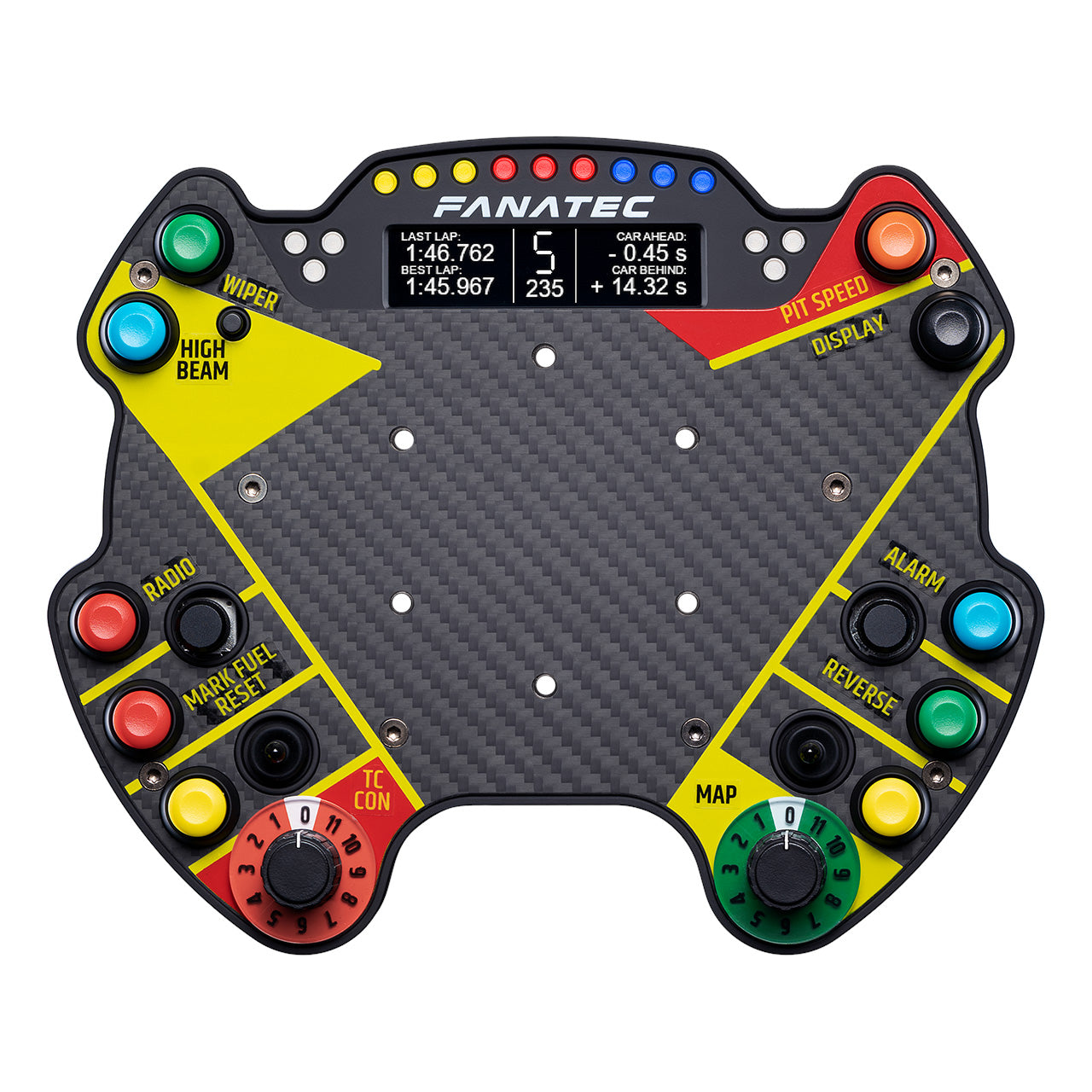
Fanatec Podium Button Module Endurance : My opinion in brief
This module gives a real feeling of advanced control: everything to do with race management becomes more fluid, more centralized, without breaking the rhythm on the track. It makes sense above all for sim racers already well equipped on PC, GT/endurance oriented and sensitive to real-time strategies and settings. The investment remains coherent if you see your rig as a racing tool.
When you buy through our links, we may earn an affiliate commission.
Fanatec Podium Button Module Endurance: test & feedback after use
The Fanatec Podium Button Module Endurance is clearly a niche product in sim racing: a high-end button module designed for the GT/endurance steering wheels in the Fanatec range. It doesn't give you the power of a Direct Drive base, but it transforms the interface between you, the car and on-track settings.
On paper, it promises ultra-fast access to all functions useful in endurance, GT3 or prototype racing: advanced mappings, dual joysticks, encoders, large color display. All in a format that is very reminiscent of what you see in real modern racing cars. The idea is simple: fewer menus to memorize, more control at your fingertips.
For my part, I evaluated it mainly from two angles: pure ergonomics (access to controls, legibility, comfort over several hours) and the ability to make race management more fluid (strategy, ABS, TC, fuel mixture, radio, etc.). This is not a product designed to look "better" on the rig. It's a steering and management tool.
Honestly, it's this kind of accessory that takes a Fanatec setup from "excellent for gaming" to "really competition-oriented". But you also have to accept its compromises and its very clearly premium price.
Design and manufacture of the Podium Button Module Endurance
In hand, the first impression is of density. The module doesn't give the impression of a simple plastic casing with a few buttons stuck on top. It feels like a serious, well-assembled block, with a carbon-fiber front panel and a chassis that doesn't budge when you press hard on the keys.
The push-buttons have a short travel and a clean click, firm enough to avoid unintentional presses, without being tiring. The two multi-directional joysticks are particularly successful: precise, with a clean return to center, perfect for navigating a menu or managing a virtual scroll wheel in the game. As for the rotary encoders, they offer well-marked notches. You'll know right away if you've made a click or two, even in the middle of a race.
The central color screen makes a real difference in terms of perceived quality. It's not huge, but it's legible enough to display your main telemetry info without squinting. Colors are clean and contrast correct, even with conventional ambient lighting.
What's most surprising at first is the sheer number of orders in such a compact space. Everything is very dense. On an already busy rig, it's visually imposing. Up close, you can tell it's been designed for professionals rather than the general public.
Where it can be slightly disappointing is on certain plastic details around the screen and the rear of the module, which look a little less "jewel-like" than the carbon front panel. Not annoying in use, but in stark contrast to the rest of the Podium range.
Compared to simpler solutions such as a GT steering wheel with a few integrated buttons or an external button box, we're clearly in a different league. This is a product designed to be hit thousands of times without flinching. In terms of rigidity, nothing flexes, nothing creaks, even over long, aggressive sessions.
Settings, customization and compatibility
The Podium Button Module Endurance is fully integrated into the Fanatec ecosystem. This is a product designed to work with Fanatec bases, notably the Direct Drives in the ClubSport / Podium range, and with compatible steering wheels (podium hub-type washers and hubs, etc.). It's not a universal accessory that you're going to mount on any wheel or DIY base.
In terms of compatibility, in practice, optimal use remains on the PC. Advanced screen functionalities, detailed telemetry and full display customization are best used on the PC, with Fanatec software. On consoles, the module remains usable, but loses some of its customization finesse, depending on games and updates.
Settings are made mainly via the Fanatec software and internal menus. The learning curve isn't steep, but you do have to be willing to spend a little time: assigning buttons in games, setting the screen display pages, choosing what info you want to see and when. At first, it can feel a little overwhelming. After a few sessions, it all makes sense.
Where it gets interesting is in the customization of the bindings. Each button and encoder can be assigned to a critical function: TC variation, ABS, braking balance, fuel mixture, HUD page change, box request... Once you have a minimum of method, the module becomes a customized dashboard.
Ecosystem-wise, it integrates perfectly with a complete Fanatec rig: DD chainstay, pedal set, shifter, handbrake. You get the impression that this product is not an "entry point", but rather a mid/top-of-the-range piece designed for someone who's already well established. It's more an evolution than a first purchase.
In terms of durability, this is an accessory that can accompany several generations of bases, as long as you stay within the Fanatec universe. Scalability comes mainly from your own progression: the higher you go, the more you exploit the mapping and display possibilities.
Sensations in play: what it really changes
The Podium Button Module Endurance doesn't change the strength of your force feedback, but it does change the way you interact with your FFB and the car's parameters. And there, the difference is clear.
When cornering, what really stands out is the ease with which you can adjust parameters in real time without breaking your rhythm. For example, reduce the traction control on the exit of a curve, adjust the brake bias before heavy braking on a descent, or modify the fuel mixture to hold out for one more lap. All this can be done at your fingertips, without having to search for a key on the keyboard or a function hidden in a menu.
Grip is not read by the module itself, but by the car's ability to adapt to that grip in a matter of seconds. On a track that's getting colder, or during a stint with heavy tire wear, it's very natural to adjust the ABS, diff or mapping. You quickly feel that the consistency between what the steering wheel says and what you change on the module improves your overall understanding of the car. It's easier to understand why you're wasting time.
On the curbs, here again, the benefit is indirect but real: the possibility of adjusting a suspension or diff setting to make the car more tolerant, without waiting for the next return to the pits. In endurance racing, or even just on a serious sprint, it makes a real difference to your mental comfort. You keep your hands on the wheel, your eyes on the track, and you take action.
In rapid corrections, the key point is that the buttons don't get in the way. Even in violent countersteering, you won't find yourself pressing a critical button by mistake. The layout is well thought-out: the controls you use in a straight line or stable phase remain accessible, but are not under the areas where you squeeze hardest when sliding.
On longer sessions, this is where the module really comes into its own. You don't have to go back and forth through the game's menus, or look for the pit limiter or radio button. Everything is grouped together, logical, and the central screen provides crucial information: delta, position, fuel, tires, depending on your settings. Cognitive fatigue is reduced. You drive cleaner, more focused.
Compared to a setup with a simple GT steering wheel and no dedicated module, the overall feeling of race control is clearly superior. You don't have more FFB, but you do have more control. Compared with an even more advanced setup with ultra-premium steering wheel and dedicated dashboard, we're on a very homogeneous, more integrated solution, a little less extreme but more than sufficient for the vast majority of demanding sim racers.
Who's it for? What we like, what we don't like
The Podium Button Module Endurance is clearly aimed at a user profile that's already well into its stride: intermediate to confirmed sim racers, who regularly race in GT3, LMP and multiclass, and who are starting to play seriously with strategies, stints and long stints. On the PC, it makes perfect sense. On consoles, it remains interesting, but its potential is a little less exploited.
What's immediately noticeable is the overall quality of the controls. The buttons are precise, the screen is easy to read, and the overall ergonomics look very serious. You gain enormous comfort in race management: everything is at hand, and you can adjust directly. Integration into the Fanatec ecosystem, with a single coherent steering wheel + base + module, is also a real plus. You don't have to cobble together third-party solutions or external dashboards.
Another highlight is the professional feel of the setup. Once you've got your bearings, the module really gives you the impression of sitting behind the wheel of a modern GT car. We're no longer just talking about "playing the simu", but about managing a race, a car, a strategy. For a driver who wants to progress in a league or online competition, this is a real asset.
In terms of limitations, the price clearly places this module in the serious investment category. This is not the kind of accessory you buy on a whim. You already need a compatible base, a suitable steering wheel, and a real desire to take advantage of all its functions. Another limitation is its total dependence on the Fanatec ecosystem: if you change your base brand in the future, the module will become much less useful.
Finally, the configuration interface will require a little patience from those who don't like spending time in menus and telemetry overlays. For someone who just wants to "plug and ride", it's probably too fiddly. But for a sim racer who sees his rig as a working tool, the value/performance equation remains very interesting.
Verdict: is the Podium Button Module Endurance worth it?
In an endurance racing or serious GT sim setup, the Fanatec Podium Button Module Endurance isn't just a decorative accessory. It quickly becomes the nerve center of the entire race management system. It doesn't add Nm of torque to your base, but it does change the way you exploit every lap, every stint, every liter of fuel.
On the market, this is a clearly premium product, halfway between a top-of-the-range steering wheel integrating everything and a simple steering wheel + button box/independent dash combo. Its real strength lies in its integration. Everything remains within the Fanatec ecosystem, without cables everywhere, with ergonomics designed for modern control.
I recommend it to sim racers who are already well-equipped, who drive regularly, and who have a real desire to manage their races as if they were real races: stints, tire strategies, dynamic settings. For a beginner or a more casual player, the budget and complexity are not necessarily justified. Better to invest first in a good base, a serious pedal set and a stable cockpit.
If you're looking to professionalize your GT/endurance-oriented Fanatec cockpit and gain more control over everything that surrounds pure driving, this product can clearly make the difference in your setup.




Reviews