MOZA Universal Hub Kit : Test & Reviews | What it's really worth in 2026
MOZA Universal Hub Kit : My opinion in brief
This hub gave me the sensation of a very solid and transparent link between the MOZA base and a "real" steering wheel, with no loss of precision or feel. Above all, it makes sense for PC-based sim racers already committed to the MOZA ecosystem, who want to easily change steering wheels according to discipline. For this profile, the value is consistent and lasting.
When you buy through our links, we may earn an affiliate commission.
MOZA Universal Hub Kit: my opinion after real-life testing
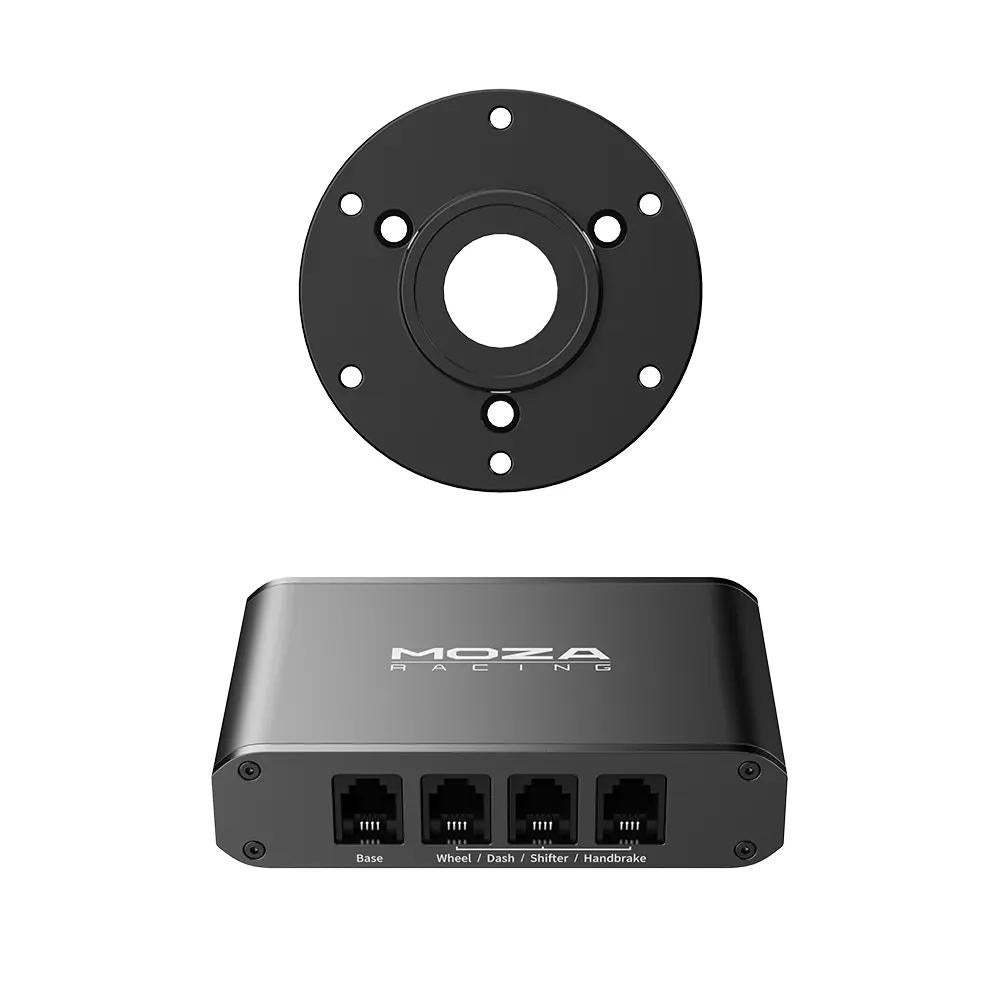
In the MOZA ecosystem, the Universal Hub Kit occupies a special place. It's neither a steering wheel, nor a base, but the part that allows you to connect almost any "real" steering wheel to a MOZA Direct Drive base, while retaining the essential functions: buttons, paddles, and possibly a display module depending on the assembly.
It's attractive because it promises two things that are highly sought-after in sim racing: total freedom to choose your steering wheel, and clean integration into the MOZA ecosystem, with no dubious fiddling or exotic electrical adapters. Basically, the idea is simple: you keep the power and finesse of a Direct Drive base, but you get the sensations of an "IRL" car steering wheel.
So my angle on this test is clear: does this kit really hold its own in terms of build quality, rigidity and signal reliability, and above all, does it deserve its place in an already well-equipped setup? Or is it still a nice accessory, but dispensable if you're already riding with the official MOZA steering wheels?
Design and manufacture of the MOZA Universal Hub Kit
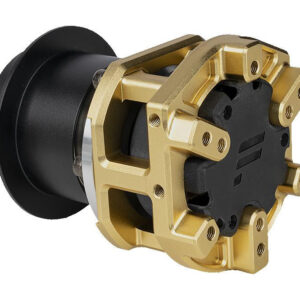
First contact: it exudes metal. The hub is mostly machined aluminum, giving the impression of a solid block, with no parts that sound hollow or move in the hand. In hand, the density is a little surprising for a "simple" hub, but it's immediately reassuring in terms of rigidity when you think of the constraints of a high-torque Direct Drive.
The overall finish is clean: rounded edges, uniform anodizing, clean engravings. Screws are well recessed, nothing protrudes, giving the impression of a product built to last. Once mounted on the base, there's no perceptible play. When you deliberately force the steering wheel, the connection remains stable, with no noticeable parasitic flex. On a strong setup, this is exactly what you want: no loss between base and hands.
What's most striking is the careful integration of the MOZA quick release. Engagement is straightforward, and locking gives a clear "click" with no wobble. It's clear that we're dealing with a standard Direct Drive and not a cobbled-together adaptation of a consumer steering wheel.
Where I'm a little more nuanced is on certain ergonomic details. Depending on the steering wheel you mount, the wiring and button management can quickly become visually overwhelming. The hub does what it can, but it's not magically "clean" with any third-party hardware: you have to think about your set-up at least a little. I also find that, compared with some very modular high-end hubs, the whole thing looks a little less "jewel-like" and more like a "serious tool". It's not a fault, but it's not very luxurious.
Compared to other hubs in a similar category, the MOZA Universal Hub Kit is clearly in the serious mid/high-end segment: more robust and better integrated than a generic adapter, a little less premium than some ultra-custom kits that cost considerably more. A good compromise between sturdiness, finish and price.
Settings, customization and compatibility
As far as settings are concerned, everything goes through the MOZA Pit House software. The Universal Hub Kit is recognized as part of the ecosystem, which makes life much simpler. There's no need for obscure drivers or twisted mappings. Button inputs are seen as classic MOZA inputs, making in-game assignment very straightforward.
The most important customization comes down to how you map your controls. With an "IRL" steering wheel, you have fewer buttons than with some of MOZA's well-stocked dashboards, so you have to think about what's really essential: headlights, radio, engine map change, pit limiter, etc. The hub is nice because latency is imperceptible and pressure reliability is good. What makes the hub so pleasing is that latency is imperceptible and pressure reliability is good. Press and it responds immediately, with no phantom double-clicks or dead zones.
The learning curve really depends on your experience with sim racing. If you're already familiar with MOZA software and mappings, integration is straightforward. If you're new to both a Direct Drive base and this hub, there's a slight learning curve, but nothing to get stuck into. Honestly, the most time-consuming part is often choosing how to distribute your functions over fewer buttons.
Compatibility-wise, we're back on classic MOZA ground: it's designed primarily for the PC. Consoles are trickier, as hardware recognition of custom hubs and wheels depends very much on the games and manufacturers' limitations. If you're mainly running a console with a proprietary ecosystem, this kit loses much of its appeal.
As far as the ecosystem is concerned, the hub goes very well with MOZA Direct Drive chainstays, pedal sets and shifters. It's easy to imagine a complete MOZA setup where only the steering wheel is a "real" model or from another sim racing brand. It's clearly an opening product: it transforms a MOZA base into a more universal platform. For me, it's not just an entry point, it's a real lasting brick: once you've got it, you can evolve your steering wheels according to your desires, without changing the rest of the setup.
MOZA Universal Hub Kit: sensations in play
On the track, the hub's role is very simple: not to damage anything. It must not filter force feedback, add flex or generate any parasitic play. And in this respect, the MOZA Universal Hub Kit performs really well.
On a MOZA Direct Drive base, the flow of information remains very clean. Micro-variations in torque, small grip deviations, slight load transfers under braking: everything passes through without the impression of a mechanical "buffer". When you switch from a brand's original steering wheel to one mounted via this hub, what's most surprising is that the sensations remain comparable in precision, provided that the steering wheel chosen is itself rigid. You quickly get the feeling that the base continues to "talk" just as much.
When cornering, especially in GT3s and prototypes, the grip reading remains fine. You can feel when the front end begins to saturate. The steering wheel angle, the gradually increasing resistance, the little surface vibrations: it's all there. It's not the hub that limits your ability to control your corner entry. If there is any flex, it almost always comes from the steering wheel itself or the cockpit, rarely from the kit.
On curbs, behavior is interesting. With a good FFB setting, you can feel the pattern of the curbs, the frequency changes from track to track, and the hub doesn't seem to filter out these details. The dry shocks are frank, but without the parasitic noise of moving parts in the system. When the car bites into an aggressive curb a little too hard, you feel the jolt in your hands, and that's precisely where the benefit of a rigid linkage comes into play: you know exactly when to lift your foot off the accelerator or release the steering wheel slightly to let the car settle.
Over long sessions, the Universal Hub Kit makes itself forgotten, which is a good sign. No perceptible loosening, no noises that appear when hot, no sensation that the link becomes less firm after several hours of riding. Consistency is really good. For regular, even daily use, this is reassuring.
When making fast corrections, especially in nervous cars or in rally/rallycross, you're looking for responsiveness. When the car stalls, you counter-steer and bring the steering wheel back to center, the hub follows without delay or unnecessary damping. The base gives everything, the hands receive everything, immediately. This is where you really see the difference with some of the softer adapters or DIY set-ups, where you lose the direct link. Here, little oscillations, racket strokes and violent catches remain well under control.
Compared with a "native" MOZA steering wheel mounted directly without using a universal hub, I didn't feel any noticeable loss of precision, as long as the mounting is correct and the chosen steering wheel is serious. On the other hand, compared to a less powerful base with a lighter steering wheel, the assembly is obviously more physical. Depending on the diameter and weight of the "IRL" steering wheel installed, it may feel a little heavier to manoeuvre at high intensity. This is not a fault of the hub, but a point to bear in mind: the larger the steering wheel, the more the lever arm works on the base.
All in all, the overall experience is highly immersive: you get the benefits of a modern Direct Drive, with the pleasure of a customized steering wheel. You immediately understand what the car is doing, which is exactly what you'd expect from a hub of this type.
Who's it for? And what we like / don't like
I clearly see this kit as an ideal solution for intermediate to advanced sim racers, already equipped with a MOZA base or seriously considering entering the ecosystem. If you're coming from a mainstream all-in-one steering wheel and want to take things to the next level, this hub can be part of that move upmarket, but it makes perfect sense for someone who already knows what they want in terms of steering wheel type: GT, single-seater, rally, "real car" steering wheel or replica.
What I appreciate most is the rigidity of the whole. You feel a direct connection, without any softness, even when the base is put under heavy strain. Secondly, the integration into the MOZA ecosystem is very clean: reliable recognition, simplified mapping, no unnecessary software complications. Last but not least, the freedom it offers is a real plus: being able to change the steering wheel without having to change all the electronics is a real pleasure. You invest in the hub once, and then you play with the wheels as you wish.
But there are limits. The first is that this is not a product designed for beginners who want a "plug and play" kit without thinking: you need a minimum understanding of your setup, the space available, the buttons you really need, etc. The second is the dependence on the MOZA ecosystem and the PC. Secondly, there's the dependence on the MOZA ecosystem and the PC: on a console or with other bases, usefulness drops drastically. Finally, the overall budget must be taken into account: the hub alone is not unreasonable, but it is only fully useful with a Direct Drive base and a quality steering wheel, so the final investment can quickly climb.
In terms of perceived value, I think the price/utility ratio is good if you really intend to exploit the modularity it offers. If you ride all the time with a single steering wheel and have no desire to customize, the interest becomes more relative. For someone who regularly changes discipline, or who likes to fine-tune his feel with different steering wheels, the kit makes perfect sense.
Verdict: should you include the MOZA Universal Hub Kit in your setup?
This kit doesn't transform a base into something more powerful, but it clearly changes the way you can evolve your setup. It frees up your choice of steering wheel while maintaining a clean, solid mechanical link with your MOZA Direct Drive base. In an environment where many accessories simply add gadgetry, this is a functional, serious and useful brick.
On the market, I position it as a pivotal mid-range/high-end product: well-built enough to satisfy demanding sim racers, without reaching the sometimes unreasonable prices of certain ultra-custom solutions. It's not the product you'd dream of in the photos, but it's typically the one you'd be happy to have when you want an evolving, coherent setup.
I'd recommend it above all to PC users already committed or ready to commit to the MOZA ecosystem, who want to build one or more "real" or specialized wheels. For a console-only gamer, or someone who just wants a ready-to-use kit with no questions asked, it's not the best choice.
If you're looking to keep the power and finesse of your MOZA base while opening up the world of custom wheels, this product can clearly make the difference in your setup.</assistant




Reviews