
Fanatec ClubSport Universal Hub V2 for Xbox : Test & Review | What it's really worth in 2026
Fanatec ClubSport Universal Hub V2 for Xbox: My quick review
This hub gave me the sensation of transforming a Fanatec setup into a real modular driving platform, without interfering with the feel of the steering wheel or complicating Xbox use. It makes sense for intermediate to advanced sim racers who want to multiply hoops and stay in the Fanatec ecosystem for a long time. The investment makes sense if you're aiming for a serious, upgradeable setup.
When you buy through our links, we may earn an affiliate commission.
Fanatec ClubSport Universal Hub V2 for Xbox: high-end versatility for custom wheels
In the Fanatec ecosystem, the ClubSport Universal Hub V2 for Xbox plays a very special role: it's not a steering wheel, it's not a base, it's the "brain" that lets you mount almost any GT, rally or drift type hoop on a Fanatec base, while retaining Xbox compatibility. It's a niche product, but one that attracts a lot of sim racers as soon as you start wanting a more serious or customized setup.
On paper, the promise is simple: a robust, ultra-configurable, Xbox-compatible hub, with real racing controls (paddle shifters, buttons, joystick, screen) and the freedom to choose the diameter and style of steering wheel you want. In practice, this kind of product can quickly become frustrating if the ergonomics are poorly thought-out or if the rigidity isn't up to scratch.
My angle is clear: evaluate it as a real driving tool, not as a collector's gadget. Comfort of use over time, accessibility of buttons in full battle, feel of the paddles, overall quality, Xbox/PC compatibility management, and above all: is it worth the investment compared to a "complete" turnkey Fanatec steering wheel. That's where this hub really comes into its own.
Design and manufacture: a real piece of serious hardware
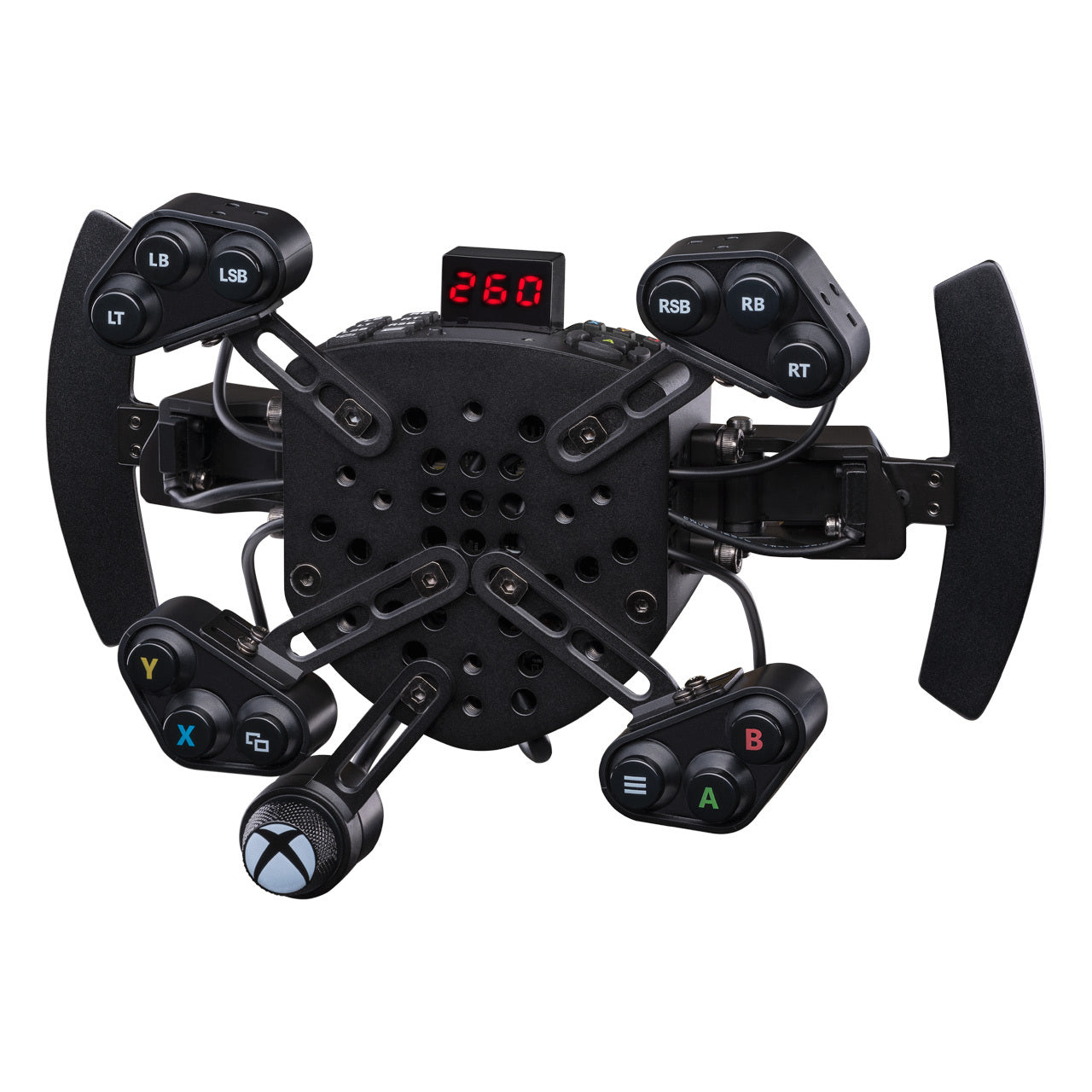
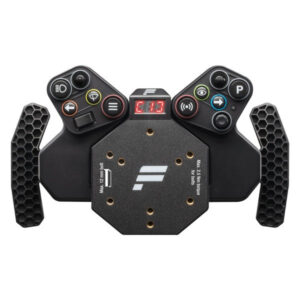
In hand, the ClubSport Universal Hub V2 for Xbox immediately gives the impression of holding a serious piece of hardware. The main body is solid metal, with that reassuring feeling of density you'd expect from a product positioned above the entry-level range. Nothing sounds hollow, nothing moves suspiciously. You can feel that it's been designed to withstand hours and hours of riding with hoops that are sometimes quite heavy.
The modular arms that support the buttons and display can be adjusted to several positions. This is where the design shows its intelligence: the hub adapts to different steering wheel diameters, while maintaining correct access to the controls. The buttons have a clean, well-defined click, without excessive play. It's not the stuff of prototypes, but for an advanced consumer sim racing product, it's clean. You can spam certain buttons while racing without fear of tearing them off.
The gearshift paddles are another highlight. Their metal construction inspires confidence, the stroke is short and the click is clear. The feel isn't as refined as on some high-end magnetic shifters, but it's clearly close. For GT and rally use, it does the job with a very good feel. It's a pity that, if you're playing in a quiet room, the click sound is a bit present, but that's not a problem.
What's surprising is the overall compactness despite the level of functionality. You've got a screen, buttons, joystick, D-pad and Xbox switches, all without it becoming a gas factory in front of your eyes. Compared to more basic hubs or certain "low-cost" steering wheels, we clearly gain in rigidity, manufacturing finesse and mechanical feel. Compared with an all-integrated Fanatec CSL-type wheel, the Universal Hub is more of a "working tool", less of a toy, with a modular aspect that's much appreciated when you want a serious setup.
The only real design drawback is the density of wiring and parts around the column once it's all assembled: visually, it's not as uncluttered as a one-piece steering wheel. But that's the price you pay for modularity.
Settings, customization and compatibility: the king of the Xbox/custom mix
This hub is primarily designed as a gateway: it provides Xbox recognition thanks to dedicated buttons, while remaining perfectly usable on the PC. On consoles, you benefit from the native Xbox mode of compatible Fanatec bases, with Xbox button icons directly on the hub. In practice, this makes life much simpler: no fiddling, no strange mapping on the console side, everything's clear.
The customization comes mainly from the possibility of fitting 6-hole 70 mm type hoops, which are very common in the auto and sim racing world. So, if you're dreaming of a 320 mm GT steering wheel, a big rally hoop or a drift steering wheel, you can do it. This is where the hub comes into its own: it will transform your Fanatec base into an open platform without sacrificing ecosystem functionality.
As far as settings are concerned, everything can be managed within the Fanatec ecosystem (via the base's menu and PC software). The hub itself isn't a "tuner" product like a Direct Drive base; it offers an organization of buttons and palettes that you can physically adapt. You can adjust the position of the button modules, and set the distance and angle, all so that the controls just fall into place. There's a learning curve: it takes a little time to find the right position for your hoop, hand size and riding style. Once set up, you forget about the hub and concentrate solely on the track, which is exactly the point.
Compatibility with other Fanatec components is excellent: pedal sets, shifters, handbrakes, everything goes through the base as usual. The hub doesn't complicate the chain. It plays its role as an interface for controls and Xbox, without adding unnecessary layers.
In terms of scalability, I clearly see it as a sustainable investment. You can start with a single hoop, then add a second for another discipline without changing your hub. It's an entry point to a modular setup, not an accessory you replace every year. As long as you stay within the Fanatec ecosystem, it's worth every penny.
Sensations in play: immersion and control, especially with a good hoop
Even if the hub doesn't generate the force feedback itself, it has a strong influence on the overall feel of the steering wheel. The first thing that stands out is the rigidity of the assembly. On a Direct Drive Fanatec base, the connection between the column and the hoop is very clear: no perceptible flex in the hub, no parasitic play. You can really feel the torque and fine variations of the FFB passing directly through your hands.
In the corners, steering precision depends very much on the diameter and style of steering wheel you use. With an average GT hoop, the hub + base combination gives very clean steering: you can feel exactly where the front starts to stall, and small, fine corrections become natural. The hub doesn't filter anything, it simply transmits. It's this neutrality that's interesting: it doesn't "color" the feedback.
Grip reading is very good as long as you choose a hoop consistent with your discipline. On the racetrack, you can feel how the steering wheel loads up on entry, the slight release at the chord point, and the micro-vibrations when the tires start to saturate. You quickly understand what the car wants to do. On less powerful bases or with more flexible steering wheels, these transitions are often more blurred. Here, the hub holds up perfectly to the torque of a Direct Drive, and this translates into a sharper feel.
Curbs are a good test: with this hub, each type of curb has a clear signature. The small F1-type edgings give off fast, dry, well-detailed vibrations. The big circuit club curbs make the steering wheel move in your hands, but the assembly doesn't squeak or twist. The hub doesn't add parasitic mechanical noise, keeping things clean and controlled. And that's where we see the difference with setups where the steering wheel or hub take on play after a few hard sessions.
On long sessions, the ergonomics of the buttons and paddles really make the difference. You can ride for several hours without being bothered by the layout of the controls, provided you've taken the time to adjust the modules. Comfort also depends on the hoop fitted, but the hub doesn't add unnecessary weight. The weight is there, but well-balanced, which helps maintain good control even in rapid corrections.
When it comes to aggressive corrections on corner exits or unexpected glides, the hub is totally forgettable. You can tap into it, catch a drift, thwart a snap oversteer without fighting against the ergonomics. The paddles respond instantly, and critical controls remain accessible. You can really fly by instinct, without having to search for buttons. It's this kind of detail that builds confidence on the track.
Compared with a simpler, already complete Fanatec steering wheel, the Universal Hub V2 allows you to go further in the overall feel thanks to the freedom of the hoop. You can get closer to the dimensions and style of a real steering wheel, which, combined with a Direct Drive, changes the relationship with the FFB. On the other hand, compared with an ultra-high-end, one-piece GT wheel-type assembly, the hub is a little less compact, a little more "cobbled-together" visually, but it largely recaptures the essential feel, with modularity as a bonus.
Who's it for? Daily strengths and weaknesses
I clearly see the ClubSport Universal Hub V2 for Xbox as a product for motivated sim racers, rather intermediate to advanced, who know what they want in terms of steering wheel style. On Xbox, it's aimed at those who want to move away from the "plastic" all-in-one towards a Fanatec base + serious hoop combo, without losing console compatibility. On PC, it will be of more interest to those who want a modular setup, with several interchangeable wheels while retaining the same interface.
What I appreciate most is the overall robustness. It feels like real sim racing equipment, capable of withstanding powerful bases without flinching. Then there's the real modularity: numerous hoops can be fitted, button modules can be adjusted to suit different driving styles. Last but not least, built-in Xbox compatibility, which makes life a whole lot easier for console gamers, avoiding the need to juggle several steering wheels depending on the platform. For an immersion-oriented setup, this is a huge asset.
Nevertheless, there are limits to be aware of. The first is the relative complexity for a total beginner: this is not the product to buy if you're new to sim racing and just want to plug and play. You need a minimum of patience to configure everything correctly. Secondly, the price clearly positions this hub as an investment: it's not an add-on accessory, but the centerpiece of an evolving setup. If you only have one style of play and one hoop is all you need, an integrated Fanatec steering wheel may be more rational. Finally, both visually and ergonomically, the modular aspect implies more parts and screws around the hub: it's not as clean as a one-piece wheel, and some will find it a little busy.
In terms of perceived value, it all depends on your setup project. If you plan to stay in the Fanatec ecosystem for a long time, change hoop, perhaps switch from Xbox to PC, the Universal Hub V2 makes sense and pays for itself over time. If your use is more occasional or limited to a single discipline, the expense may seem less obvious to justify.
Verdict: a pivotal point for an evolving and serious Fanatec setup
The Fanatec ClubSport Universal Hub V2 for Xbox doesn't single-handedly transform your force feedback, but it clearly changes the way you build your setup. It bridges the gap between a serious base, hoops of your choice and Xbox compatibility. In a market where many steering wheels are "closed" and fixed, this hub acts as a linchpin: it's the piece that allows you to move to a level closer to a racing setup, without losing simplicity of use.
On the market, it's positioned as a premium solution, above the all-in-one gamer wheels, but below the ultra-specialized professional sim racing kits. It's of maximum interest to those who want a versatile, upgradeable setup, with several wheels and a Fanatec base already in place or planned.
I clearly recommend it to intermediate to advanced sim racers, especially those on Xbox who want to get away from "closed" wheels without sacrificing compatibility. For a beginner or someone just looking to play occasionally, an integrated wheel will be simpler and more economical.
If you're looking to build a serious, modular Fanatec setup, with the freedom to choose your hoops while remaining Xbox compatible, this product can clearly make the difference in your setup.




Reviews