
MOZA Front Mounting : Test & Review | What it's really worth in 2026
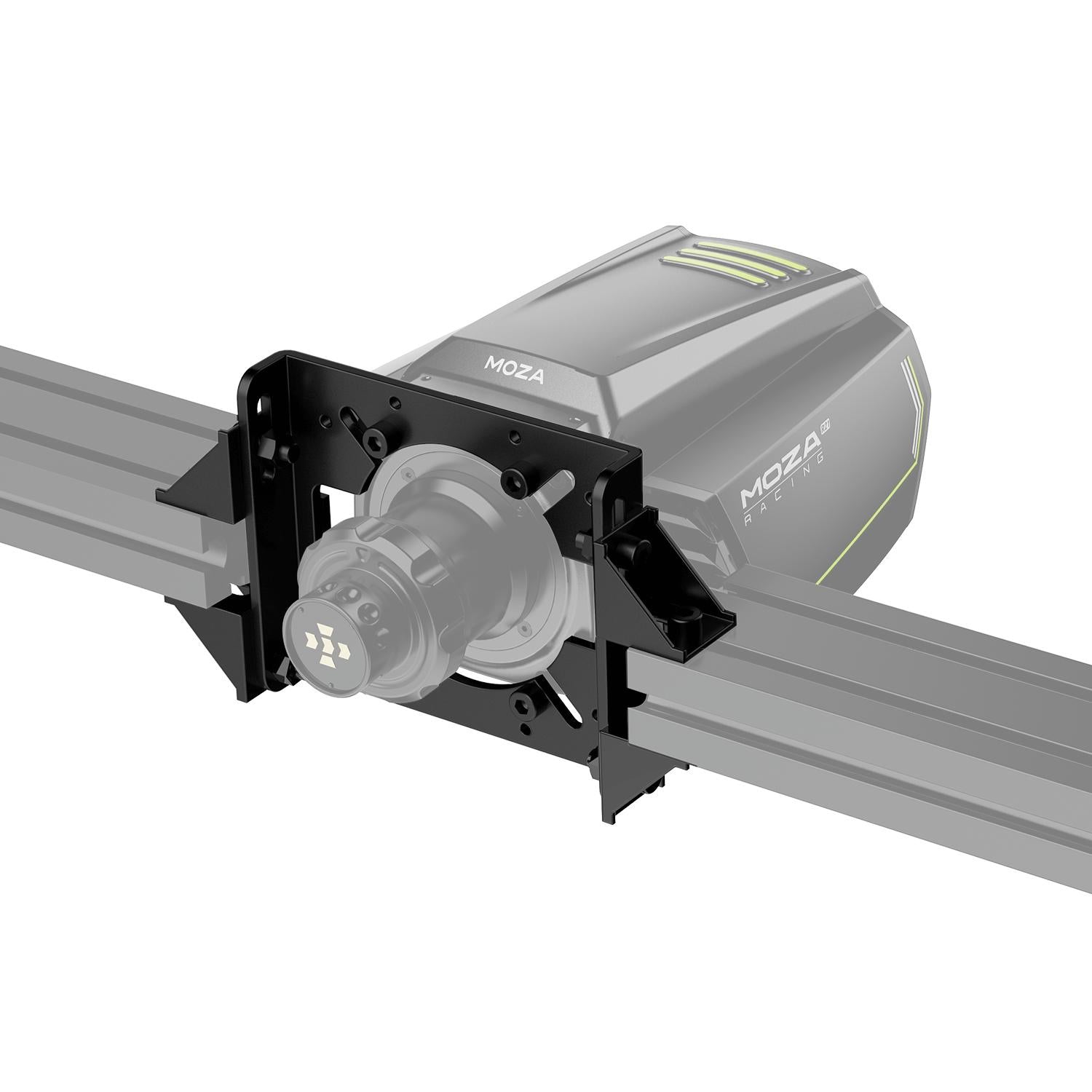
MOZA Front Mounting: My opinion in brief
This support gives a much clearer, more coherent feel: the base really seems to be attached to the cockpit, and FFB information becomes more legible and consistent, especially with powerful bases. It's aimed at simracers with a rigid profile cockpit who have already invested in the MOZA ecosystem. On a serious rig, the investment is coherent and truly relevant.
When you buy through our links, we may earn an affiliate commission.
MOZA Front Mounting: what's it really for in a sim racing setup?
MOZA Front Mounting is an ultra-specific accessory that can completely change the rigidity and feel of a setup. We're talking here about a front mounting bracket for MOZA Direct Drive bases, designed to be screwed to the front of a chassis or crossbar, like a "pro" installation.
It's aimed above all at users of high-torque MOZA bases, who want to eliminate as far as possible flex, parasitic vibrations and cobbled-together assemblies on wooden chainrings that are too thin. The idea is simple: to stiffen the connection between the base and the cockpit, so that everything that comes out of the engine reaches the flywheel... and not the structure.
My angle on this test is clear: does this front mount bring a real gain in feel, consistency and comfort of use, or is it just another "nice to have" accessory in the MOZA catalog? I focused on rigidity, build quality, ease of integration into a cockpit, and above all the impact on in-game feel.
We're not talking about a product that's spectacular to the eye, but a key element for those who want a clean, solid and coherent setup. The kind of part that makes no noise... but can transform the overall feel of the base.
Design, workmanship and solid feel
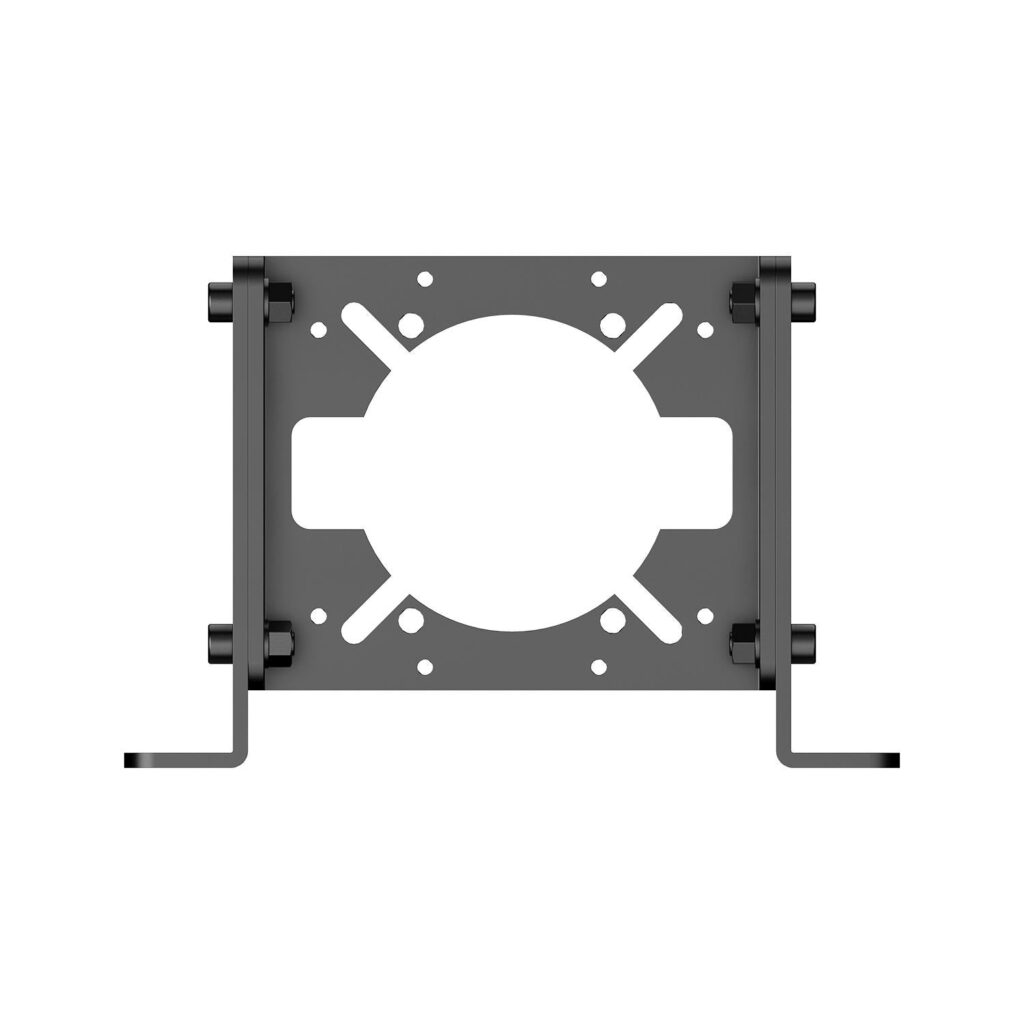
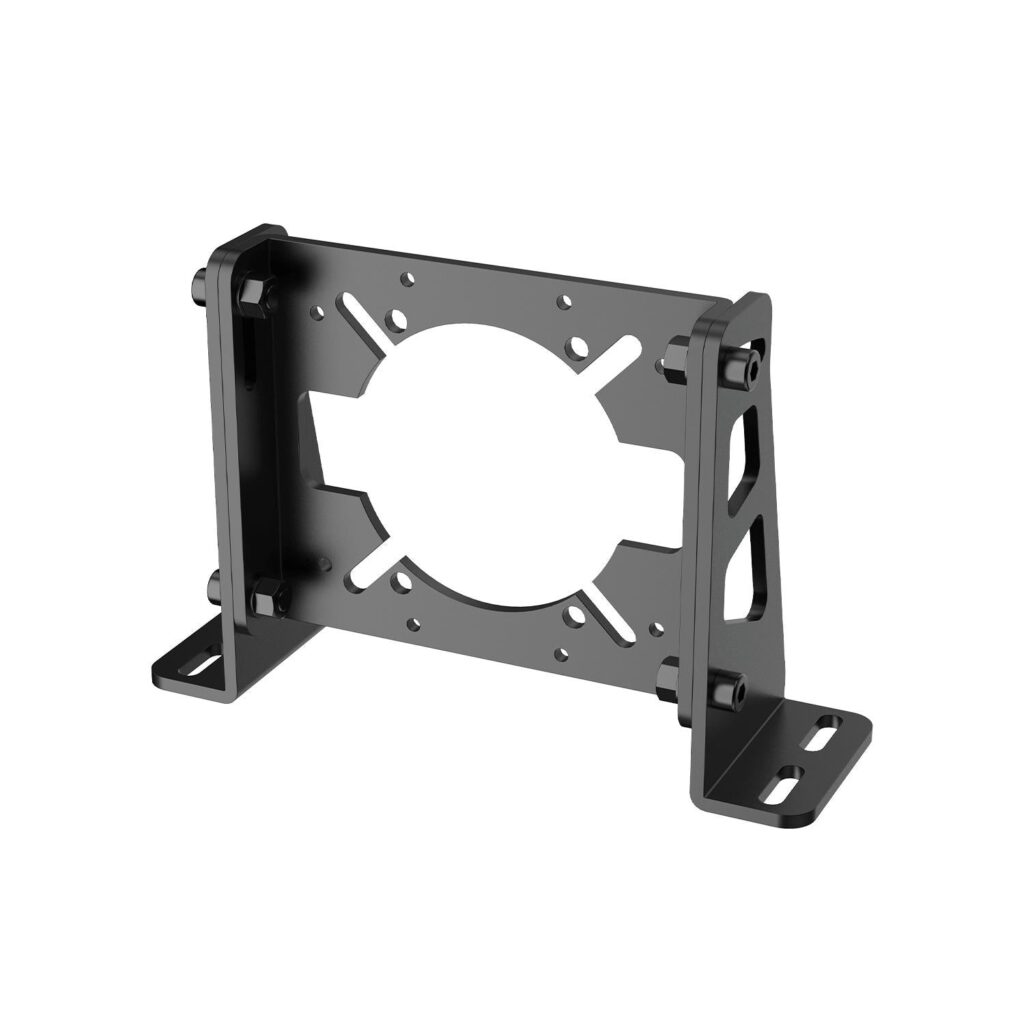
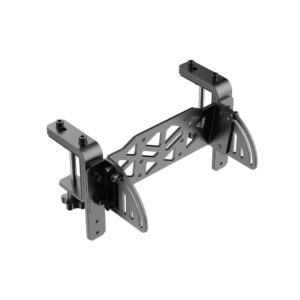
Visually, the MOZA Front Mounting is very sober. It's a rather compact piece of machined metal, with a black finish that blends in well with the style of MOZA bases. In hand, the first impression is of density: you quickly sense that you're not dealing with a thin, hastily bent metal sheet, but with something rigid, designed to withstand significant mechanical stress.
Surfaces are clean, edges well finished, no burrs or rough holes. The holes are straight, the alignment serious. This is the kind of detail that counts when you start talking about Direct Drive and aluminum chassis: the slightest play here translates into vibrations and float in the steering wheel.
Once assembled, the perceived rigidity is truly striking. The mount doesn't twist or bend, even when the base is subjected to heavy loads. When pressed sideways, the part stays in place, which is exactly what you'd expect from a front mount worthy of the name. The connection between base and cockpit immediately gains in consistency.
Where it may disappoint slightly is in its raw versatility. You get the feeling that the product is really designed for the MOZA ecosystem, with geometry and center-to-center distances oriented towards the bases and aluminum profile-type cockpits. On more exotic or tubular cockpits, without a good flat front zone, integration requires a little more thought.
Compared with some third-party universal brackets, which are sometimes more modular, MOZA Front Mounting clearly focuses on clean fit and rigidity, rather than on all-out compatibility. In terms of pure quality, we're in the upper mid-range of the market, with a "cleaner" feel than many lighter generic mounts.
Settings, customization and compatibility in one setup
The MOZA Front Mounting obviously has no "menus" in the software sense, but it does offer some latitude for physical adjustment. There are several positioning options via the mounting holes, allowing you to adjust the base's height or overhang to suit the cockpit's geometry.
On an aluminum profile chassis, integration is fairly straightforward: you attach the part to a front crossmember, then bolt on the base from the front, and adjust slightly to align the steering wheel with the seat and pedals. Assembly requires a minimum of method, but the learning curve remains low for someone who has already assembled a cockpit. For a complete beginner, you'll simply have to take your time and measure carefully.
In terms of compatibility, the benefits of MOZA Front Mounting are obvious if you're already part of the MOZA ecosystem, especially with a mid-range or high-end Direct Drive base. It's basically designed for PCs, but the real issue isn't the console/PC compatibility of the product itself: it's a purely mechanical element. As long as your MOZA base works on your platform, the front mount follows.
With the brand's steering wheels, pedals and shifters, it integrates very well into a complete setup: everything is at the right height, and the steering wheel axis is more easily aligned with the rest. On a rigid profile-type cockpit, you get a very coherent whole. On "lighter" cockpits or folding stands, the interest is less, or even questionable.
In terms of scalability, this support can clearly accompany a move upmarket within the MOZA ecosystem. If you go from a small base to a more powerful one, you keep the same mounting method. It's more of a lasting brick in your cockpit than an accessory you'll be changing every year.
Sensations in play: what the front binding really changes
The impact of a front mount like MOZA's is felt most keenly once you're on the track. What struck me was the disappearance of certain micro-games that you don't always notice with a classic top-mount on a somewhat flexible chainring. Here, the base seems literally "welded" to the cockpit. And that translates directly into the steering wheel.
In terms of force feedback, precision takes a notch higher. Small variations in torque, subtle effects around neutral, everything becomes sharper. You feel less the cockpit at work, more the car. You get the impression that the engine's energy is no longer absorbed by the support board, but transmitted 100 % to your hands. For fine maneuvers on corner exits or drift management, this is very appreciable.
In fast bends, the behavior is more legible. The base doesn't move or flex, so FFB information remains constant. When you go hard into a long corner at high speed, the load on the steering wheel isn't diluted by parasitic chassis vibrations. You can feel exactly how the grip is changing, when the front starts to stall or pick up.
On vibrators, the difference is even more obvious. A less rigid mounting tends to "shake" overall: you feel a mixture of vibrations from the flywheel and the structure. With the MOZA Front Mounting properly attached, impacts remain focused on the flywheel, with a dry, clean, almost surgical feel. You know right away whether you're biting the vibrator too hard or caressing it just right. This is where the mount really changes the experience.
On longer sessions, consistency is better. A less rigid base can end up moving very slightly, loosening, or inducing micro-movements that tire the wrists. Here, as long as the mounting is well done, the base doesn't budge. The steering wheel remains in the same position, so sensations don't drift over time. It's more restful for the brain: stable information means less unconscious compensation.
During fast corrections, especially in drifting, rallying or very oversteering GTs, the absence of flex is a real plus. You can catch a rear stall in one swift movement, without the cockpit feeling the pinch. The base remains fixed, so your spatial reference doesn't change. The result: more confidence, more ease in getting the car back on track. You immediately understand what the car is doing.
Compared to a base mount on a wooden or light metal plate, the difference is clear, even with a base that's not extreme in terms of torque. With a very powerful base, the front mount becomes almost indispensable to really exploit the potential without turning the cockpit into a sounding board. In the face of thinner or more flexible competing solutions, MOZA Front Mounting holds its own, with a more "solid", more controlled overall feel.
Who's it for? Strengths and points to watch out for
The MOZA Front Mounting is clearly aimed at users who take their setup at least a little seriously. If you're on a simple desk with a clamp-on base mount, it's not for you. On the other hand, if you've got a rigid cockpit, especially in aluminum sections, and a MOZA Direct Drive base, then it's starting to become very relevant.
For an intermediate simracer who wants to go upmarket without changing everything, this front mount can be a great evolution: you keep your base, you just reinforce the link with the cockpit. For an experienced user, especially in intensive or competitive use, it's almost a must-have to make a MOZA-based setup more reliable and stable.
What I really like is the solid feel once mounted. There's no flex, no unnecessary vibration, and the impression of a compact block. The gain in FFB precision is real: you can better read the grip, load transfers and small stalls. The third positive point is the "clean" aspect of the installation: the front-mounted base gives a serious racing look, in line with what we see on high-end rigs.
On the other hand, there are a few limitations to bear in mind. Firstly, dependence on a suitable cockpit: without a rigid front structure, the product loses much of its appeal. Secondly, compatibility is naturally oriented towards MOZA bases; it's not a universal medium that you can easily recycle on other ecosystems. Finally, for a beginner or a very occasional player, the investment may seem disproportionate: if the base is modest and the cockpit flexible, the bottleneck is not there.
In terms of perceived value, it all depends on the level of your setup and your expectations. On a serious setup, the investment is well worth it, because it directly improves the operation of the Direct Drive base. On a more casual setup, it's better to spend the money on a stiffer cockpit before considering this type of accessory.
Verdict: is MOZA Front Mounting worth it?
MOZA Front Mounting doesn't change the power of your base, but it does change the way that power gets to your hands. It transforms a "correct" mounting into a much more coherent, rigid and precise whole. In a performance-oriented setup, it's a structural brick rather than a mere accessory.
On the market, we can clearly place it on the side of serious mid- to high-end solutions, designed for profile rigs and Direct Drive bases capable of producing substantial torque. It's neither a gadget nor a mass-market product, but a finishing tool for those who want to get the most out of their MOZA ecosystem.
I recommend it to PC or console simracers already equipped with a rigid cockpit and MOZA base, who experience flex, float or a lack of sharpness in force feedback. For a beginner on a desktop or folding stand, it makes almost no sense: there are other priorities before this type of support.
If you're looking to make your MOZA base more stable, accurate and consistent in a serious cockpit, this product can clearly make the difference in your setup.</final



Reviews