
MOZA Performance Kit for SR-P Lite : Test & Review | What it's really worth in 2026
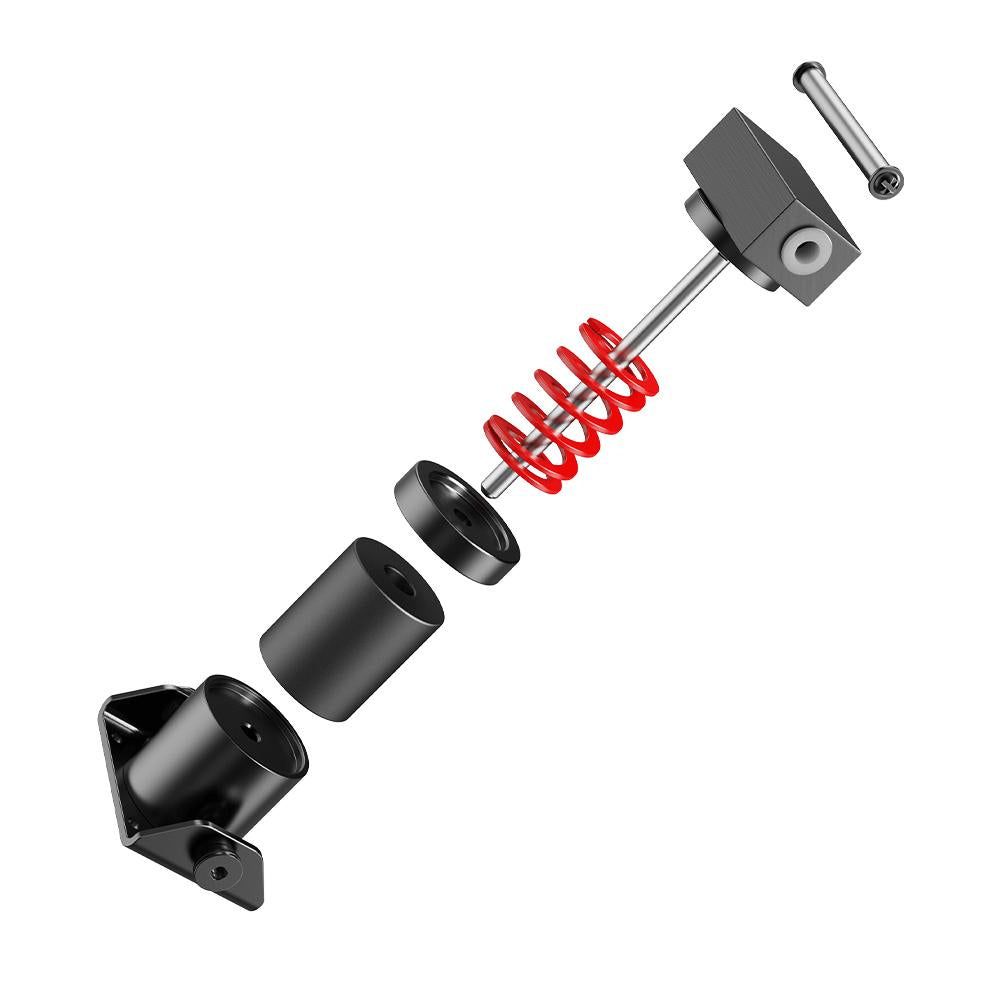
MOZA Performance Kit for SR-P Lite: My quick review
This kit gave me the sensation of transforming the SR-P Lite's brake into a reliable and consistent tool, with a real gain in control and consistency. It's aimed above all at simracers already equipped with an SR-P Lite, who ride regularly and feel that the original brake limits them. For this profile, the cost/benefit ratio is clearly relevant.
When you buy through our links, we may earn an affiliate commission.
MOZA Performance Kit for SR-P Lite: essential upgrade or cool gadget?
The MOZA Performance Kit for SR-P Lite has a very specific objective: to transform the entry-level SR-P Lite crankset into something more serious for sim racing. Not a new crankset, but a mechanical upgrade kit to improve feel, progressiveness and control, especially on the brake pedal.
This kit is very appealing for a simple reason: the SR-P Lite is often the first crankset purchased with a MOZA flywheel, and you quickly feel its limitations as soon as you start riding seriously. The Performance Kit promises to rectify this without forcing you to change the whole crankset. In short, the idea is to approach the sensations of a more advanced crankset, at a contained cost.
For my part, I approached it from three angles: build quality (does it hold up over time), braking precision and overall consistency with the basic crankset. What interests me most here is the real added value: does the brake finally become reliable lap after lap, does the pedal transmit grip better, and does it justify the investment compared to a complete crankset change.
This is a highly targeted product, aimed at those who want to take their SR-P Lite to the next level without blowing their budget. It remains to be seen whether it really makes a difference in everyday life.
Design and manufacture: a kit that solidifies the SR-P Lite
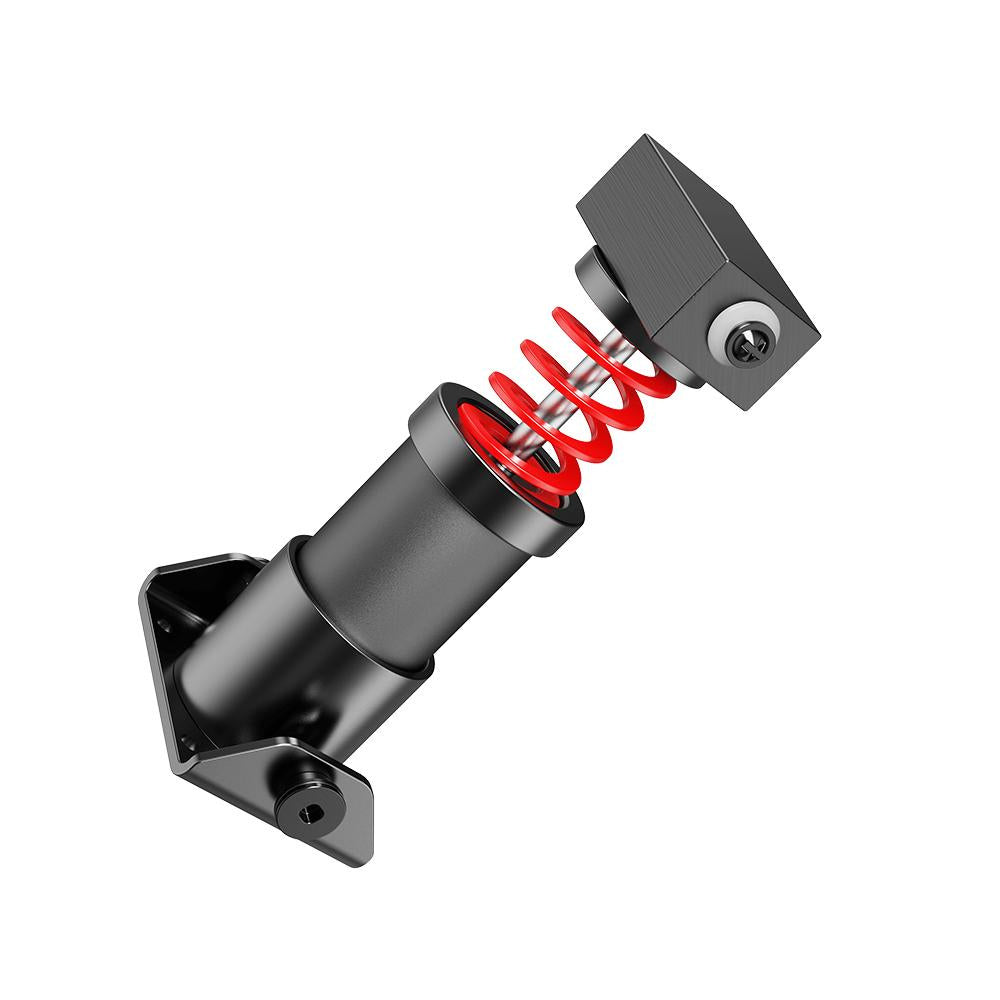
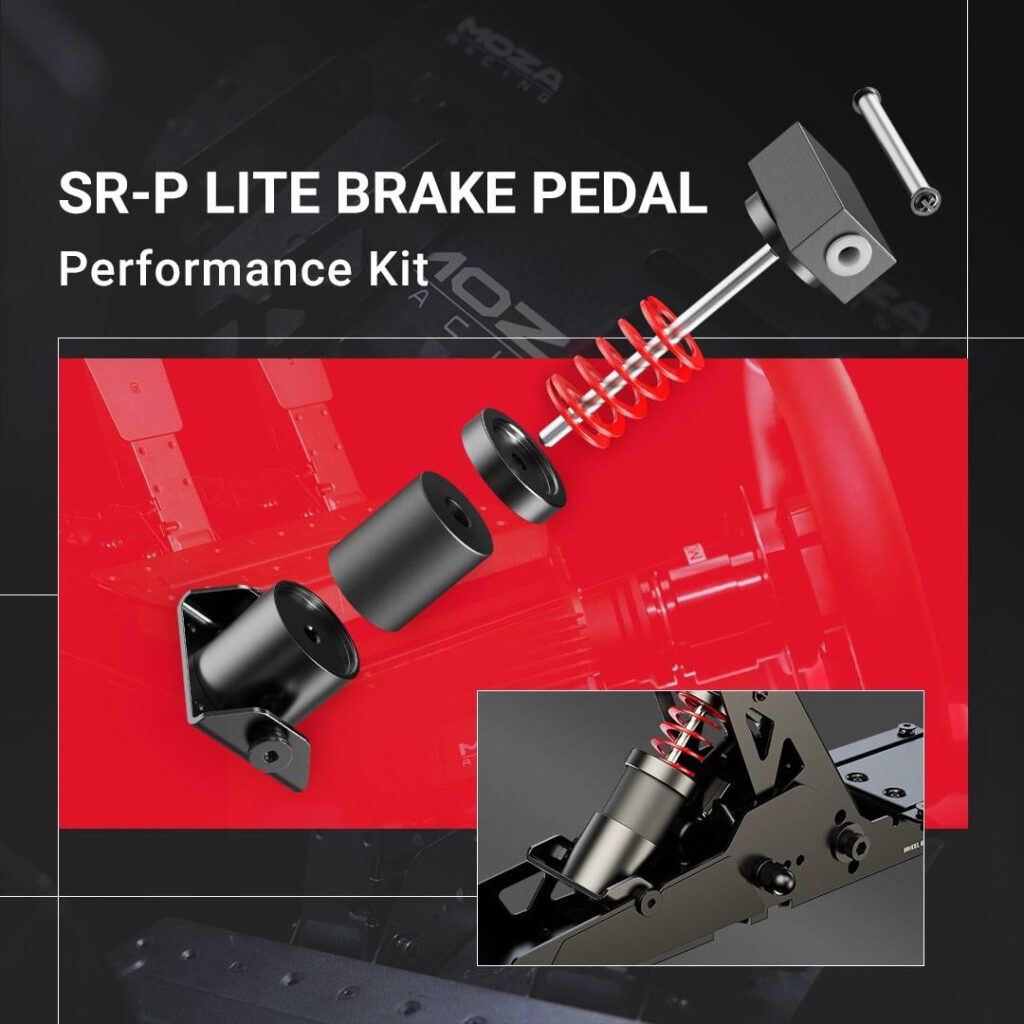
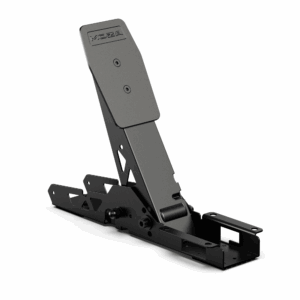
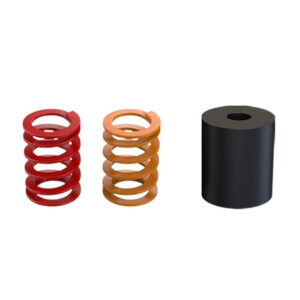
Visually and in hand, the MOZA Performance Kit immediately gives the impression of a serious upgrade. The parts are mostly metal, with firmer springs and an elastomer module for the brake pedal. It's a far cry from the lightweight plastic used on some parts of the SR-P Lite: the overall feel, once fitted, is denser, more "mechanical".
What's most striking is the extra rigidity, especially on the brake pedal. Parasitic play is reduced, and the stroke becomes sharper and more controllable. The pedal no longer gives the impression of a "toy" flex that the Lite can have in stock configuration. You can feel that the crankset is better able to accept heavy pressure, without fear of bending.
The parts seem to be correctly machined, tolerances are clean, and adjustments are made without forcing. We're not at the level of a high-end full-metal crankset, but for an upgrade kit, the value for money is convincing. No cheapness on first contact, and no abnormal noise once correctly assembled.
Where it's a little disappointing is that it's not a radical transformation of the whole crankset. The base remains that of the SR-P Lite, so the overall construction doesn't become magical. The brake is much improved, and the whole thing is more solid, but it's not suddenly the equivalent of a premium load cell crankset.
Compared to other upgrade kits of this type, MOZA's is rather well positioned: more serious than a simple harder spring, but less extreme than a complete conversion kit with separate load cell. It's an assertive in-between, oriented towards improved sensations rather than revolution.
Settings, customization and compatibility
The MOZA Performance Kit for SR-P Lite remains a purely mechanical kit. Setting it up is therefore mainly a matter of assembly, choosing the components and configuring them in the MOZA Pit House software with the connected crankset.
On the brake pedal, we gain more leeway: a more progressive stroke, the possibility of adjusting hardness via the spring and elastomer, and above all a clearer pressure point at the end of the stroke. The most important adjustment, in my opinion, is made in the software: adjust the brake curve and sensitivity to make the most of the new feel. Once the kit is installed, it's almost compulsory to recalibrate the reference points.
The learning curve is reasonable. It takes a little time to get used to the new brake resistance, especially if you're coming straight from the basic SR-P Lite. You brake more "with your foot" and less "on the run". The first few turns may seem disconcerting, but you soon get the hang of it, especially if you play regularly.
For compatibility, the kit is obviously designed for the MOZA SR-P Lite crankset, and only it. This is an important point: this is not a universal kit, it cannot be adapted to other cranksets. On the other hand, once the pedalboard is connected to a PC via the MOZA ecosystem, everything integrates neatly: settings in Pit House, profiles per game, simple calibration.
On the console, the situation depends on the overall setup (MOZA base, mode used, pedalboard compatibility via the base). The kit itself changes nothing in terms of electronic compatibility, since it doesn't affect the SR-P Lite's electronics. It improves feel, not connections.
In terms of upgradeability, this kit represents more of an intermediate step. It's clearly more serious than the stock SR-P Lite, and may suffice for a long time for an intermediate player. For a very demanding simracer, it remains an entry point towards a more high-end pedalboard in the long term.
Sensations at stake: braking that's finally controllable
Where the MOZA Performance Kit really makes a difference is on the brake pedal. On the track, you immediately feel that the stroke is more progressive, with a more natural build-up of resistance. We go from a rather linear and soft pedal to something more reminiscent of a "pressure" brake than a "distance" brake.
In heavy braking phases, confidence increases significantly. You can load the pedal harder without fear of crushing everything or releasing the lock too abruptly. The useful braking zone widens: there's more detail in what the foot feels, more nuance between braking at 60 % and 90 %. It's easier to understand what the car is doing on corner entry.
When it comes to reading the grip, the difference is mainly psychological and mechanical. The original crankset doesn't send back force information like an advanced load cell system, but the fact that it has a harder stroke and a more pronounced resistance point helps enormously in stabilizing the brake point. It's easier to settle on a repeatable pedal force, which, lap after lap, makes all the difference to consistency.
When the brake is released, the transition becomes more controllable. You can release the brake more gradually, playing on the load transfer without "jumping" from 30 to 0 % all at once. The car remains more predictable. This is particularly noticeable on cars without ABS, or in more demanding simulators.
On vibrators, of course, the pedalboard doesn't transmit vibrations like a direct-drive steering wheel, but you get a better feel for the impact of your braking on the car's behavior when you're climbing an aggressive kerb. You know more quickly if you've held on too much brake or if you can reopen slightly. It's not the pedals that "talk", it's the regularity of our pressure that gives us a better idea of how the chassis reacts.
Over long sessions, consistency is better. The Lite's old brake tended to push you to brake too deeply, or to compensate by habit rather than feel. With the kit, the muscle memorizes a clearer pressure force. Physically, you tire a little more, especially if you set the brake hard enough, but you gain in repeatability. Lap times become more stable, and silly braking errors diminish.
During quick corrections, when you have to release the brake very quickly to save the start of a jam, having a firmer stroke allows you to be more honest. You don't "over-release", you can manage modulation more finely. It's subtle, but when you're riding, you can feel that you're recovering more from borderline situations.
Compared to an entry-level crankset without this type of kit, the gap is clear: braking becomes a precise tool rather than an enhanced switch. Compared to a more high-end crankset with a true dedicated pressure sensor, we're still a long way behind in terms of pure signal finesse and ultimate realism. But we're clearly getting closer to this pressure braking philosophy, for a fraction of the price.
In terms of overall immersion, this kit delivers exactly what you'd expect from a good upgrade: more control, more confidence, and fewer moments when you blame the hardware when you go wrong. You get the impression that the car obeys your right and left feet more directly, especially at the limit. That's where the gaming experience really changes.
Who's it for? What we like, what we don't like
The MOZA Performance Kit for SR-P Lite is primarily aimed at a very specific profile: motivated SR-P Lite crankset users who are starting to look for consistency in racing or in online championships. Not necessarily a professional sim racer, but someone who clearly feels limited by the original brake. Typically a PC gamer, but still of interest in a console setup as long as the SR-P Lite is used.
What you immediately appreciate is the gain in braking control. The pedal becomes usable to the millimetre, especially once you've found your settings in the software. We also like the robust feel of the crankset: we dare to lean on it more, and stop braking delicately for fear of breaking. Finally, the value/price ratio is interesting: for a reasonable investment, you get close to the sensations of a much more expensive crankset, especially for a user who doesn't yet want to change all his gear.
On the other hand, there are clear limits. The first is that we remain dependent on the SR-P Lite base. You improve, but you don't change the fundamental nature of the crankset. Those hoping for a high-end pedalboard-style "miracle" may be a little disappointed. The second is the purely mechanical aspect of the kit: no change in electronics, no real feeling of a dedicated pressure sensor, so a performance ceiling that still exists. Finally, this is a very specific product: if you don't already have an SR-P Lite, this kit is of no interest, and the question of upgrading or going straight for a better crankset quickly arises.
In terms of investment, the Performance Kit is clearly a smart buy to extend the life of your current crankset. It's a way of delaying the need to upgrade to a more expensive model, while unlocking a real gain in performance and pleasure. For someone who wants to optimize his budget without sacrificing sensations, the compromise is coherent.
Verdict: an upgrade that makes sense... for the right profile
The MOZA Performance Kit for SR-P Lite may not transform your setup from top to bottom, but it does change one essential thing: the quality of your braking. And in sim racing, this is often where it all counts. The crankset gains in consistency, firmness and precision, to the point of no longer giving the impression of being "the weak link" in an entry-level or mid-range MOZA setup.
On the market, this kit positions itself as an intelligent mid-range product: more serious than a simple spring tuning, less radical than a complete crankset change. It's an interesting pivot for all those who don't yet want to switch to a premium crankset, but who are beginning to feel the limits of their stock equipment.
I clearly recommend it to SR-P Lite users who ride regularly, are looking to improve their times and want to stabilize their braking without redoing their entire setup. On the other hand, if you're already thinking of upgrading to a much higher-end crankset, or if you don't yet have an SR-P Lite, the calculation will be different.
If you're looking to make your MOZA SR-P Lite brake finally precise, solid and reliable lap after lap, this Performance Kit can clearly make the difference in your setup.





Reviews