
Fanatec Podium Mounting Brackets : Test & Review | What it's really worth in 2026
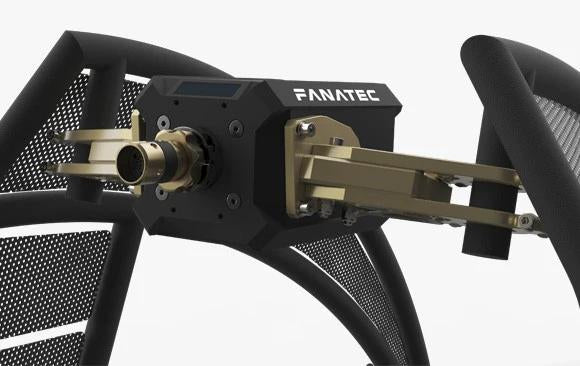
Fanatec Podium Mounting Brackets: My opinion in brief
This support gave me the feeling of really unleashing the Direct Drive's potential: more legible force feedback, perfectly stable steering wheel, "blocky" setup. Above all, it makes sense for simracers already equipped with a rigid cockpit and a Fanatec base, who ride often. The price remains high, but coherent if you see it as a structural investment.
When you buy through our links, we may earn an affiliate commission.
Fanatec Podium Mounting Brackets: my opinion as a demanding user
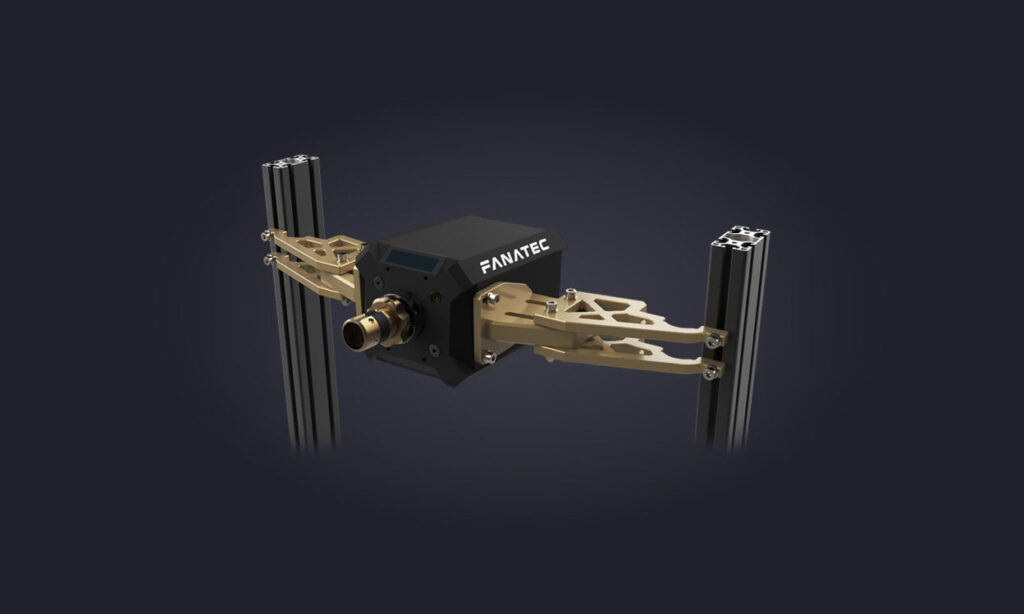
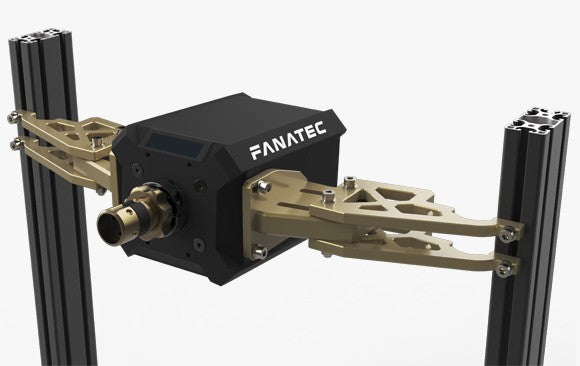
On paper, Fanatec Podium Mounting Brackets are purely "accessory". In reality, in a Direct Drive setup, they are a structuring element. These brackets are designed to secure high-end Fanatec bases (Podium, but also CSL DD / DD1 / DD2 depending on configuration) to a chassis or desk-type board, with a simple objective: zero flex, zero play, even with a lot of torque.
What makes them so attractive is their promise of "pro" rigidity and clean integration into a streamlined metal or aluminum cockpit. The idea is to go from a DIY or average assembly to a real Direct Drive mount. You don't gain Nm, but you do gain control. And in sim racing, you can feel it immediately.
My angle here is clear: stability, in-game feel and real interest compared to universal solutions or mounting systems supplied with bases. Do these brackets justify their price in an already expensive setup, or do generic brackets ultimately do the same thing? That's how I judge them: on what they really change in front of the screen.
Design and manufacturing
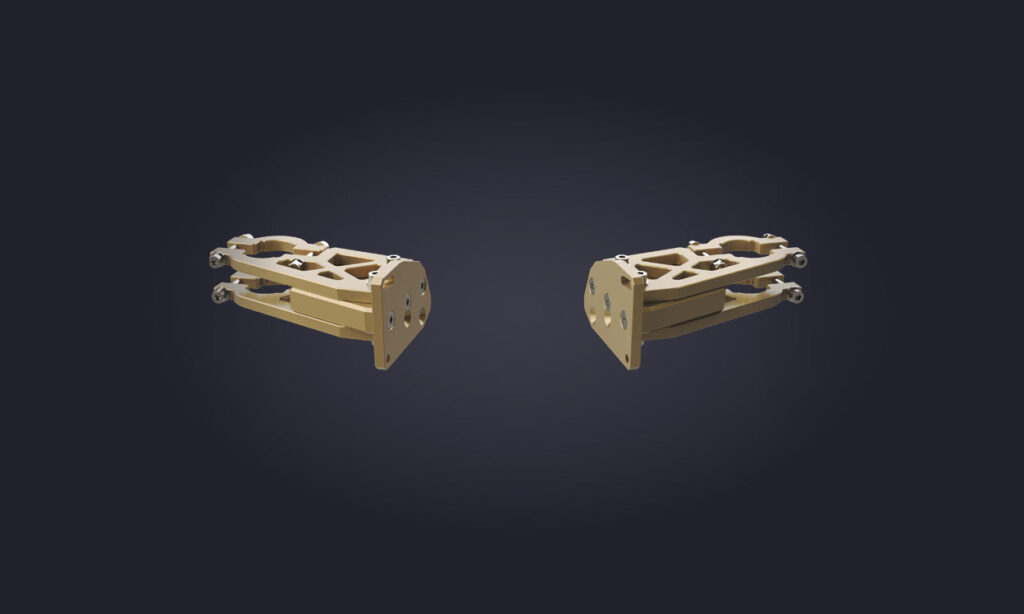
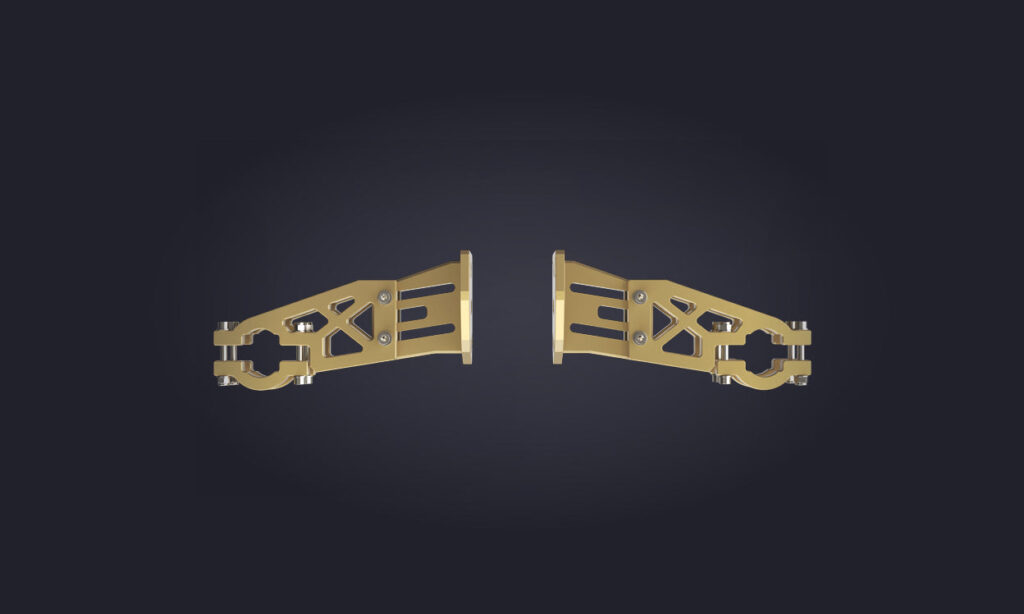
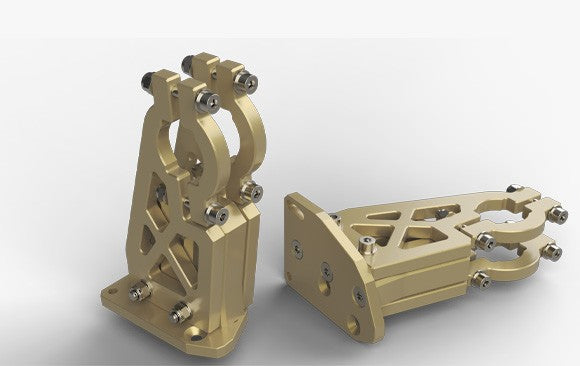
In hand, Podium Mounting Brackets give an immediate impression of seriousness. We're dealing with thick, cleanly machined steel or aluminum, with a black finish that blends perfectly with the style of Fanatec bases. The edges are clean, the drillings are just right, and the density of the metal immediately reassures us that it won't bend at the first stroke of an aggressive steering wheel.
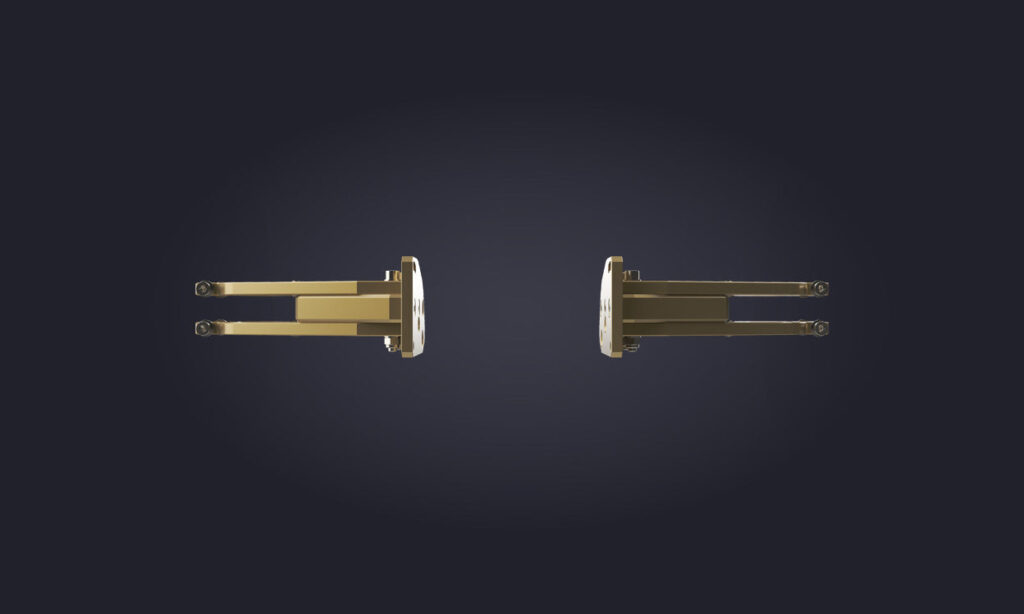
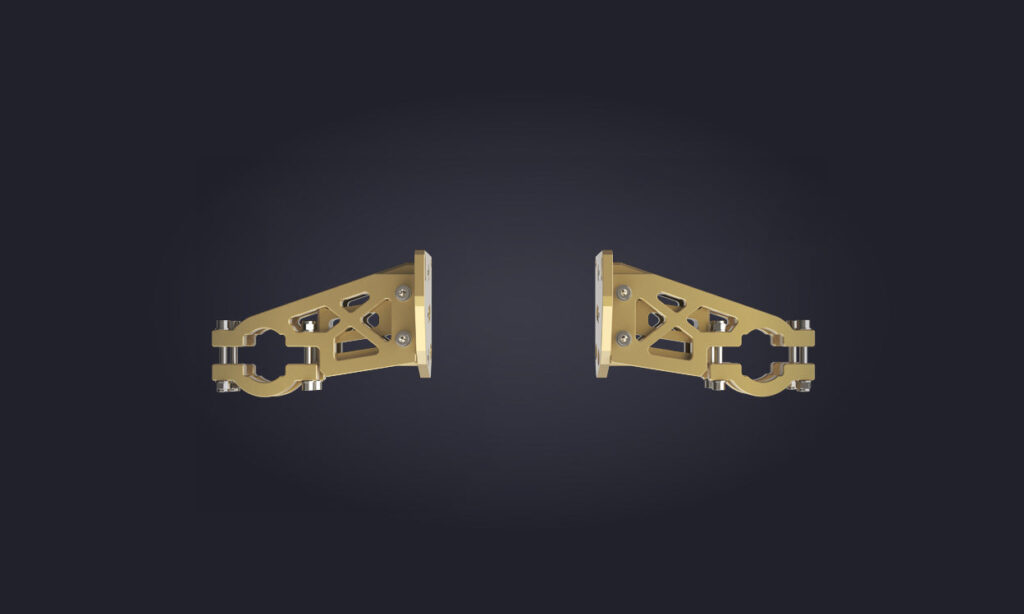
The kit looks like a premium OEM product: nothing fancy, just two large side brackets, designed to match the shape of the base. Once in your hands, you understand their purpose: to lock the base, clamp it to the cockpit and prevent it from twisting. It's very machine-tool-like, in a good way.
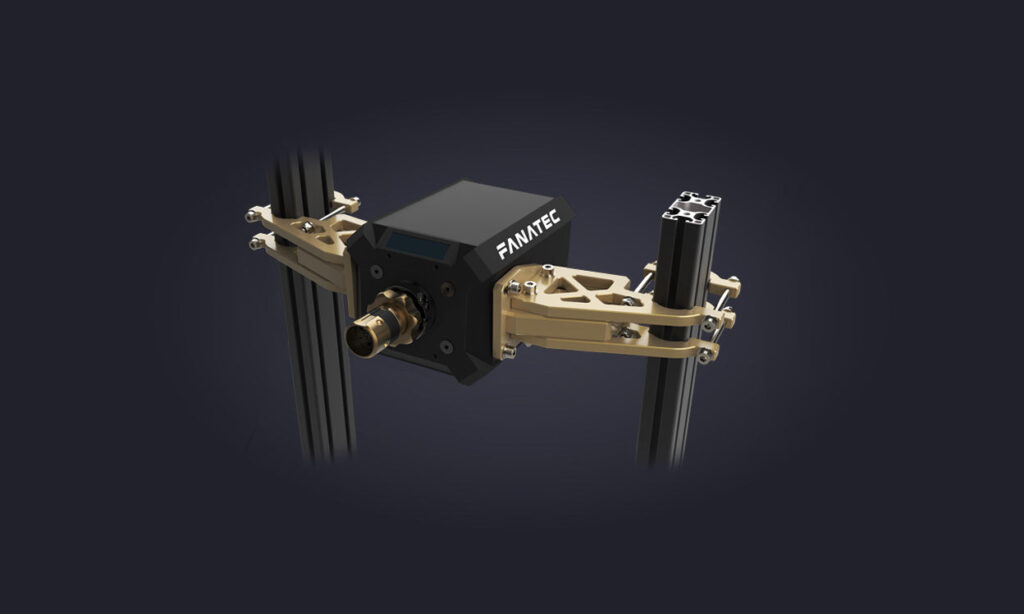
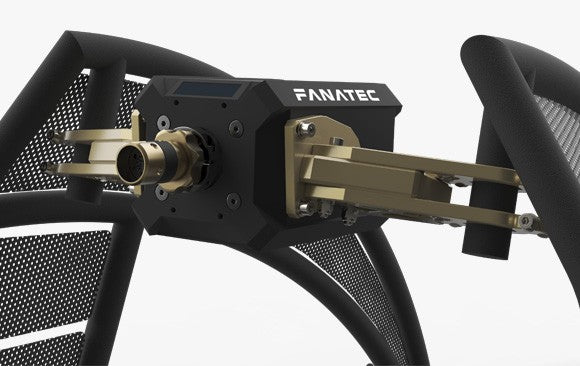
Assembly with the base is via screws that fit into the mounting points provided by Fanatec. There's no perceptible play once everything is properly tightened. You get the feeling that everything has been designed together, and this consistency is often lacking on universal brackets, where you have to juggle with washers, spacers and slight offsets.
What's surprising is how compact they are. We sometimes expect massive, bulky brackets. Here, it's relatively discreet, yet visibly sturdy. On an 8020 aluminum cockpit, it blends in very well, both visually and mechanically.
What may be a little disappointing is the absence of "extras": no integrated advanced adjustment, no graduations, no quick-set system. We're sticking to our philosophy: fix it, tighten it, and it won't move. Compared with some universal brackets that can be infinitely tilted or are packed with adjustment slots, the Podium Brackets may seem a little basic. But in terms of pure perceived quality, they're clearly a cut above low-cost solutions in thin sheet metal that can twist with powerful bases.
Settings, customization and compatibility
As far as adjustments are concerned, we're talking about something very mechanical and concrete. The brackets mainly offer a range of base inclination, via the various side mounting points and drilling possibilities on your cockpit. This is not a "menu" accessory; everything is done with an Allen key and a flat wrench.
The really useful adjustments: the angle of the steering wheel in relation to your seat and the height of the base via the mounting points on the chassis. For someone looking for a position very close to that of a GT or proto, this is appreciable. The base can be lowered and moved back slightly, compared to a front-mounted or edge-mounted model. Final ergonomics will depend very much on your cockpit, but the brackets give you real room for manoeuvre.
The learning curve is simple: test, loosen, move up one hole, tighten again. It takes a little time at first to find "your" angle, but there's nothing complex about it. The important thing is to anticipate the alignment with the seat and crankset, to avoid having to dismantle everything three times.
Compatibility: the kit is designed for Fanatec bases in the Direct Drive range. As long as you're in the Fanatec ecosystem, you're in the clear. PC or console, it doesn't matter: these are mechanical supports, so there's no limit on the platform side. Where it gets trickier is on the cockpit side. Brackets are perfectly at home on profiled aluminum or rigid steel structures, a little less so on desks or MDF boards which lack reinforcement.
In terms of scalability, it's clearly a sustainable solution. You can upgrade the basic range within the Fanatec ecosystem without changing the fastening principle. For a user who plans to stay with a Fanatec Direct Drive for several years, this is typically a one-off purchase. This is a "foundation" accessory, rather than an optional gadget.
Sensations in play: what it really changes
The sensations involved are paradoxical to describe, because brackets don't actually generate force. They reveal what your base already knows how to do, by removing a weak link: rough assembly.
The first thing that catches the eye, or rather the eye of the hand, is the precision of the force feedback. When the base is simply clamped onto a board or bracket that's working a little, some of the small details are lost: micro-vibrations, the onset of grip loss, track texture. With Podium Mounting Brackets screwed onto a rigid chassis, these signals become clearer. You get a better feel for when the tire starts to slip, not just when it stalls. This translates into a better reaction margin on the track.
In fast corners, the difference is even clearer. Instead of the sensation of the column moving a millimeter or two sideways, everything becomes perfectly solid. The steering wheel pivots around a fixed point. As a result, the load transfers perceived in the FFB are more coherent, and you can fine-tune the angle. You stop unconsciously compensating for the flex of the support, and concentrate solely on the car. You immediately understand what the front end is doing.
On vibrators, this gain in rigidity is also interesting. Jolts are cleaner and more direct. Where a slightly supple support dampens without you noticing, the brackets transmit the profile of the vibrator directly into the base. This doesn't mean it's brutal, but it's more "legible". You know whether you're biting a little, biting a lot, or hovering over it.
On long sessions, consistency makes the real difference. No clamps that loosen slightly, no brackets that play up, no stray vibrations that appear after an hour's riding. The position remains exactly the same, the steering wheel keeps its axis, and the brain settles on these stable reference points. Fewer micro-adjustments, less fatigue.
In fast corrections, especially when sliding or drifting, the absence of flex is felt as a gain in reactivity. The base returns counterforce immediately, without the delay caused by a deforming structure. It's not going to turn a CSL DD into an overpowered base, but compared to a less serious set-up, you really get the impression of exploiting 100 % of what the base can give. This is where solid mounting changes the experience: you dare more, because you feel better.
Compared to a less powerful base mounted correctly, you're obviously limited by torque. But compared to the same base mounted quickly on a desk or standard clamp, the feeling of control and immersion goes up a notch. The car feels more connected to you. Every steering wheel movement has clear, interference-free feedback. It feels like the steering column of a real car, rather than a steering wheel on a piece of furniture.
Who's it for? What we like, what we don't like
Fanatec Podium Mounting Brackets are aimed primarily at intermediate to advanced simracers who are already equipped with Fanatec Direct Drives, or who plan to switch to them soon. For a beginner in entry-level belt- or gear-driven flywheels, they would clearly be oversized. On the other hand, for someone with a serious cockpit or who wants to make a high-end setup more reliable, the accessory starts to make a lot of sense.
What I particularly appreciate is the rigidity: once mounted on a serious chassis, the brackets really give the impression that the base and cockpit are a single unit. Secondly, the integration with the Fanatec base is impeccable: adapted screws, perfect alignment, shape designed for the ecosystem. Visually, it's clean, and that counts for something in a setup we look at every day. Finally, stability over time is a real plus: you don't have to spend your time tightening, adjusting and compensating for a working support. You just adjust once, and you're on your way.
On the other hand, there are several limitations worth noting. The accessory is clearly dependent on a solid cockpit: on a simple desk, it's of little interest. It's a product that really comes into its own on profiled aluminum or a well-designed steel structure. Secondly, the level of adjustment is pretty basic. It can be tilted and positioned, but not to the millimetre, nor with the flexibility of certain highly modular universal brackets. Finally, the notion of price comes into play: this is a product positioned as "premium for what it is". For many, it remains "two expensive pieces of metal". It should therefore be seen as an investment in the setup base, not as a fun accessory.
In terms of perceived value, it all depends on how demanding you are. If you're looking to secure a setup costing hundreds or thousands of euros, make the most of your Direct Drive base and drive often, the purchase will be justified fairly quickly. If you play occasionally on a desktop, the added value will be much lower.
Verdict
Fanatec Podium Mounting Brackets may not sound like a new base or a new steering wheel, but they play a key role: they transform a base + cockpit assembly into a rigid, stable block, operable at 100 %. In a Direct Drive setup, it's often this kind of detail that raises the bar in terms of feel and confidence.
On the market, we're clearly in the premium segment of basic brackets: it's not the cheapest, it's not the most versatile of all brands, but it's probably one of the most coherent solutions if you're in full Fanatec and have a strong chassis. It's a consolidation product, not a transitional one.
I'd recommend it above all to simracers already committed to the Fanatec ecosystem, with a Direct Drive base and a rigid cockpit, who want to make their set-up more reliable and improve FFB readability. For an occasional desktop user or a beginner without a dedicated cockpit, this won't be the best choice, as the money would be better invested elsewhere.
If you're looking to make your Fanatec base really solid, stable and precise in a serious cockpit, this product can clearly make the difference in your setup.




Reviews