Fanatec Podium Button Module Rally : Test & Review | What it's really worth in 2026
Fanatec Podium Button Module Rally: My quick review
Above all, this module gave me a better feeling of "managing" the car rather than just driving it, with very natural access to settings in the middle of a special stage. It makes sense for sim racers who are already well-equipped with Fanatec, rather on PC, and who drive seriously in rally or modern GT. The value is real, but clearly oriented towards advanced setups.
When you buy through our links, we may earn an affiliate commission.
Fanatec Podium Button Module Rally: full review after use
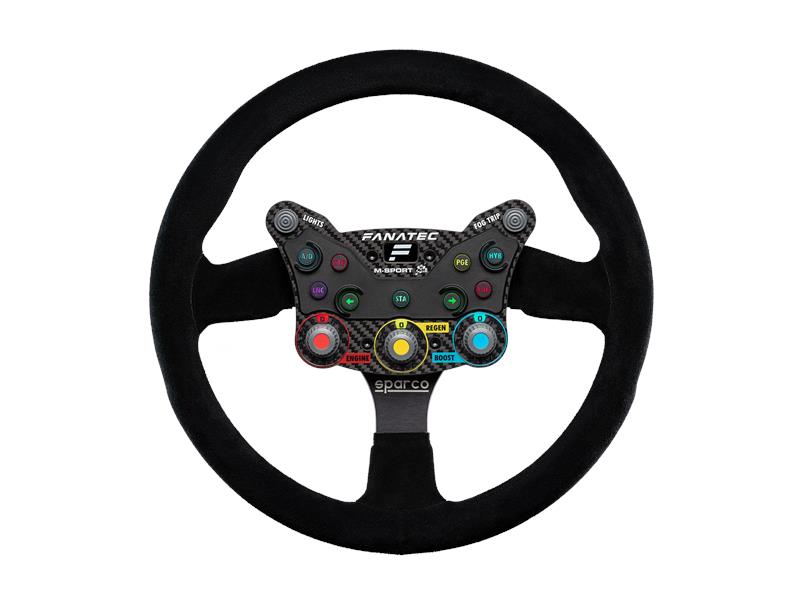
The Fanatec Podium Button Module Rally occupies a very special place in a sim racing setup. It's neither a complete steering wheel, nor a simple button box. It's a control module designed for rallying and rallycross, directly inspired by what's found in modern WRC cars, and designed to fit behind certain Fanatec steering wheels.
On paper, it promises ultra-direct access to essential functions, ergonomics designed for special events, and seamless integration into the Podium/ClubSport ecosystem. In short: fewer menus, more instinct. We're targeting sim racers who want a cockpit interface that resembles a real rally steering wheel, with a maximum number of controls at their fingertips, and no tinkering.
My angle is simple: does this module really change the comfort of rally and circuit driving, or is it just a nice premium gadget for WRC fans? I focused on three points: build quality, ergonomics in real-life situations, and the appropriateness of the investment in an already well-stocked Fanatec setup.
Design and manufacture: a real piece of racing car
In hand, the Podium Button Module Rally immediately gives a serious impression. The chassis is mainly metal and composites, with a dense front panel that doesn't flex or creak, even when twisted slightly. It looks more like competition hardware than a gaming accessory. Buttons are firm, with a crisp, short click and no perceptible play. It's easy to see that it's meant to be abused.
The rotors (rotary knobs) have well-marked notches, neither too hard nor too soft. You can operate them with gloves on without missing a setting. The small switches are precise, with clear tactile feedback. Nothing feels cheap. We're on the Podium level, well above the lighter plastics found on entry-level and mid-range steering wheels.
The overall finish is clean: legible silk-screen printing, logical spacing between controls, no unsightly screws. Integration behind a compatible steering wheel remains compact, so you don't end up with a disproportionate unit. Visually, the rendering is clearly "WRC" oriented: functional, technical, with no unnecessary frills.
Where I'm a little more mixed is on two aspects. Firstly, the module really comes into its own with higher-end Fanatec steering wheels and bases. Used with a more modest setup, the difference in level is obvious. Secondly, some buttons are quite close together. This is effective in competitive use, but if you've got big hands or are riding without gloves, you can sometimes touch two zones at the same time at first.
Compared with more "sim racing garage" third-party button boxes, this Podium Button Module Rally is much more integrated, cleaner and, above all, more solid to the touch. On the other hand, we lose a little in freedom of assembly, since it's clearly designed for the in-house ecosystem.
Settings, customization and compatibility
The Podium Button Module Rally is primarily configured via Fanatec software (FanaLab or Fanatec driver, depending on platform). Each button, rotator or switch can be assigned a function, with in-game visual feedback depending on the title. For someone already familiar with the ecosystem, getting the hang of it is a breeze. The same Fanatec logic is applied: profiles, mapping, save by game.
The most useful settings concern context-sensitive functions: brake mix, differential, traction control, ERS mappings, HUD page changes, headlamp management, wipers, radio, and so on. The idea is to centralize all "stage" or "engineer" controls on the module, to keep the steering wheel focused on pure driving. This works particularly well on simulations, which manage fine-tuning in real time.
The learning curve depends above all on the discipline. In rallying, you'll quickly get the hang of it: once you've decided which button handles what, memorization comes fairly naturally. On the racetrack, with all the modern functions (engine maps, level ABS, fuel mixture), it takes a little longer to build up a logical layout. But once the mental schema has been established, fluidity is clearly enhanced.
In terms of compatibility, this is primarily a PC-oriented product. It also works with consoles, but here it's the base + steering wheel + game combo that dictates the recognized limitations. You don't always benefit from all the assignments possible on a console, especially for the most advanced functions. For a console-only gamer, the module's appeal is somewhat reduced, even if the essentials are retained.
On the Fanatec ecosystem, integration is clean: some rims are explicitly designed to accommodate this module. With a good rigid cockpit, a high-end pedal set and a Direct Drive base, you really get the feeling of having a complete cockpit. Conversely, I see it less as an entry point and more as an upgrade to an already mature setup. It's not the first piece to buy, it's a finishing brick for a sim racer who knows what he wants.
Sensations in play: where the module comes into its own
Although the Podium Button Module Rally doesn't manage force feedback itself, it has a direct influence on how we use what the Direct Drive base sends back to us. Where I feel its value most is in the ability to adjust settings in real time, without taking your eyes off the car or delving into keyboard menus or steering wheel shortcuts.
In rallying, on tricky stages or on changing surfaces, being able to quickly modify the differential, brake distribution or engine map literally changes the way you read the grip. You'll find yourself testing one or two adjustment clicks to adapt the car, instead of having to endure imperfect behavior throughout the entire stage. You stay connected to the FFB, reading what the car is doing better, because your mind is no longer fighting with the menus.
In tight, low-grip corners, control becomes more instinctive. You keep both hands on the wheel, but your thumbs and fingers find the controls without hesitation. This point is essential: the module avoids those floating moments when you're looking for a key on the keyboard or an impractical button. In chicanes or hairpins, quick corrections are cleaner, because you no longer interrupt your steering wheel gestures to go and find a control elsewhere.
On curbs and degraded sections, the contribution is more indirect. You can still feel oscillations, grip jumps and compressions via the Direct Drive base, but you can, for example, reduce an ABS or traction control level as soon as you feel the car is stifling too much traction. We adjust our behavior based on what we feel, not on vague post-race impressions. The module becomes a natural extension of force feedback.
In endurance or over long sessions, the consistency of sensations is reinforced by the reduced mental load. You don't have to spend so much time trying to figure out what does what, as your fingers integrate the positions of the buttons. You can change a fuel consumption setting, modify the braking delta or activate a secondary function without losing track of the trajectory. Riding comfort goes up a notch, especially for those who take part in serious road races.
Compared to a setup with just a basic steering wheel, or a less powerful base with fewer controls, the difference is felt above all in the fine management of the car. On a small base without a module, you concentrate on "holding" the car. With a Direct Drive base and this Podium Button Module Rally, you concentrate on "managing" the car. It's more strategic, more methodical.
Faced with even more extreme setups (top-of-the-range multi-brand bases, custom button boxes, multiple dashboards), the Fanatec module plays the clean integration and reliability card. You don't get the absolute freedom of a full custom rig, but you do get a very coherent interface, designed around advanced rally/racing use.
In the end, what I really feel in the game is an increase in confidence. You dare to change parameters live, you dare to exploit the functions of modern cars, because everything is at your fingertips. You're no longer subjected to the interface, you live it.
Who's it for? What we like, what we don't like
The Podium Button Module Rally is clearly aimed at an intermediate to advanced profile. Someone who rides occasionally, making do with assists and a minimum of tuning, won't get the most out of it. Conversely, a sim racer involved in rallying, rallycross or modern GT/prototype racing will find it a real efficiency booster. On the PC, it takes on even more meaning thanks to the richness of its assignments.
What I appreciate most is the action-oriented ergonomics. The buttons are easy to use, and the rotators are easy to manipulate during braking or acceleration. You can do a lot without breaking your riding rhythm. Secondly, the build quality inspires confidence: you dare to press hard, turn fast, without fear of breaking. Finally, integration into the Fanatec ecosystem is really clean. Cables are kept to a minimum, the steering wheel is kept clean, and improvised mounting around the cockpit is avoided.
In terms of limitations, the first is obvious: it's an investment. We're talking about a premium module that only makes sense as part of an already solid setup. For a player who's just starting out, or who doesn't yet have a serious Direct Drive base, the budget would be much better spent elsewhere (base, pedals, cockpit). The second limitation is that console compatibility reduces the interest for those looking for maximum ergonomic gains on these platforms. You keep the basic functions, but you don't always benefit from the breadth of PC capabilities. Thirdly, the rally/wrc specialization is an asset... and a constraint. For pure arcade drifting or very casual driving, the module will be a little "too much".
In terms of perceived value, I see it as a consolidation purchase. Once the core setup is in place, this module adds a very specific layer of efficiency and pleasure. It's the kind of upgrade that doesn't make you gain in raw power, but does make you gain in control and serenity when racing.
Verdict: a premium brick for serious setups
The Fanatec Podium Button Module Rally doesn't miraculously transform an average setup into a competition machine. It doesn't replace a good base, a serious pedalboard or a solid cockpit. What it does change is the way you interact with your virtual car. We go from a steering wheel that's "just" nice to hold to a set that looks like a real, functional cockpit.
On the market, it's clearly positioned in the premium category, halfway between comfort accessory and performance tool. It's not essential for everyone, but for those involved in rallying or modern disciplines with many parameters to manage, it quickly becomes difficult to do without.
I recommend it to sim racers already equipped with Fanatec, mainly on PC, who want to push cockpit immersion and race management efficiency. For a beginner, a very occasional player, or someone without a Direct Drive Fanatec base, there are more logical priorities before considering this type of module.
If you're looking to bring your steering wheel closer to what you'd find in a real rally car, with total control over real-time settings and racing ergonomics, this product can clearly make the difference in your setup.


Reviews