
MOZA Universal Base Mount Adapter : Test & Review | What it's really worth in 2026
MOZA Universal Base Mount Adapter: My quick review
This adapter gave me the sensation of locking the setup: once mounted, you completely forget about the part and the force feedback becomes sharper, with no parasitic movements. It makes sense for simracers already using Direct Drive (especially MOZA) with a rigid cockpit, who want to secure and perpetuate their setup. Its utility/price ratio is consistent with this approach.
When you buy through our links, we may earn an affiliate commission.
MOZA Universal Base Mount Adapter: full review after testing
The MOZA Universal Base Mount Adapter is a small accessory, but it touches on a key point of any sim racing setup: how to properly attach the base to the cockpit. It's clearly in the "mount / cockpit" category, not the spectacular one, but it's typically the kind of part that can turn a shaky setup into a solid platform.
Its objective is simple: to enable a MOZA base (and certain other bases) to be mounted on aluminum profiles or structures that weren't necessarily designed for it, while gaining in rigidity and adjustability. It is particularly attractive to those who are switching to a more torquey Direct Drive base and realize that their current support is starting to bend or vibrate.
For my part, I approached it from a very concrete angle: does this adapter really add to rigidity, ease of assembly and versatility, or is it just a well-marketed metal plate? I focused on build quality, sturdiness when tightened, height/tilt adjustment options and compatibility with 8020 profile-type cockpits and more conventional chassis.
The idea is not to make you dream, but to see if, once in place, you completely forget about the part. Because for a good adapter, the best compliment is precisely that you don't think about it while you're riding.
Design and manufacturing
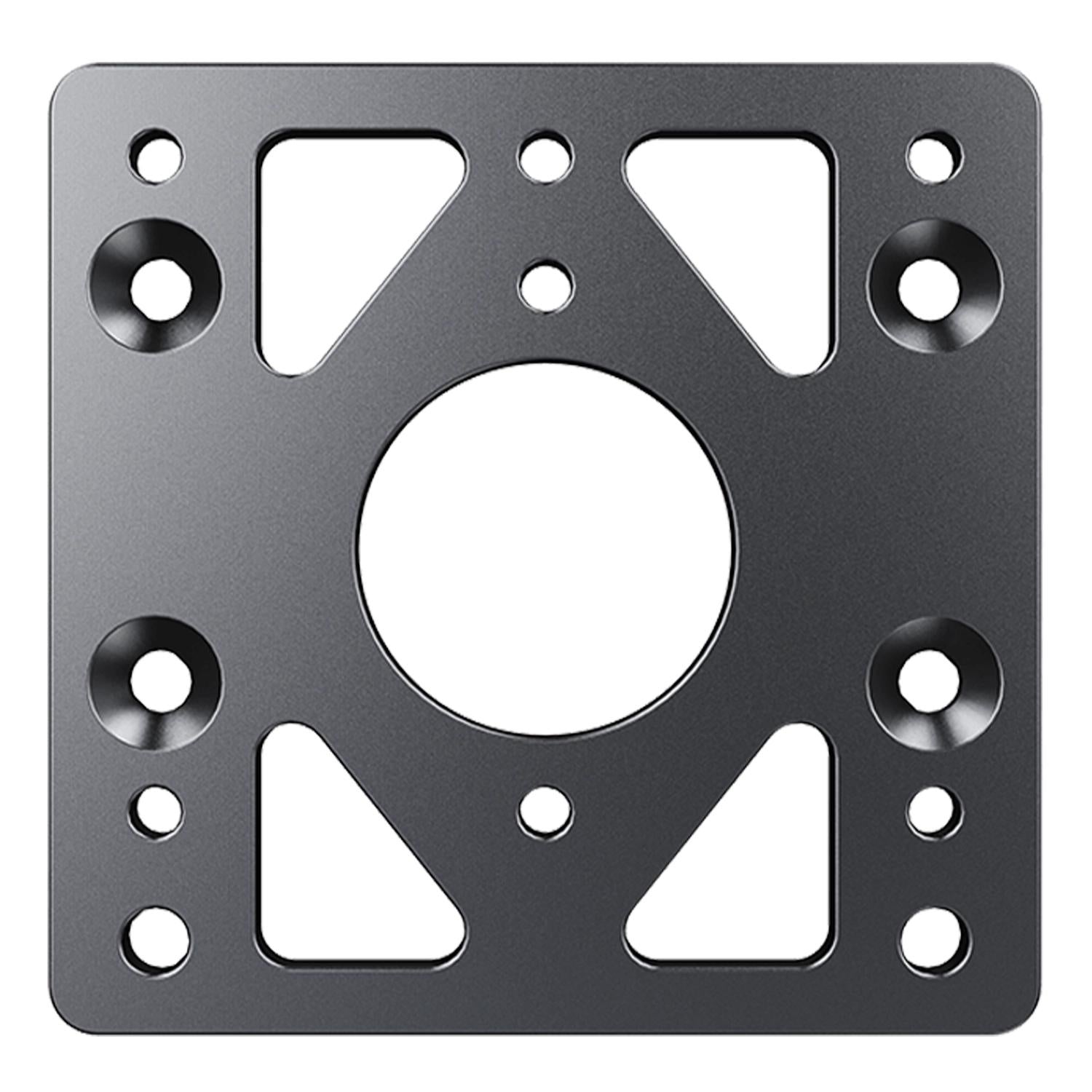
In hand, the MOZA Universal Base Mount Adapter immediately gives an impression of density. This is thick machined aluminum, with a dark anodized finish that exudes seriousness. No sharp edges, no burrs in the drillings, the chamfers are clean. We understand that the aim is to hold a Direct Drive base without flinching, and the product immediately sends this message.
Perceived rigidity is good. When you try to twist it by hand, it doesn't bend. The main plate and side elements (depending on kit and configuration) are strong enough to withstand an already muscular torque. On a cockpit made of aluminum sections, the result is a very coherent whole, with no "fragile spacer" between the base and the chassis.
Mounting the base on the adapter is a logical process, with the holes falling neatly into place and the screws positioned without excessive play. It feels like a product designed for the MOZA ecosystem, not a vaguely compatible generic accessory. When tightened, it sounds full, not hollow.
What's surprising is the level of finish on a part that will ultimately be almost invisible. You can feel that this isn't just a hastily drilled plate. The alignments are clean, and the paint or anodizing seems resistant to assembly scratches. You don't get the impression that you're handling something "cheap".
What may be slightly disappointing is that this premium look doesn't erase one reality: it's still an adapter, not an ultra-modular articulated mount. Compared to some very high-end specialized mounts, we have a little less extreme freedom on angle or fine height to the millimeter, especially if the cockpit itself is limited. But compared to many "no name" universal mounts, the perceived quality is clearly superior, both in rigidity and finish.
Settings, customization and compatibility
MOZA's Universal Base Mount Adapter doesn't offer a "menu" in the software sense, but rather mechanical adjustments. The idea is to offer different mounting positions to adapt the height and, depending on the cockpit configuration, a certain degree of inclination.
In concrete terms, the multiple fixing points allow you to move the base slightly closer or further away, and above all to adjust its position on standard aluminum profiles. These are simple but useful adjustments, especially if you want to fine-tune the height of the steering wheel without dismantling the whole thing. This is not a complex articulated arm, but a rational support, designed to be adjusted once, then forgotten.
The learning curve is very small. If you've already fitted a profiled cockpit or Direct Drive base, you'll understand how to use it straight away. The only thing that can take a bit of time is finding the ideal position in relation to the seat: the right steering wheel height, the right set-back, the right angle. But it's not the adapter itself that complicates matters, it's the overall adjustment of the driver's seat.
In terms of compatibility, the product is obviously aimed at MOZA bases, for which it offers clean, secure assembly. Depending on how you organize your cockpit, you can also use it with third-party structures such as 8020 profiles or certain metal chassis, provided you have the right center-to-center distances and the right screws. For consoles, the question is not directly linked to the adapter itself: this support doesn't change the platform compatibility of the base, it simply supports it.
As part of a wider ecosystem, it fits perfectly into a complete setup: MOZA steering wheel, crankset, shifter on profiles. You get the feeling that MOZA has conceived this adapter as a piece of an overall puzzle. In terms of upgradeability, it can clearly serve as a durable base: if you upgrade your cockpit or base within the MOZA ecosystem, you can often keep it and adapt your set-up. It's more of a long-term base than a simple disposable accessory.
Sensations in play: what it really changes
This type of product has no force feedback to speak of, but it does directly influence the quality of the FFB you get in your hands. The key question: is the overall rigidity of the base + adapter + cockpit assembly up to scratch, or do we lose information in bending and parasitic vibrations?
In practice, with the MOZA Universal Base Mount Adapter tightly clamped to a rigid cockpit, the transmission of force feedback gains in clarity. Rapid jerks, torque variations and surface details have no tendency to dissipate in a moving mount. The steering wheel remains perfectly on axis, even when the base is delivering high torque.
When cornering, especially at high speed, you can clearly feel it. The steering doesn't feel "soft" or floaty. When the car starts to understeer or stall from the rear, the information that arrives in the hands is direct, with no latency due to a twisting chassis. You keep a cleaner line and dare to correct a little later, because you have a better feel for what's going on.
On grip reading, the adapter does its most discreet job, but most importantly: it doesn't pollute the signal. Grip returns, micro-losses of grip, small adjustments to the throttle, everything passes through the base without being dampened by movements of the support. You get the impression that the car is talking, and that nothing interferes with the conversation.
On vibrators, it's even more obvious if you come from a setup where the base was fixed to a thin plate or support that vibrated. With this mount, the shaking remains firm and controlled, without the steering wheel feeling like it's bouncing off a support that's moving all over the place. You can feel the edges, the ridges, the "clack" when attacking aggressive vibrators, but it's clean, legible and free of parasitic noise.
On long sessions, consistency is good. No rapid loosening, no perceptible change in position after several hours at high torque. The fatigue felt comes solely from the FFB itself, not from the need to correct a steering wheel that starts vibrating because the support is working. You gain in mental comfort: you know that this side is locked.
Fast corrections, in controlled drifting or oversteer recovery, benefit greatly from solid support. When you release the steering wheel to let it turn and then catch up, there's no sense of blur. The center remains well defined, the base comes straight back, nothing twists in the driver's seat. You can "let the horses loose" without any second thoughts about the mechanical performance of the setup.
Compared with a lighter bracket or a DIY mount, the difference is clear. Where a thin mount will vibrate and dampen some of the FFB, the MOZA Universal Base Mount Adapter lets the full personality of the base shine through. Compared to high-end dedicated mounts, we remain true to the same philosophy of correct rigidity, with an interesting compromise between price, simplicity and efficiency. We're not talking about an oversized industrial system, but for the vast majority of consumer Direct Drive bases, it's more than a match for the road.
Who's it for? What we like, what we don't like
I clearly see this adapter as a good option for intermediate to advanced simracers who are switching to or already on a Direct Drive base, especially in the MOZA ecosystem. If you're a motivated beginner with an aluminum profile cockpit or a sufficiently rigid chassis, it's also a good investment, because you secure your setup from the outset, instead of having to rethink everything as you gain power.
One of the things I like most about it is its immediate solidity. You put it on, tighten it, and you can feel that it's not going to bend at the first torque. Secondly, the level of finish is really clean for an accessory of this type: it's pleasant to handle, and doesn't feel like a garage part. Finally, its natural compatibility with profile cockpits and MOZA bases makes it a simple solution to recommend: you don't spend hours adapting it, you just fit it and go.
As for its limitations, it's important to bear in mind that this is not a miracle support for flexible chassis. If your cockpit is light, tubular or poorly designed, even a very good adapter won't eliminate all parasitic movements. Secondly, it's not the most extreme system in terms of very fine angle adjustments or hyper-modular adjustment. It's versatile, but not designed to be adjusted to the millimeter every day. Finally, the perceived value depends on your overall budget: some will see a dedicated adapter as a logical investment to protect an expensive base, others will find it "just a piece of metal" compared to more visible expenses like a new steering wheel or pedalboard.
In terms of the investment/benefit ratio, I'd say it's pretty good. This is a product that doesn't add any flashy features, but directly improves the stability, perceived precision and potential lifespan of your setup. For someone who takes his sim racing seriously, this kind of part quickly becomes an obvious choice.
Verdict
The MOZA Universal Base Mount Adapter won't change the power of your base or the quality of your FFB, but it will change the way that FFB gets to you. It transforms an average set-up into a stiffer, cleaner, more coherent whole. In a Direct Drive setup that's starting to get serious, this is exactly the kind of link you want to make more reliable.
On the market, I see it as a solid mid- to high-end solution in its category: more serious, cleaner and more reassuring than basic universal plates, while remaining in an accessible "consumer sim racing" spirit. It integrates particularly well into a MOZA ecosystem, but can also serve as a base for those who are building a cockpit on profiles and want a clean support for their base.
I clearly recommend it to PC or console users who are already running Direct Drive or who plan to switch to it, and who have a sufficiently rigid chassis to take advantage of it. If you're on a very light entry-level cockpit, the money might be better spent on a chassis upgrade before thinking about this type of adapter.
If you're looking to stiffen your driving position, make your MOZA base mounting more reliable and get the most out of your FFB without unwanted vibrations, this product can clearly make the difference in your setup.



Reviews