
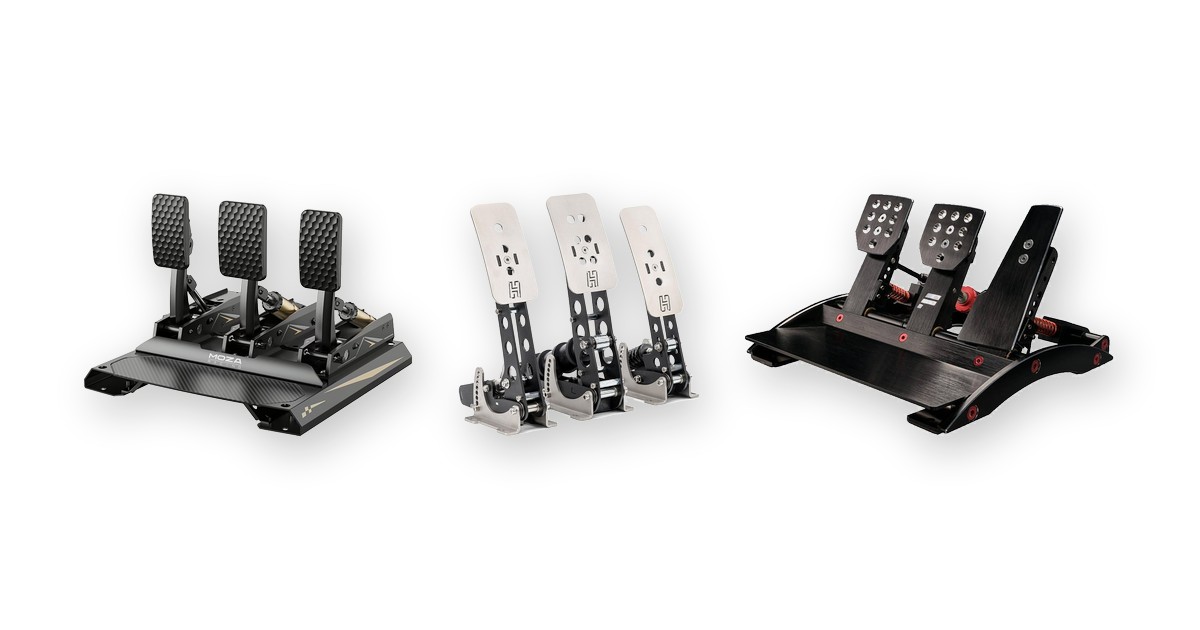
The Best Sim Racing Pedals in 2026
By the Sim Racer Gear team · Updated in 2026. How to choose: We compare the benchmark tests with our own driving experience; we evaluate the brakes first (the real test), and we always specify the technology and the number of pedals.
In a nutshell: Our verdict
The best crankset for most people in 2026 is the Moza CRP2 : High-quality load cell braking and premium construction, all at an affordable price. On a tight budget but still a real load cell: the Moza SR-P. On console: the Fanatec CSL Pedals LC or, with haptic feedback, the Fanatec ClubSport V3. The ultimate: Heusinkveld Sprint and Ultimate+.
If you had to improve just one thing about your setup, it would be the pedals—and more specifically, the brake. This is the accessory that offers the greatest improvement in realism and performance—far more than an extra set of steering wheels. The reason is simple: a good brake can be modulated to the pressure (in kilograms), not distance, just like in a real car. Switching from a spring-loaded pedal to a brake load cell saves an intermediate-level driver one to two seconds per lap. See also Our selection of cranksets.
I compared the top models for 2026—from the best affordable load cell to the competition-grade hydraulic pedal system—by combining test results with real-world experience. Here is my selection of the Best Sim Racing Pedals, sorted by budget and purpose.
The Best Sim Racing Pedals at a Glance
| Pedal set | Brake | Pedals | Price | Note | |
|---|---|---|---|---|---|
| Moza CRP2 No. 1 The Best Crankset (Value for Money) |
200 kg load cell | 3 pedals | About 499 € | 9/10 | See the price |
| Moza SR-P The Best Budget Option (Real Load Cell) |
100 kg load cell | 2 pedals | About 179 € | 8.5/10 | See the price |
| Fanatec CSL Pedals LC The Best for the Console (on a Budget) |
Load cell | 2 pedals | About 200 € | 8/10 | See the price |
| Fanatec ClubSport V3 The best with haptic feedback (3 pedals) |
90 kg load cell | 3 pedals | About 400 € | 8.5/10 | See the price |
| Heusinkveld Sprint The best premium option (the gold standard) |
Load cell | 2 or 3 pedals | About 770 € | 9/10 | See the price |
| Heusinkveld Ultimate+ The Ultimate Premium (Hydraulic) |
Hydraulics | 2 or 3 pedals | About €1,440 | 9.5/10 | See the price |
How to Choose the Right Crankset?
Three criteria, and the first one overshadows all the others:
- The type of brake—THE deciding factor. From least to most realistic: the spring-loaded sensor / potentiometer (measures the stroke, not very accurate, best to avoid it whenever possible), the load cell (measures pressure—the first real upgrade you should make, a huge improvement in dosing accuracy), and thehydraulic (the feel of a true master cylinder, typically found only in high-end models). If you remember just one thing: go for a brake with a load cell.
- A rigid cockpit is required. A good load-cell brake requires a lot of force to operate (often 60 to 100 kg). It needs a stable mount; otherwise, you’ll be pushing the frame instead of braking. A sturdy pedal assembly and a flimsy cockpit don’t mix well.
- Two or three pedals? Two pedals (brake, accelerator) are sufficient for the GT3 and F1 with paddle shifters. The third pedal (clutch) is used for the H-pattern gearbox, heel-and-toe shifting, and immersion. Many pedal sets offer the third pedal as an option.
One last thing: adjustability (brake stiffness via springs and elastomers, angle, preload) and materials (steel, machined aluminum) make the difference between a pedal set that lasts for years and one that needs to be replaced quickly.
Our detailed reviews, crankset by crankset
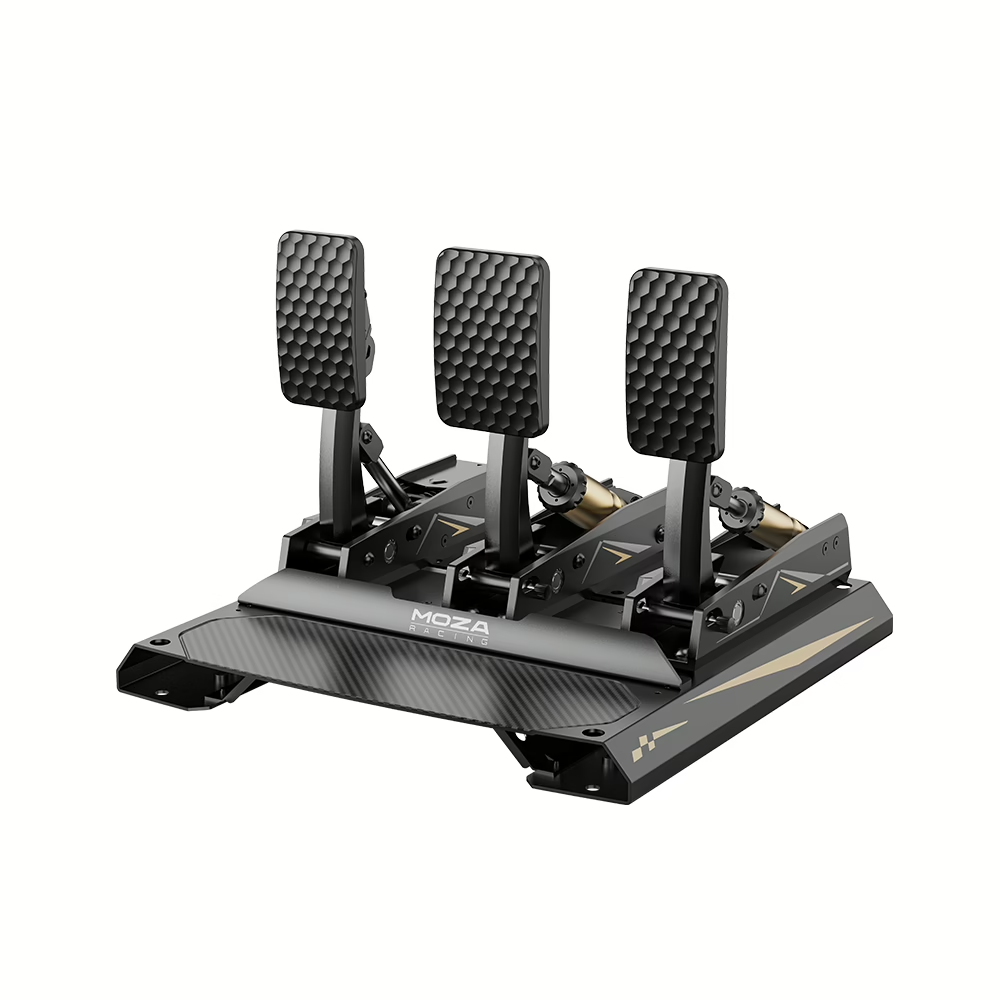
The Best Crankset (Value for Money)
Moza CRP2 9/10
About 499 € · 200 kg load cell · 3 pedals
In my opinion, it offers the best balance of performance, build quality, and price in 2026. The CRP2 is equipped with a brake that 200-kg load cell, combined with an angle sensor and a fusion algorithm that ensures remarkable precision in tuning. The build quality is top-tier (aluminum, carbon heel cup, interchangeable dampers), and the adjustability is staggering, with over 1,700 possible combinations via the Pit House software. You get about 90% of the feel of a premium pedal system for half the price. Two honest caveats: there is No official PlayStation compatibility (PC and Xbox only), and its highly precise calibration requires a little patience to find the perfect setting.
We love
- 200-kg load cell brake, exceptional precision
- High-end construction (aluminum + carbon), highly adjustable
- About 90 % of premium quality at half the price
We like it less
- No official PlayStation compatibility (PC and Xbox)
- Precise adjustment, takes a little while to dial in
Who is this for: For anyone looking for the best feel per euro and a controller that will last, whether on PC or Xbox.
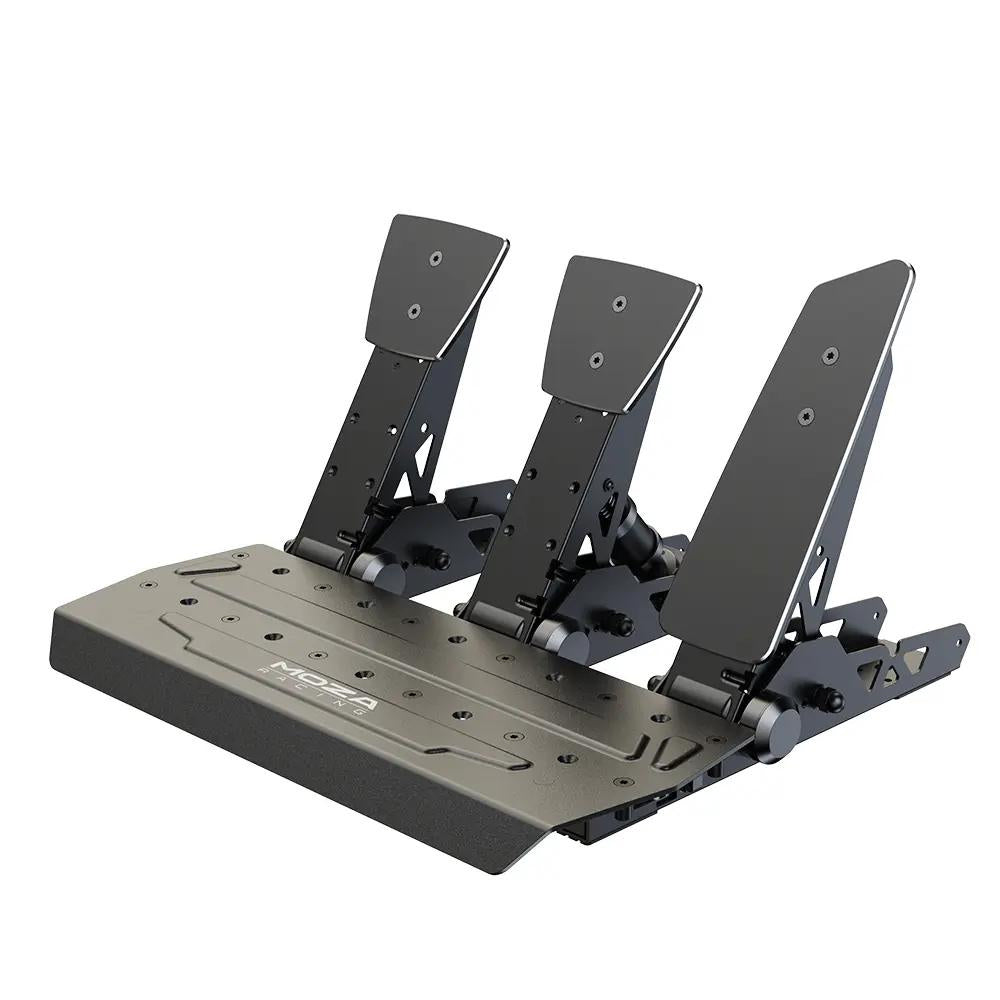
The Best Budget Option (Real Load Cell)
Moza SR-P 8.5/10
About 179 € · 100 kg load cell · 2 pedals
Here’s the best-kept secret in the entry-level segment: a real brake on load cell for less than €200. While most competitors in this price range settle for a travel sensor, the SR-P comes standard with an all-steel load cell in a compact two-pedal design (the clutch is available as an option). The result is braking modulation that’s in a league of its own compared to a standard entry-level pedal set—all at an unbeatable price. It’s primarily designed for PC and the Moza ecosystem, and two pedals will suffice for most users, but as a first true load cell, it has no equal at this price point.
We love
- A genuine load cell brake for less than €200
- All-steel construction
- The best value for the price
We like it less
- Mainly PCs / Moza ecosystem
- Two pedals (clutch optional)
Who is this for: The best first real load cell, on a tight budget.
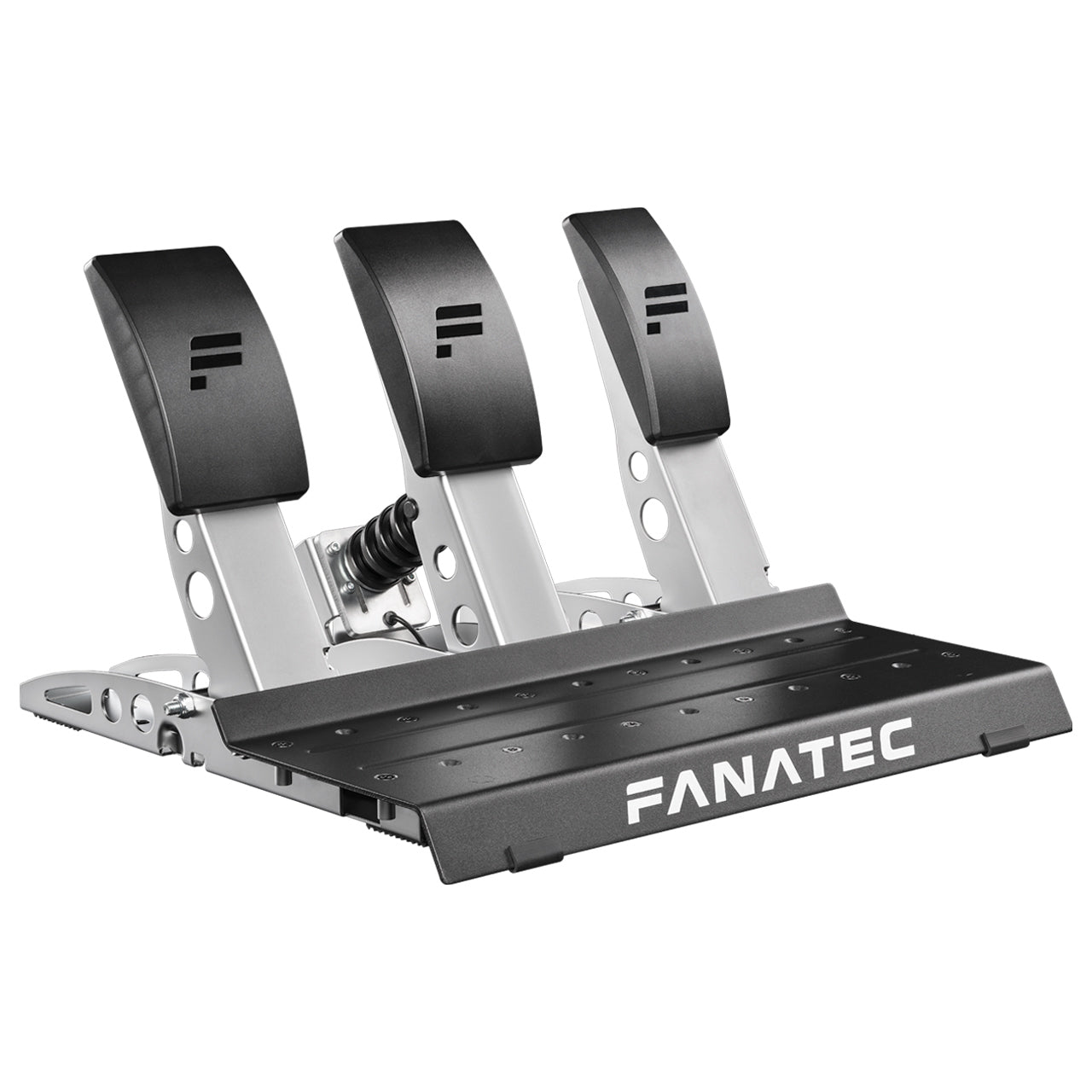
The Best for the Console (on a Budget)
Fanatec CSL Pedals LC 8/10
About 200 € · Load cell · 2 pedals
If you play on a console with a Fanatec base, this is the perfect way to get started with load cell braking. The CSL Pedals bundle with the Load Cell kit costs around €200 and gives you a pressure-sensitive brake that completely changes how you control braking, all while staying within the Fanatec ecosystem (compatible with Xbox and PS5 via a compatible base). It’s a two-pedal set—the third pedal can be added later—and the setup is upgradeable if you move up the Fanatec lineup. The feel doesn’t quite match that of a Moza CRP2 or a Heusinkveld, but if you want to experience load cell technology on a console without breaking the bank, this is the way to go.
We love
- Load-cell brake for about 200 €
- Compatible with consoles (Xbox / PS5 via Fanatec base)
- Scalable within the Fanatec ecosystem
We like it less
- Two pedals (the third is an optional extra)
- Lags behind mid-range models
Who is this for: The Fanatec console gamer who wants to switch to a load cell without breaking the bank.
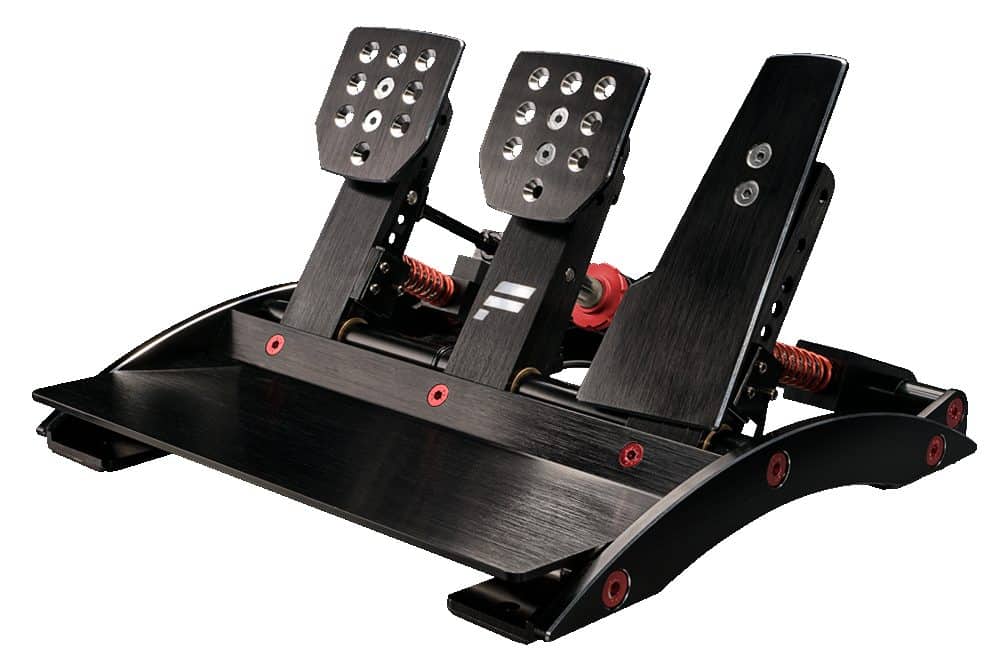
The best with haptic feedback (3 pedals)
Fanatec ClubSport Pedals V3 8.5/10
About 400 € · 90 kg load cell · 3 pedals
The ClubSport Pedals V3 has a feature that few others offer: integrated vibration motors in the pedals. Specifically, the pedal vibrates when the ABS engages or when the wheels spin, providing very useful feedback for sensing the limit of traction. It’s a 3-pedal set made entirely of CNC-machined metal, featuring a load-cell brake—a true mid-range benchmark—and PlayStation compatibility. Its limitations are fair: it’s more expensive than a Moza CRP2, which scores higher on raw braking performance, and its technology is starting to show its age. But for its haptic feedback and three-pedal setup on a console, it still holds its own.
We love
- Built-in vibration motors (ABS, wheel slip), which are very educational
- Three all-metal pedals, load cell brake
- PlayStation-compatible
We like it less
- More expensive than a Moza CRP2, which has a higher braking rating
- Technology that's starting to show its age
Who is this for: The console gamer who wants three pedals and haptic feedback to feel the limit.
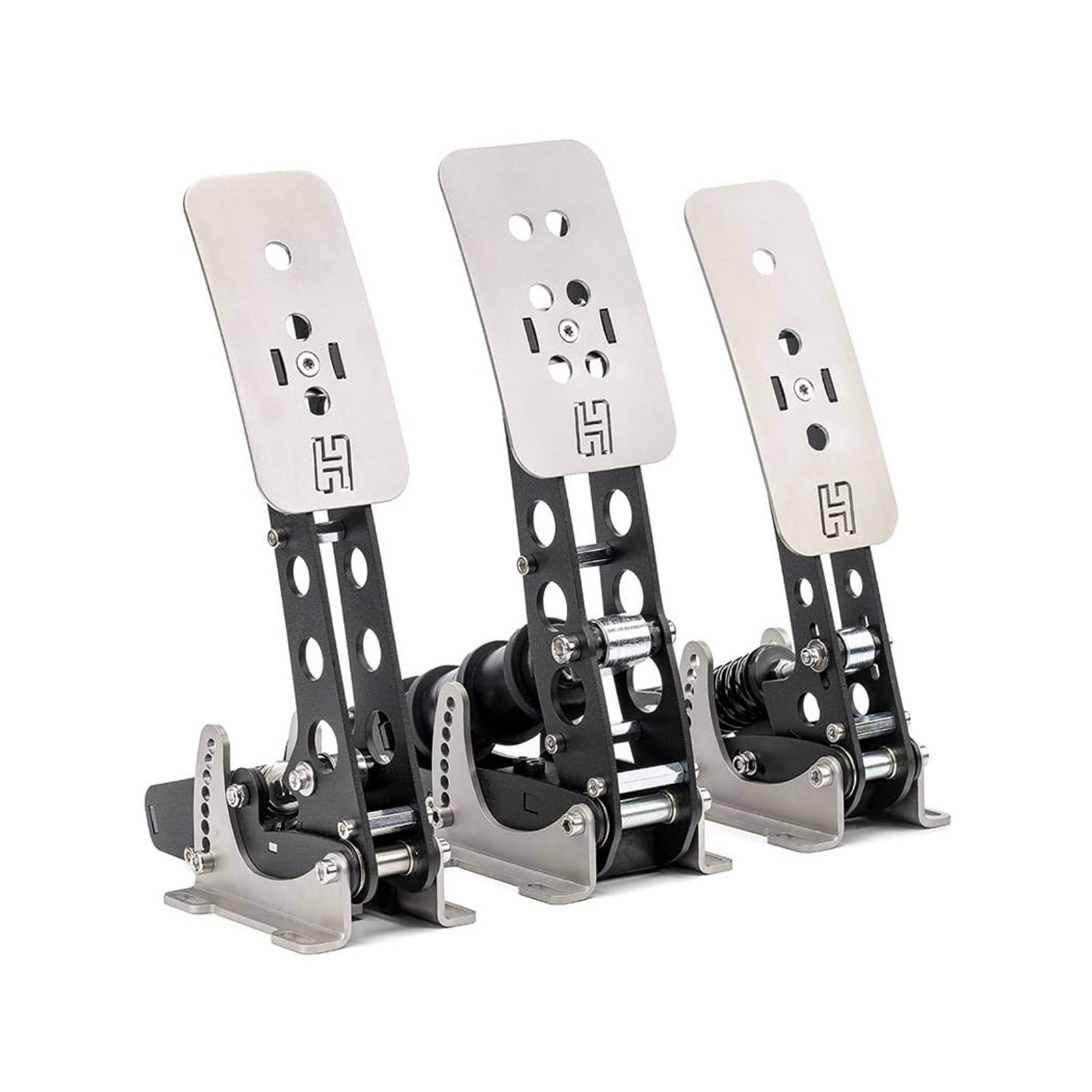
The best premium option (the gold standard)
Heusinkveld Sim Pedals Sprint 9/10
About 770 € · Load cell · 2 or 3 pedals
Since 2018, the Heusinkveld Sprint has been the gold standard in premium pedal systems, and it hasn’t aged a bit. It’s made entirely of laser-cut steel, and the brake uses a load cell and progressive elastomers that provide a clearly defined threshold : You know exactly where the limit is every time you brake, lap after lap. This consistency is what saves time on the track, and testers confirm that you get the hang of it very quickly. Six stiffness settings and the SmartControl software let you tailor it to your preferences. It’s expensive and less compact than some others, but it’s a purchase that will last ten years.
We love
- The most consistent and predictable brake on the market
- Laser-cut steel, six hardness settings
- The industry standard for years, with exemplary durability
We like it less
- High price
- Ergonomics could be improved during very long sessions
Who is this for: The demanding driver who wants the ultimate braking performance—and to keep it for a long time.
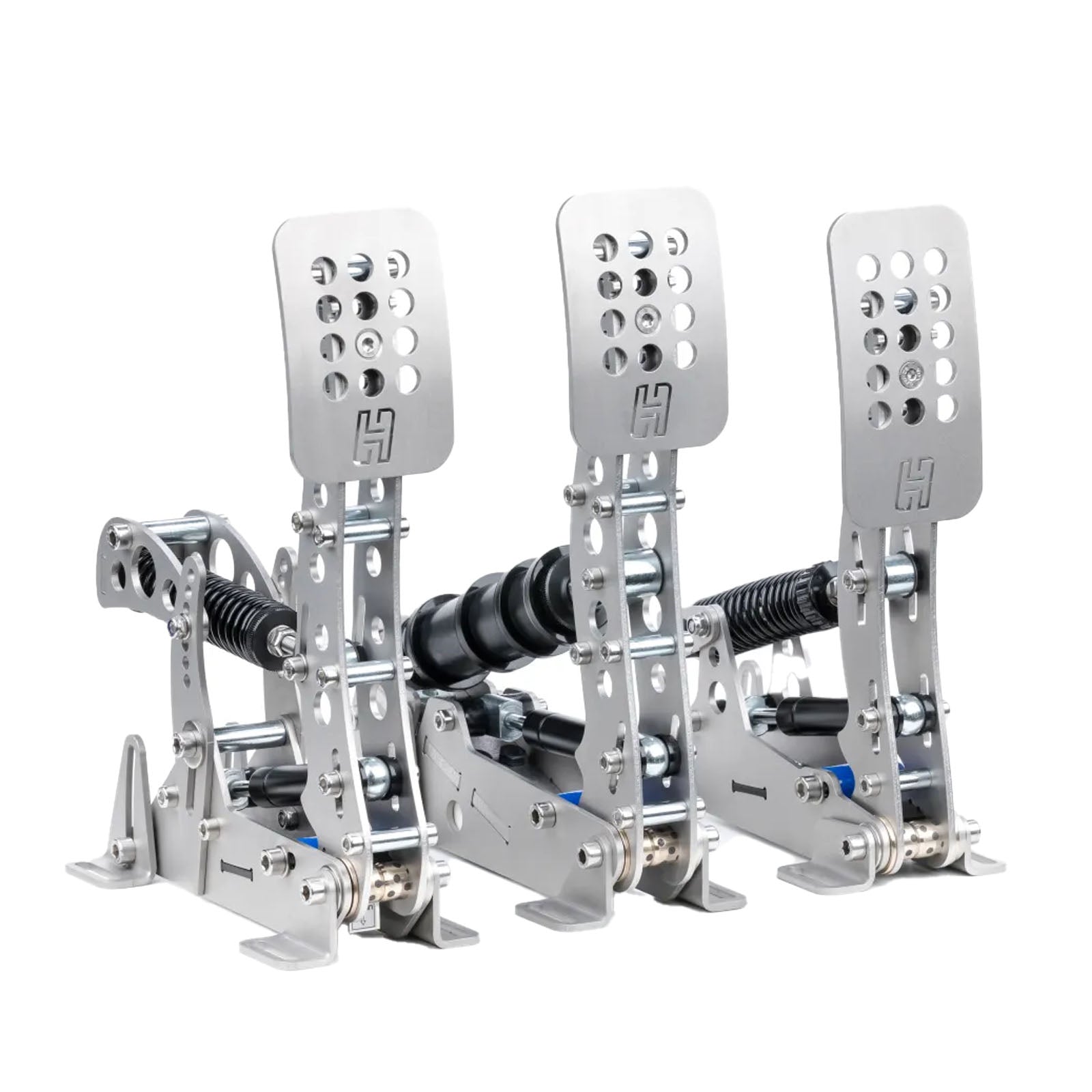
The Ultimate Premium (Hydraulic)
Heusinkveld Sim Pedals Ultimate+ 9.5/10
About €1,440 · Hydraulic · 2 or 3 pedals
When budget is no longer a concern, the Ultimate+ is the ultimate choice. It combines a load cell of approximately 200 kg and bidirectional hydraulic damping that replicates the feel of a real race car master cylinder. Testers describe it as as realistic as a simulation pedal can be, with a lifespan designed to last over a million cycles. This is gear for enthusiasts and pros: expensive, PC-only, and it requires a perfectly rigid cockpit to function properly. But for anyone seeking absolute authenticity in braking, this is the ultimate choice.
We love
- Hydraulic damping, "real car" feel
- Load cell ~200 kg, extremely durable
- The ultimate in braking realism
We like it less
- Very expensive, PC only
- Requires a perfectly rigid cockpit
Who is this for: The enthusiast who wants absolute authenticity in braking, with no budget constraints.
So, which one should you choose?
- The best option for most people: The Moza CRP2: the best value for the money.
- Best Budget Option: The Moza SR-P, a true load cell for under €200.
- The best on console: the Fanatec CSL Pedals LC, or the ClubSport V3 for haptic feedback.
- The premium choice: the Heusinkveld Sprint.
- The ultimate premium: the Heusinkveld Ultimate+ (hydraulic).
If you're starting with a spring-loaded pedal system, keep this in mind above all else: switching to the load cell is the best investment you can make for your driving experience. Other brands are worth checking out depending on your budget, such as Simagic—whose P2000 hydraulic pedal set offers a feel close to that of top-of-the-line models at a lower price—or Asetek, with its sleek design. You can also browse Our selection of cranksets.
Frequently Asked Questions
Does the load cell really make a difference?
Yes, this is the biggest improvement in realism and performance for a setup. A load-cell brake is modulated by pressure, just like in a real car: the modulation becomes precise and consistent, which saves an intermediate driver one to two seconds per lap.
Two or three pedals?
Two pedals (brake and accelerator) are sufficient for the GT3 and F1, where gear changes are made using paddle shifters. The third pedal—the clutch—is used for the H-pattern transmission, heel-and-toe shifting, and immersion. It is often offered as an option.
Does a load-cell crankset require a rigid cockpit?
Yes. A load-cell brake requires a lot of force to operate. Without a cockpit or a rigid mount, you’ll end up moving the chassis instead of braking, and you’ll lose all precision. In fact, that’s the only way to get the most out of it.
See also: to complete your setup


