MOZA TSW Truck Wheel : Test & Review | What it's really worth in 2026
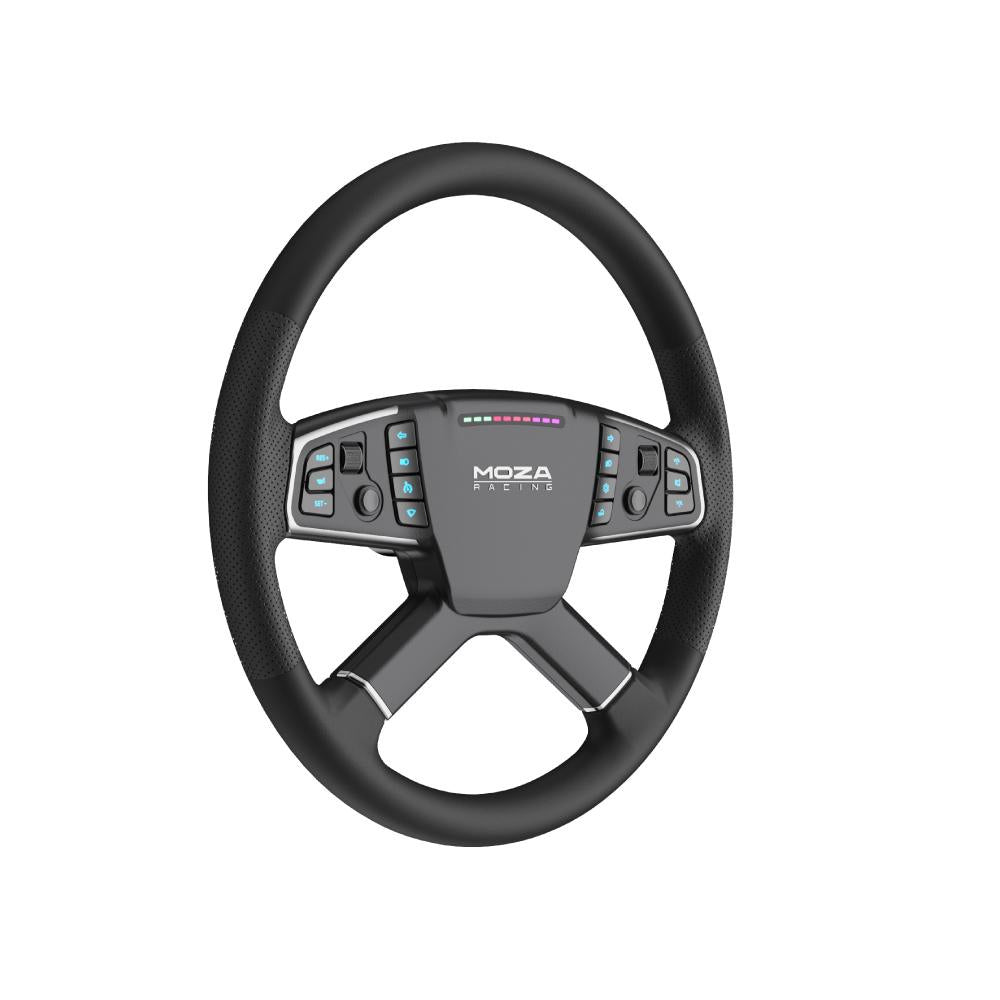
MOZA TSW Truck Wheel: My quick review
This steering wheel really gives the impression of moving from a "racing game" to real truck driving, with much more natural gestures and rhythm, especially over long sessions. It makes sense for PC gamers already equipped with MOZA who spend a lot of time on ETS2/ATS. For this profile, the investment seems coherent and sustainable.
When you buy through our links, we may earn an affiliate commission.
MOZA TSW Truck Wheel: the truck steering wheel that wants to play in the big leagues
The MOZA TSW Truck Wheel is clearly aimed at a specific niche: truck simulation enthusiasts, especially Euro Truck Simulator 2, American Truck Simulator or truck-oriented sims. We're talking about a large, heavy truck-type wheel, with a design closer to a real industrial steering wheel than to a GT or F1 wheel.
Above all, it promises two things: immersion and comfort over long sessions, with a more realistic approach to truck driving than the classic round sim racing steering wheels. The idea is simple: recapture the gestures and feel of a real truck steering wheel, while remaining within the MOZA ecosystem.
For my part, I approached it as a specialized steering wheel, not as an off-roader. I focused on three aspects: build quality, precision of controls (buttons, knobs, paddles) and in-game sensations on truck sims, but also on other more "racing" titles to see how far it could be pushed. This is a niche product, but one that could seriously transform the experience for those who live and breathe virtual delivery on a daily basis.
Design and manufacture: a real truck steering wheel, not an enlarged toy
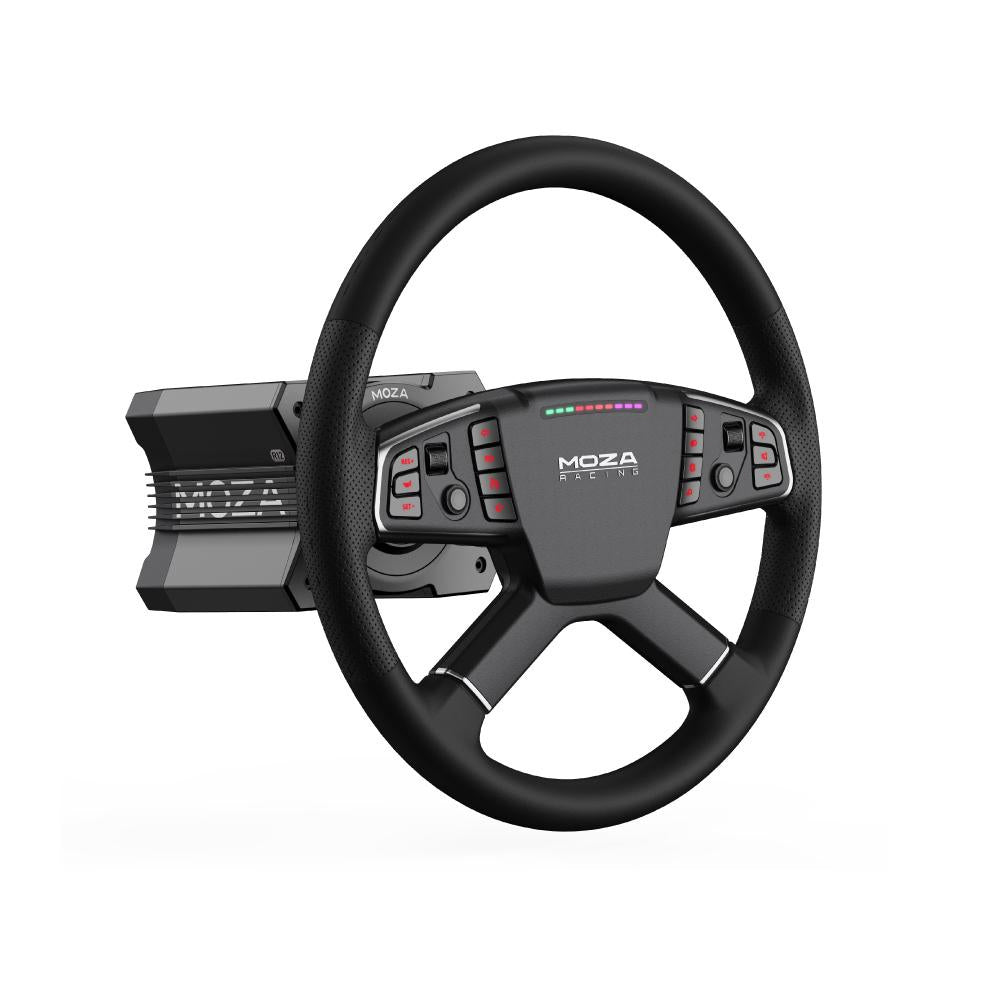
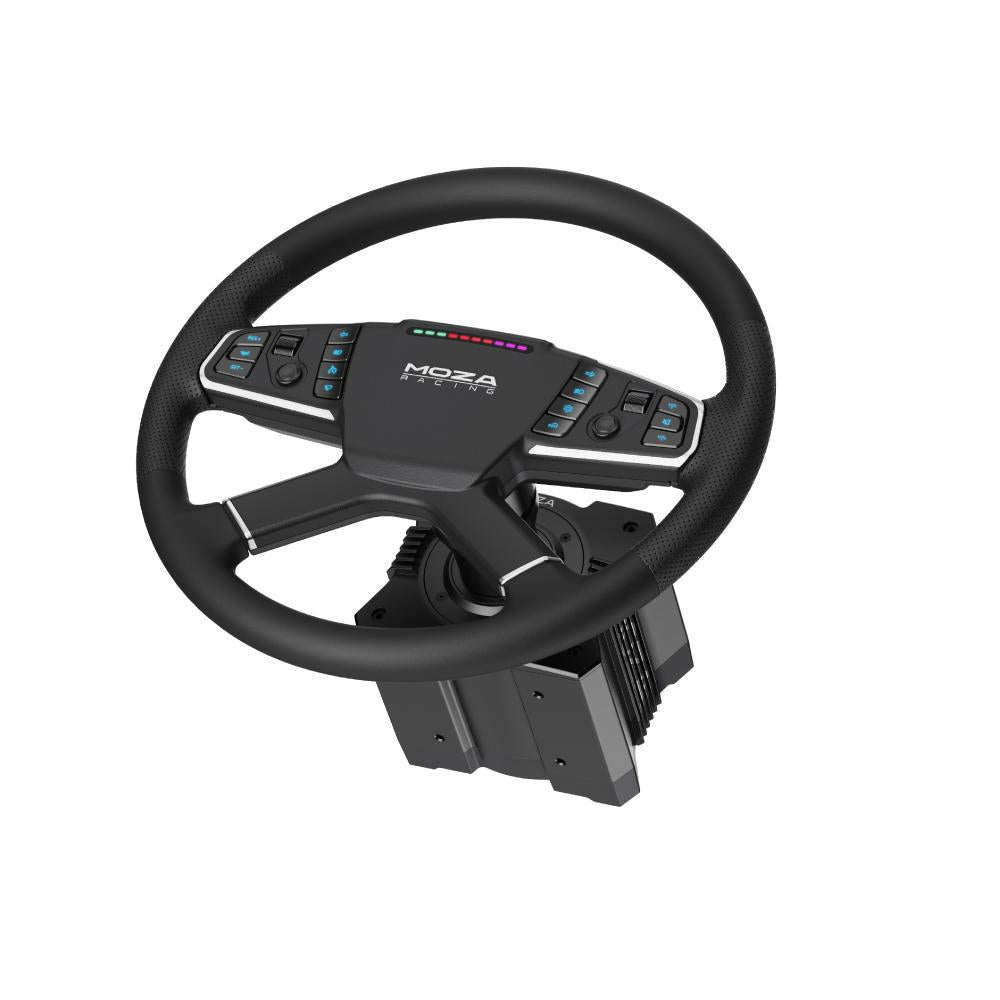
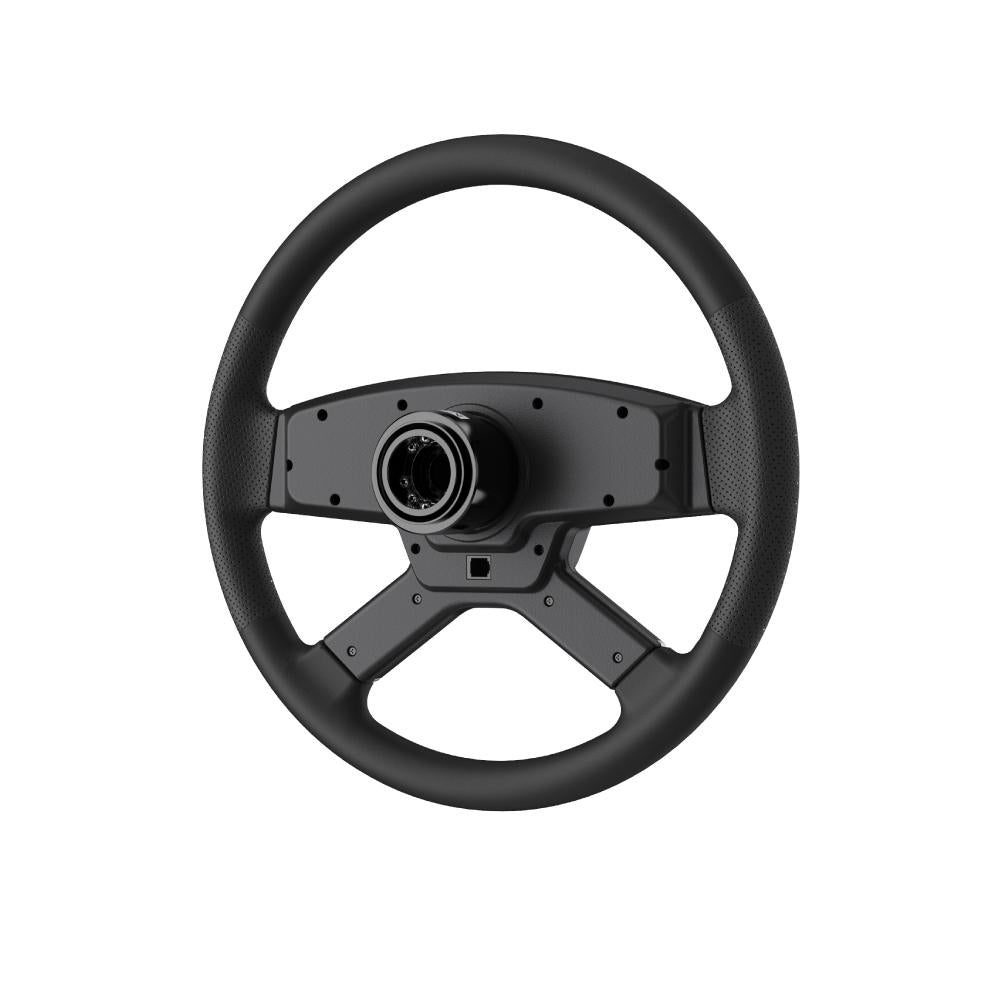
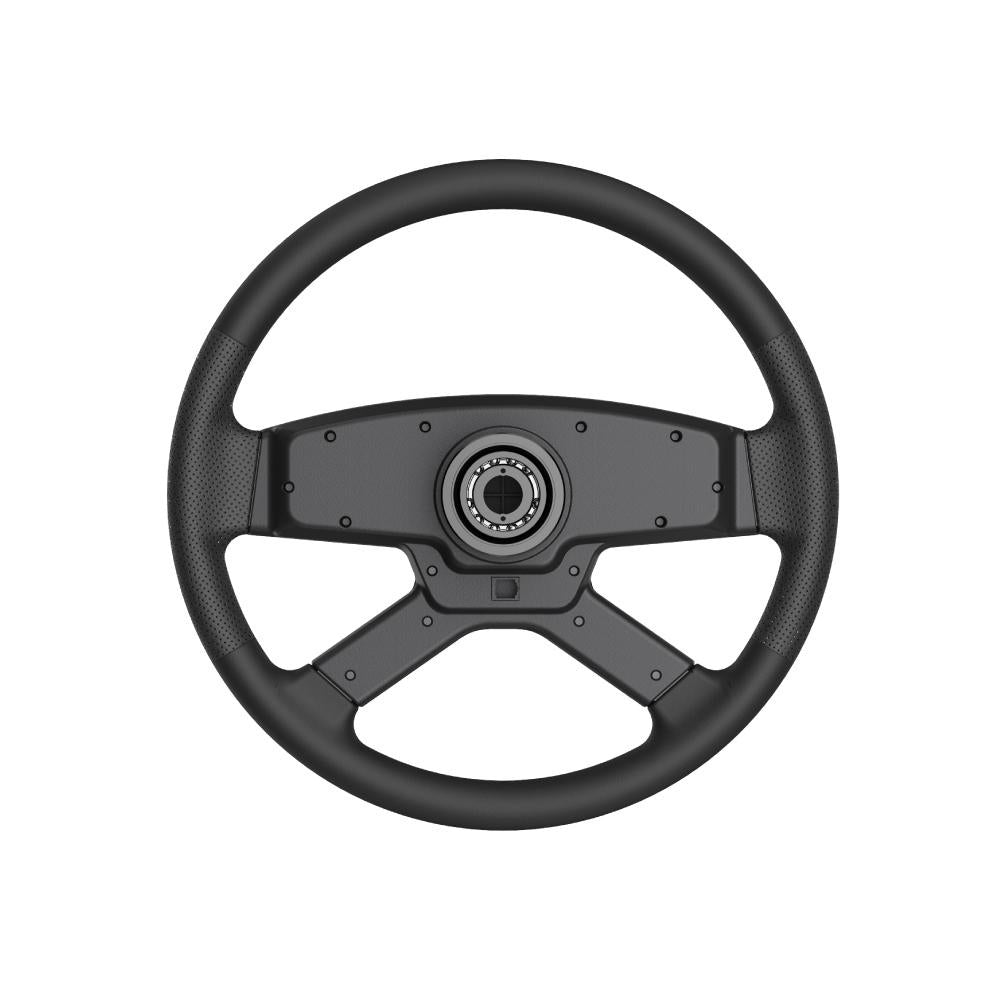
Visually, the MOZA TSW Truck Wheel makes an immediate impression. The diameter is generous, the shape clearly reminiscent of a modern truck steering wheel, with a wide central flat and thick spokes. In hand, the first sensation is one of mass: this is no lightweight hoop, but a density that inspires confidence.
The materials are rather serious. The center and the structure supporting the grips breathe metal and rigid composite, with very little flex, even when forcing on the crown. Stiffness is what you'd expect from a steering wheel designed to handle Direct Drive. This solid "block" feel gives an impression of durability. You get the feeling you're holding a serious component, made to run for hundreds of hours.
The grips are more comfort-oriented than aggressive. We're not talking about ultra-textured racing leather with sporty stitching, but rather a finish that favors long-lasting hold and low-intensity comfort. For a truck, that makes sense. The hands rest naturally, the grip is neither too thick nor too thin, and complete steering sequences are carried out without tension. For long sessions, this is clearly a strong point.
There are, however, a few more nuanced points. The design is functional, but not premium to the level of a hyper-premium steering wheel in full-grain leather with carbon insert. Some of the plastic details on the controls are reminiscent of a "robust" rather than "luxury" approach. Compared with some of the brand's GT metal and leather steering wheels or those of direct competitors, the TSW looks more like a work tool than a collector's item.
As for assembly, the adjustments are clean, there's no parasitic play on the front panel, the buttons are well aligned and the paddles don't float. Nothing squeaks, nothing moves when you shake the steering wheel. You can feel that MOZA wanted to deliver something consistent with the "pro" image of truck driving.
Settings, customization and compatibility: designed for the MOZA ecosystem
The TSW integrates naturally into the MOZA ecosystem. Connection to the brand's quick release is solid, fast and without any perceptible wobble. Once locked onto a compatible base, the whole thing holds together, which is essential with a steering wheel of this diameter, especially on a slightly muscular Direct Drive base.
As far as compatibility is concerned, we're still in the usual world: PC use above all, with a dependence on MOZA bases to exploit functions and settings to the full. For console gamers, the story will depend heavily on the base used and its compatibility with the platform. TSW itself is not a stand-alone interface; it follows the base's capabilities.
Buttons, knobs and any on-board encoders are designed for truck driving: indicators, lights, wipers, gearbox management, various dashboard functions. The layout is logical: everything can be accessed without taking your hands off the crown. You can map the essential truck simulator controls without having to multiply the peripherals around them.
In MOZA Pit House software, customization remains fairly straightforward. You can assign buttons, save profiles for different games, set the base FFB according to the steering wheel used. The learning curve is reasonable for anyone with a minimum of sim racing experience. For a complete beginner, it will take a little time to understand the impact of each slider, but this is not a hermetic product.
Where it gets interesting is in terms of setup evolution. The TSW Truck Wheel isn't a base, so it's an add-on to an existing ecosystem. It's aimed more at those who already have a MOZA base (or plan to switch to one) and want a dedicated truck wheel, different from their main GT or F1 wheel. This is a serious complement, not just a gadget accessory.
Sensations at play: where the steering wheel comes into its own
On the virtual road, the MOZA TSW Truck Wheel immediately changes the relationship with the truck. The larger diameter, weight and crown shape impose a different rhythm. You naturally adopt a more progressive, fuller driving style, with arm movements close to those of a real truck. It's easy to see why this type of steering wheel is so sought-after in this segment.
The precision of the feedback obviously depends on the base, but the transmission of sensations is very consistent. The larger steering wheel gives the impression of greater leverage: micro-corrections become finer, more nuanced. You can feel the torque variations in the steering, the little oscillations caused by the road and the weight of the trailer. On a properly tuned Direct Drive, you really get the feeling that the truck "weighs" something through the steering wheel.
In tight bends, the inertia of the steering wheel is felt, but in the right direction. You turn more, steer wider, and follow the steering instead of jerking it. City maneuvers, roundabouts and reversing with a trailer become more intuitive. The area near the midpoint remains stable, without excessive wobble, which helps you keep your line on the freeway. You'll find yourself making slow but ultra-controlled corrections. You steer more than you steer.
In terms of grip, the loss of grip on the front end of a truck is not as violent as on a GT, but you can feel when the load shifts, when the front begins to widen. The TSW, with its size, exaggerates these transitions a little, making them more legible. You can gradually feel the steering becoming lighter or heavier. You can tell if you're pushing too hard on a sharp uphill bend, for example. The overall behavior of the convoy becomes clearer.
On vibrators or road irregularities, the feel is deliberately more filtered than on a compact, race-oriented steering wheel, but this is not a fault. In a truck context, we're less looking for the micro-serration of circuit vibrators than for the sensation of pavement, potholes, bridge connections or curbs bitten too hard by the trailer. The TSW reproduces these events well, without becoming tiring. You feel the shocks, but you don't get jolted around.
This is where the steering wheel really comes into its own during long sessions. The comfort of the grip, the distribution of the load in the arms and shoulders, and the consequent diameter mean you can ride for long periods without tensing your fingers. Fatigue comes more from the body as a whole than from the hands. And that's exactly what you want when you're doing long virtual deliveries. The shoulders work a little, but fluidly, without violent jerks.
For quick corrections, of course, we're not talking about the speed of a small formula steering wheel. You can't counter-steer in a snap of the fingers. But for a truck, that's not necessarily a problem. The steering wheel offers enough reactivity to catch a trailer drift or a trajectory that closes more than expected. You're still in control, with that feeling of mass that you still have to respect. You feel like you're driving a heavy vehicle, and that's what makes it so interesting.
Compared with a smaller, round steering wheel or a GT steering wheel mounted on the same base, the TSW transforms driving. You lose pure liveliness, but gain truck immersion and progressive precision. Compared with a small, low-powered steering wheel or an entry-level belt-driven base, the TSW + Direct Drive MOZA combo delivers a much greater depth of feel, especially when driving with a heavy load. We're clearly closer to a "work tool" experience than a "play wheel".
Who's it for? What we like, what we don't like
The MOZA TSW Truck Wheel is aimed above all at a specific profile: players who spend a lot of time on truck simulators, who are motivated, already somewhat equipped, and often on PC. This is not a wheel to be recommended as the first and only wheel for everything. It makes perfect sense as a wheel dedicated to a specific discipline: convoying, heavy-duty road driving, or even certain bus or commercial vehicle simulations.
What I particularly appreciated was the immersion. Just turning a steering wheel of this size changes your posture, gestures and tempo. You almost instinctively put yourself in the driver's shoes. Secondly, the ergonomic consistency of the controls makes the experience more fluid: essential functions are right at your fingertips, and you're not constantly looking for your keyboard. Finally, comfort over time is very good. You can drive for long periods without feeling that the steering wheel is tiring because of its shape or grip.
As for its limitations, the first is obvious: it's a niche steering wheel. If you mainly play racing sims, the TSW is of no interest as a main steering wheel. It'll be too big, too slow, not suited to extreme downforce. Secondly, the finish, while solid, is not ultra-premium. Those expecting a very high-end object, with luxurious leather and refined details, will be left a little disappointed. Thirdly, it depends entirely on the MOZA ecosystem. If you're already with another manufacturer, the investment becomes heavy, as it often requires you to overhaul part of the setup.
In terms of perceived value, it all depends on how you use it. For an occasional Euro Truck Simulator player, it's probably an unreasonable purchase. For someone who spends hours every week on the road, who already has a MOZA base and possibly other steering wheels, the TSW becomes a logical investment to specialize your setup. It's a wheel that really transforms the relationship with the truck, but only if you regularly exploit this type of content.
Verdict: a real tool for truck enthusiasts
The MOZA TSW Truck Wheel brings something very concrete to a setup: it finally provides an interface adapted to truck driving. Where a GT or F1 wheel always feels a little "out of place" in a big truck, the TSW brings everything back into line. Gestures, amplitude, weight feel, everything shifts towards a more credible experience.
On the market, it stands out as a specialized mid- to high-end product, oriented towards immersion rather than timed performance. It's neither an entry-level steering wheel, nor a decorative luxury item. It's a robust tool, designed for regular use in a very specific context. It complements a serious Direct Drive base, not replaces it.
I clearly recommend it to those who already have a MOZA ecosystem, who really like truck driving and want a dedicated steering wheel for this activity. For a purely circuit, rally or classic competitive sim racing gamer, it's irrelevant as the only steering wheel. It may serve as a secondary steering wheel for the road, but it's no substitute for a good GT or single-seater steering wheel.
If you're looking to make your Euro Truck Simulator or American Truck Simulator sessions much more natural, with a real truck steering wheel feel in your hands, this product can clearly make the difference in your setup.</analysis
Other products we have tested
-
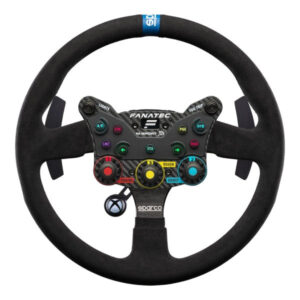
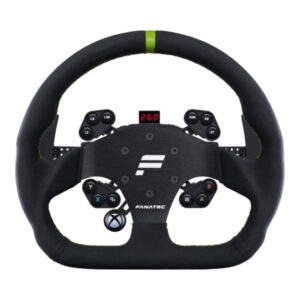
Fanatec ClubSport Steering Wheel GT Alcantara V2
-
Fanatec ClubSport Steering Wheel GT Forza Motorsport V2 for Xbox
-
Fanatec ClubSport Steering Wheel Rally Sweden for Xbox
-
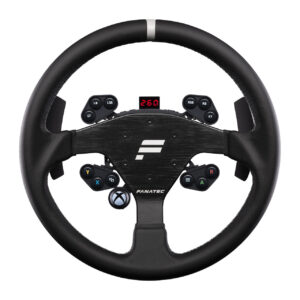
Fanatec ClubSport Steering Wheel 320 Xbox
-
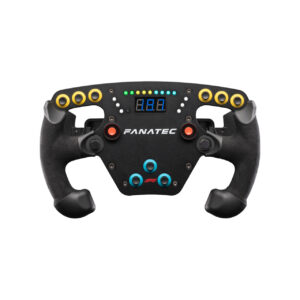
Fanatec ClubSport Steering Wheel F1 Esports V2
-
Fanatec ClubSport Steering Wheel Porsche 911 GT3 R V2 for Xbox (Suede)
-
Fanatec ClubSport Steering Wheel GT Alcantara V2 for Xbox
-
Ascher Racing F28-SC V2



Reviews