
Simucube 2 Pro : Test & Review | What it's really worth in 2026
Simucube 2 Pro: My quick review
This Simucube 2 Pro gave me the sensation of a very clean, legible and consistent steering wheel, which really helps to get a better feel for the car and to drive more confidently. It makes sense for PC sim racers who have already invested, and who want a reliable tool to progress over several years. The investment remains coherent if the rest of the setup follows suit.
When you buy through our links, we may earn an affiliate commission.
Simucube 2 Pro: the Direct Drive base that puts everyone on the same page
The Simucube 2 Pro is clearly a top-of-the-range Direct Drive base, designed for demanding sim racers who want big torque, but above all clean, detailed and usable force feedback. This is not the "discovery" Direct Drive base; it's the one you look at when you already know you want a serious, stable and durable setup.
What it promises is simple: more than enough power for everyone, surgical precision, low latency, a very natural car feel and hardware made to last. It's also a product that appeals because it has an image of a "serious reference" in the field, with no gimmicks, no bright modes, no gimmicks.
For my part, I analyze it mainly from three angles: the quality of feel (FFB, finesse, control at the limit of grip), the coherence of the ecosystem (software + compatibility + daily use) and the notion of long-term investment. The idea is to see if, in concrete terms, you really gain in confidence and consistency compared to a less powerful base, and if the price is justified by the experience you have on the track.
It's no longer a case of "I'm discovering sim racing". We're into "I want a tool that will follow me for years to come, without limiting me".
Design and manufacturing
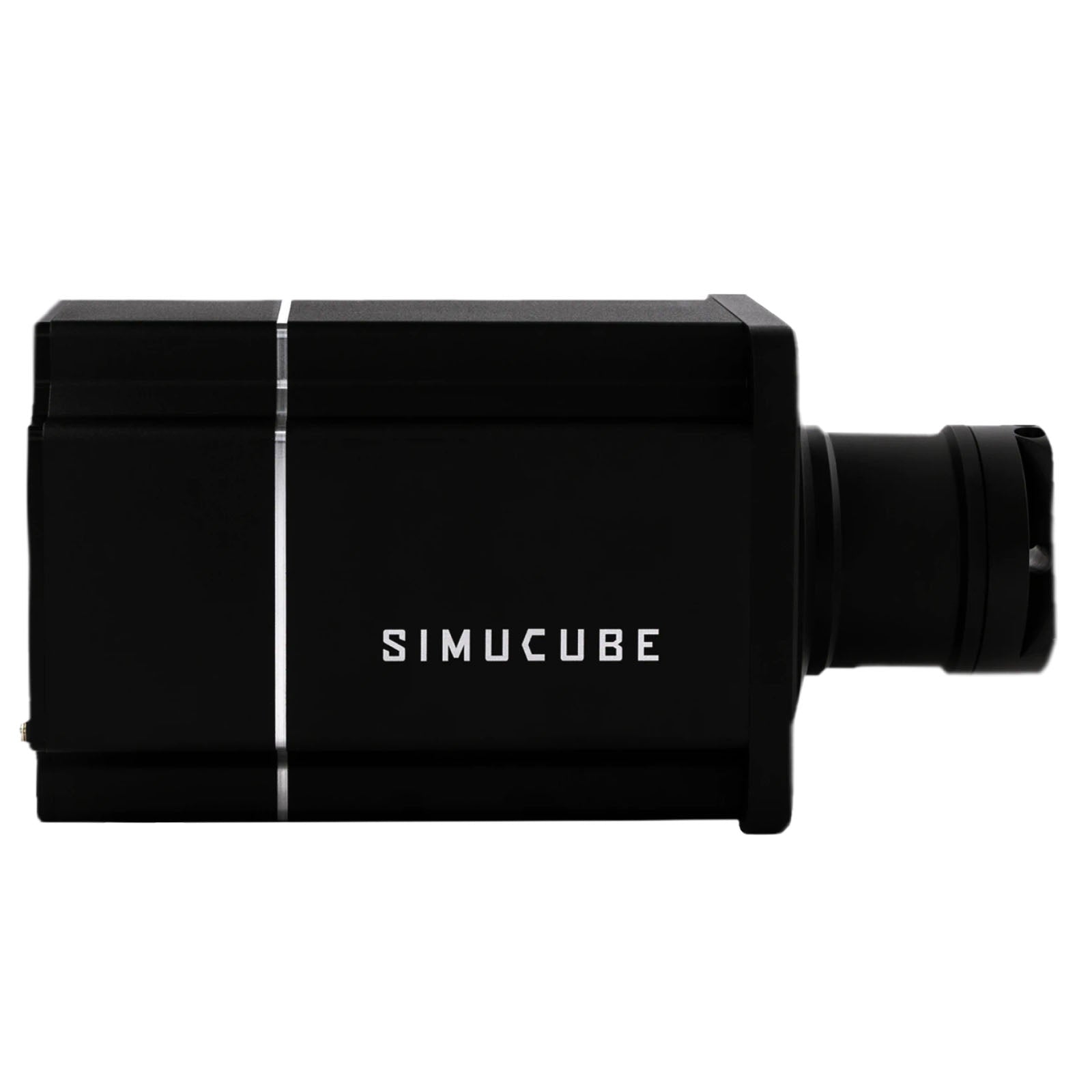
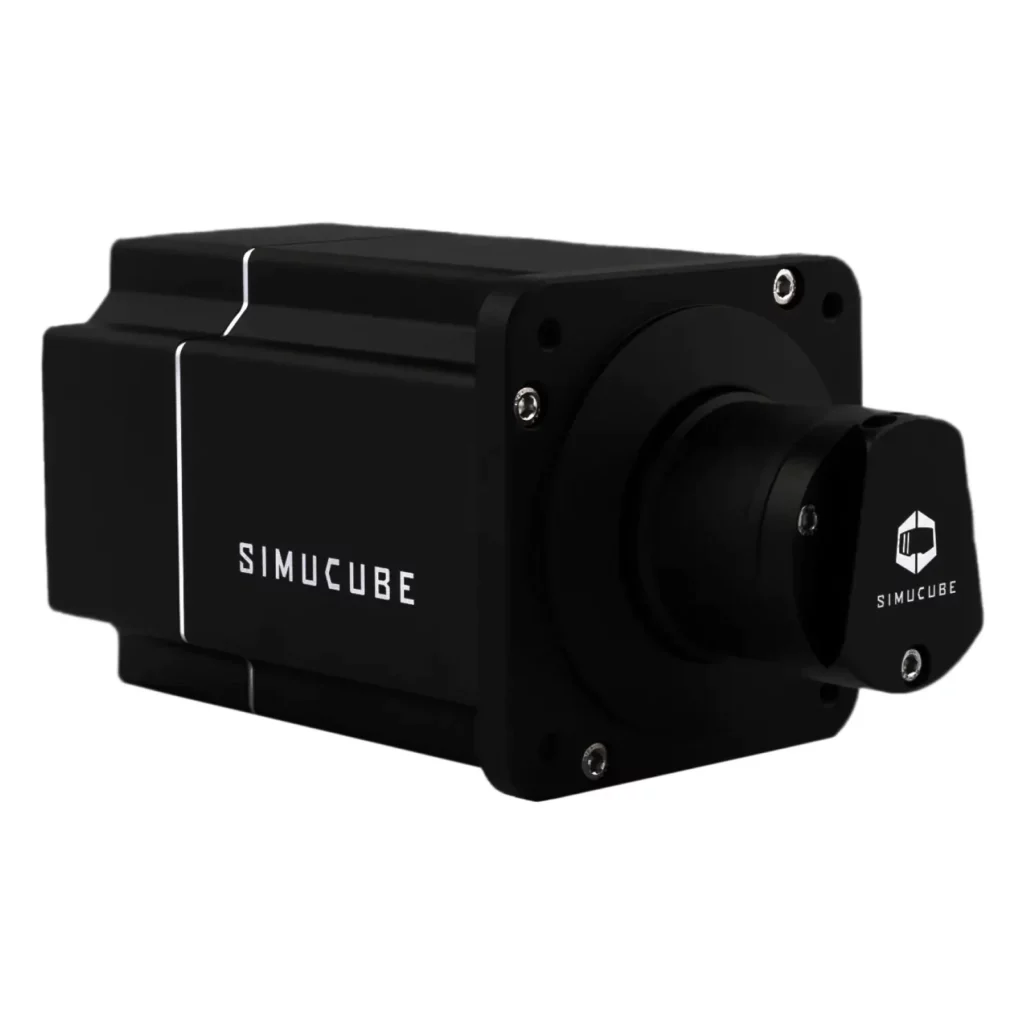
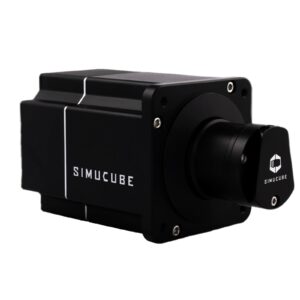
Visually, the Simucube 2 Pro exudes seriousness. The solid, machined aluminum casing immediately gives an impression of density and rigidity. There's no creaking, no parasitic play, the edges are sharp, the assembly is clean, and the coating inspires confidence. You clearly get the impression of handling a block designed for industrial use before the general public, in the best sense of the word.
In hand, when you attach it to the cockpit, the word that comes to mind is "solid". The base doesn't move, even under load, and the overall rigidity is well above that found on belt or gear bases. Torque is transmitted through the column, not the structure. When you tighten the fastening system, you can feel that it's not going to go out of adjustment every morning.
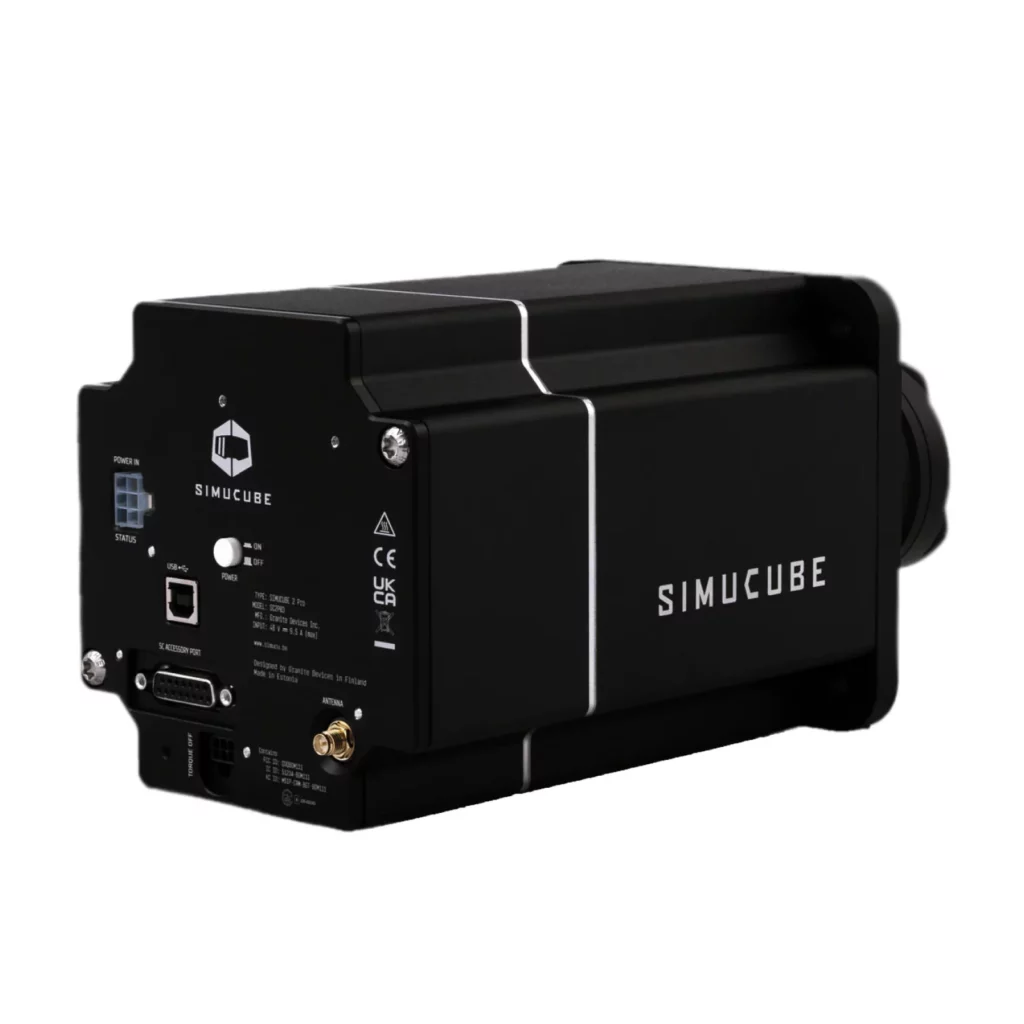
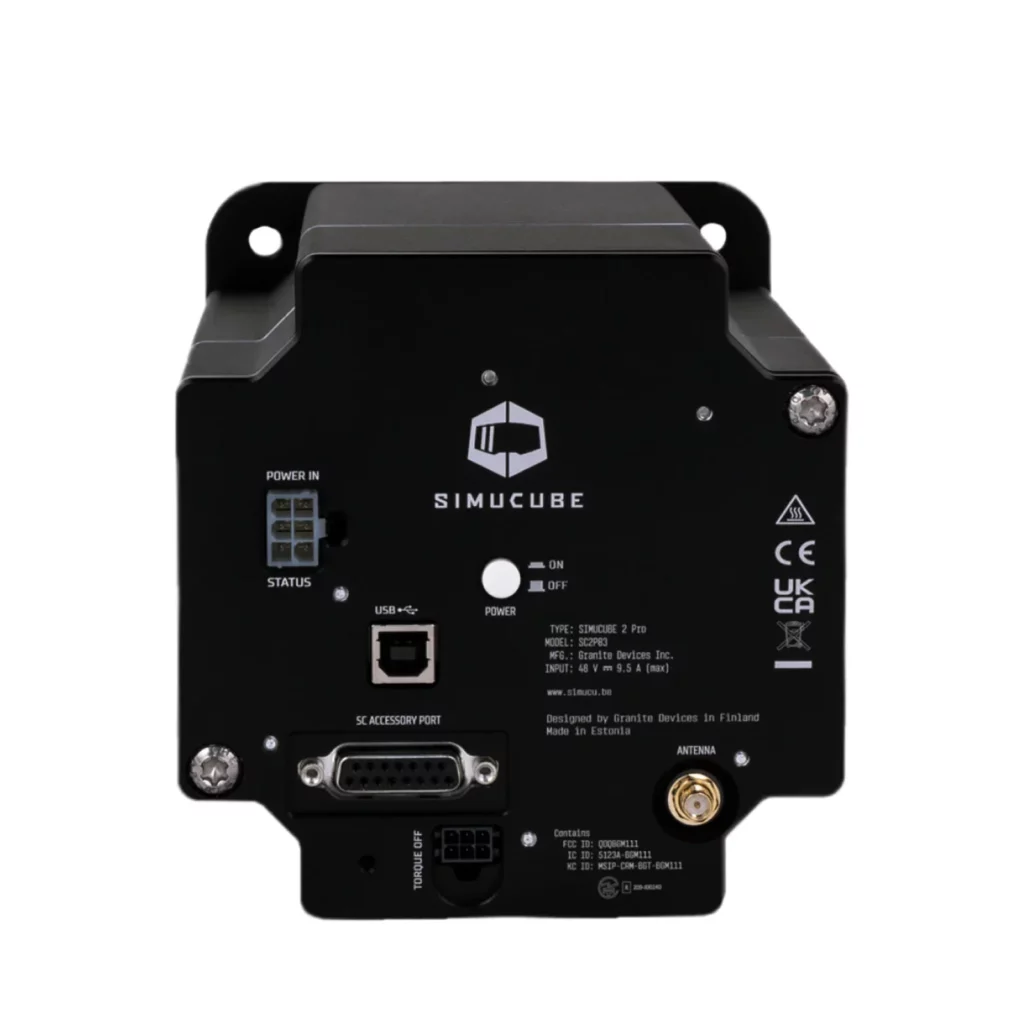
What's immediately surprising is the absence of frills: no screens, no visual overkill. It's ultra-functional. Connectivity is well organized at the rear, with well-spaced ports, and the Simucube quick release is very serious: firm locking, no parasitic rotation, no suspicious rattling even with heavy steering.
Where I'm a little more reserved is on the "raw" side of the design. No quick keys on the base, no mini-display, everything is managed via the PC. For some, this is a plus (zero distractions), for others it lacks a little comfort. Compared with other more recent premium bases, Simucube has put the emphasis on mechanics and a little less on the "integrated user interface" aspect.
Compared to entry-level Direct Drive mid-range bases, we're clearly in a different league in terms of rigidity, finish and perceived stability. It's easy to see that this is a product designed to withstand years of intensive use.
Settings, customization and compatibility
All the logic of the Simucube 2 Pro comes from the Simucube software (True Drive). The interface is clear enough, with presets by game and by use, but it's clearly designed for users who like to get their hands dirty with settings. You can easily load an existing profile, test, refine and save different configurations. For an intermediate sim racer who already knows a minimum of FFB jargon, getting to grips with it is fairly straightforward.
All the important settings are there: rebuild filter, friction, inertia, damping, rotation speed, torque limit, etc. What's most interesting is the level of control over the FFB's "texture". You can really go from a very raw and communicative flywheel to something more filtered and restful, without losing the essential info. Clearly, this takes time, but you can fine-tune it to suit your driving style and game type.
The learning curve depends on your previous experience. If you come from a simpler steering wheel with two or three basic sliders, it will take a little patience to understand the real impact of each parameter. On the other hand, once you've got your profile right, you'll hardly need to touch it. It's typically a base that you adjust once and then let it do its work.
In terms of compatibility, this is a PC-based system. No native console support. For someone who only plays modern simulations on PC, this is not an issue. For a console gamer, on the other hand, let's be clear: this is not the right product.
As for the ecosystem, the Simucube 2 Pro works with many third-party flywheels via adapted hubs or compatible QRs. This is a fairly open approach, which is appreciated for an upgradeable setup. For cranksets, shifters and handbrakes, we're sticking with classic USB connections, so there are no brand constraints.
In terms of longevity, this is more of an "end of the line" base than a simple entry point. You can easily upgrade the steering wheels, pedals or cockpit around it, without feeling that the base is becoming the weak link.
Sensations in play
This is where the Simucube 2 Pro justifies its positioning. The first thing you notice is how clean the force feedback is. The precision of the micro-information is very high, with no artificial parasitic vibrations. You can feel grip variations, load transfers and front-end micro-movements with rare clarity.
Cornering behavior is very predictable. Torque build-up as the steering wheel is loaded is smooth, progressive and jolt-free. When the car starts to slide, you can clearly feel the steering release, but without any sudden "hole". This is a great help in gaining confidence on the limit, especially in GT and single-seater racing. You know where you are in the grip curve, it's not binary at all.
Grip reading is one of our strong points. On a less powerful or belt-driven base, information is often compressed: everything passes through a fuzzier, more elastic feedback. Here, front grip is "detailed". You can feel if the tire is working laterally, if you're starting to saturate, if the rear is loading up. On bumpy circuits or with aggressive vibrators, the difference becomes obvious: the car doesn't just kick, it talks.
The vibrators are very well rendered. It's not just a dry shock: you feel the structure, the frequency, the height. On flat vibrators, there's a controlled purring through the steering wheel. On big sausage curbs, the torque rises sharply but remains controllable: the base doesn't spin out of control, it doesn't bang around uncontrollably. You can ride aggressively without feeling like you're being subjected to the machine.
On long sessions, what stands out is the consistency. Torque remains stable, the temperature doesn't dampen the feeling, and there's no particular drift as you rev. With a well-filtered profile, you can do relay after relay without running out of steam. If you remove too much filtering, on the other hand, you can quickly find yourself with a very physical steering wheel. The base clearly has more potential than most drivers really need.
In rapid corrections, the Simucube 2 Pro's responsiveness is excellent. When the rear stalls, the base immediately returns the information, but without any strange latency or uncontrollable overshoot. You can catch an oversteer, return the car to the centerline and take off again with great confidence. Whereas a less powerful or softer base will tend to "catch up" a little late, or lack punch.
Faced with an even more powerful base, the gain is no longer so much a question of available torque, but rather of managing that torque. The Pro is in a very comfortable zone: powerful enough for everything, but controllable without turning every session into a weight-lifting session. Above all, it's the balance between strength, finesse and mechanical silence that makes it so enjoyable.
Overall, immersion clearly rises a notch. You're not fighting with the hardware, you're talking to the car. You know what it's doing, why it's reacting, and you can adjust the steering wheel to suit its style rather than to compensate for its shortcomings.
Who's it for? What we like / What we don't like
Simucube 2 Pro is aimed primarily at PC sim racers who have already made a minimum investment: intermediate players who want to take their game to the next level, experienced drivers, content creators and serious leagues. For someone just discovering sim racing, it's possible, but clearly oversized and not necessarily the most educational at first. Conversely, for an advanced user who wants a reliable tool, it makes perfect sense.
What I particularly appreciate is the quality of the force feedback, both powerful and remarkably clean. You can feel that the motor and signal processing chain are up to scratch: no mechanical noise, very little lag, precision that really helps you to be more consistent. I also like the extremely serious construction, which gives the impression of a product designed to last a long time, with no play created and no suspicious noise over the months. Finally, the finesse of the available settings means you can really shape the experience to your liking, from the highly filtered and smooth to the raw and ultra-communicative.
There are limits, however. The absence of console compatibility closes the door to all those who play mainly on this type of platform. If you're PC-only, this isn't a problem, but for a hybrid home/office setup, it can be a deal-breaker. Another point: the wealth of settings can become intimidating for less technical profiles. You can spend a lot of time looking for "the right feel", which can be frustrating if you just want to play. Finally, the price clearly places the Simucube 2 Pro in the serious investment category: it's not an impulse buy, and you need to align the rest of the setup (stand, rigid cockpit, quality steering wheel) to get the most out of it.
In terms of perceived value, the product makes sense for someone who envisages sim racing over several years, and prefers to pay more once rather than upgrade three times. For occasional use, the investment will be harder to rationalize.
Verdict
The Simucube 2 Pro changes the nature of the setup by becoming the solid core around which everything else is organized. It provides a powerful, ultra-clean and highly coherent steering base, which highlights the qualities of the rest of the equipment rather than its weaknesses. Once mounted on a rigid cockpit, it feels like a "workshop" steering wheel rather than a simple gaming peripheral.
On the market, it is clearly positioned at the top end of the premium range, as a stable reference between mid-range Direct Drives and even more extreme solutions in terms of price or torque. It's an interesting pivot point for those who want something very serious without going into the "extreme" configurations reserved for a handful of enthusiasts.
I'd recommend it to PC gamers with a real desire to progress, take part in championships and work on their times and consistency. For a console gamer, or someone who occasionally plays with a controller and just wants to try out a steering wheel, it's not the right target at all.
If you're looking for a powerful, ultra-strong, highly precise Direct Drive base that can accompany you for a long time as you evolve, this product can clearly make the difference in your setup.



Reviews