Fanatec Podium Racing Wheel BMW M4 GT3 : Test & Review | What it's really worth in 2025
Fanatec Podium Racing Wheel BMW M4 GT3 : My opinion in brief
This steering wheel brings a real gain in sensations, control and immersion, with a feel very close to a real GT3 cockpit. Above all, it makes sense for sim racers already equipped with Direct Drive Fanatec, who drive GT a lot and want a consistent tool for the long term. The investment remains high, but relevant in an advanced, stable setup.
When you buy through our links, we may earn an affiliate commission.
Fanatec Podium Racing Wheel BMW M4 GT3: test & review of a very special steering wheel
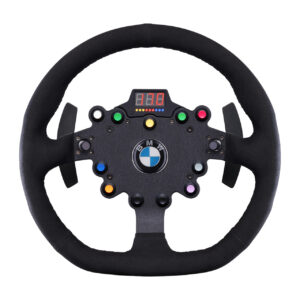
The Fanatec Podium Racing Wheel BMW M4 GT3 occupies a special place in sim racing. Not "just" a high-end steering wheel, it's an official replica designed from the outset with BMW Motorsport, and adapted to Direct Drive. On paper, it promises to bring the sim racer closer to the real car than very few products can.
This steering wheel is attractive for three main reasons: the prestige of the license, the announced quality of the materials, and its integration into the Fanatec Podium ecosystem. It's clearly a premium product, designed for a powerful base, aiming for pure performance as much as immersion.
My angle is simple: does this steering wheel offer a real gain in feel, control and comfort over a "classic" high-end GT? Does it justify its exceptional status in real use, over several simulations and long sessions? And above all, does it remain a coherent choice for a demanding sim racer, but not necessarily a pro?
Design and manufacturing
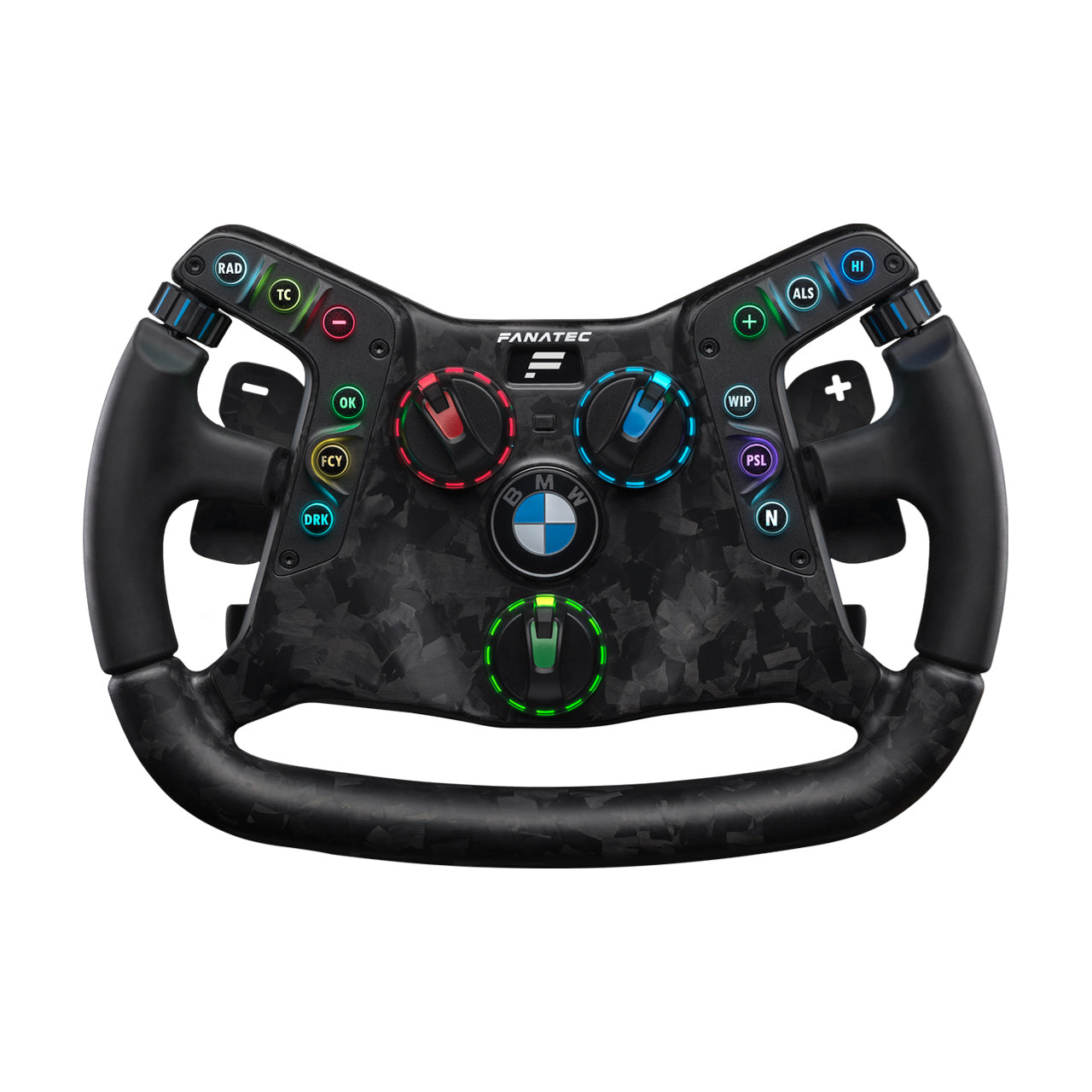
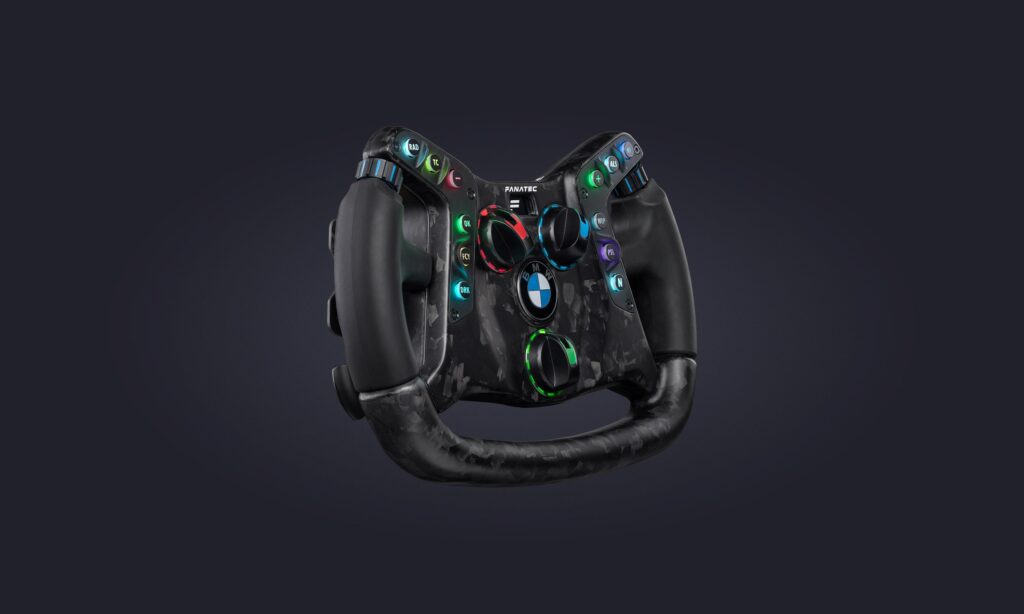
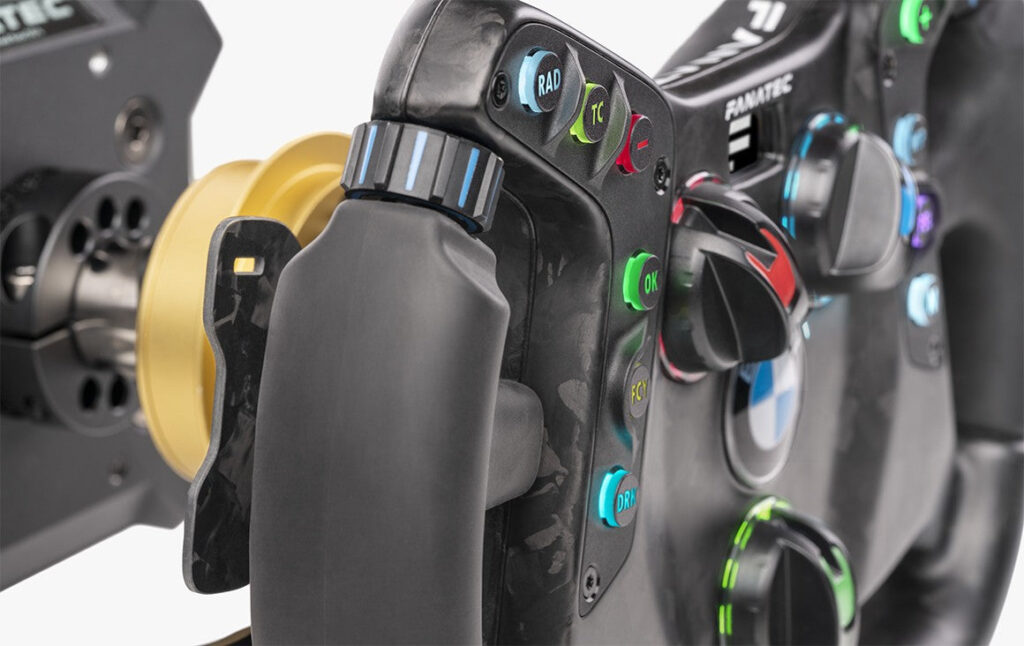
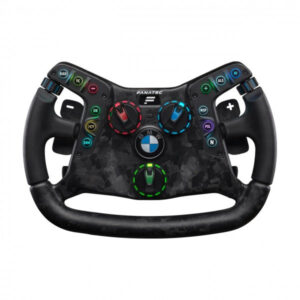
In hand, the Podium Racing Wheel BMW M4 GT3 immediately gives the impression of a very serious product. The diameter, shape and thickness of the rim breathe of a modern racing car. It's clear that the priority is not the aggressive "gaming" look, but ergonomics and consistency with a GT3 cockpit.
The materials used match this positioning. The structure inspires rigidity, with no perceptible flex, even when pressing hard on the paddles or forcing through heavy downforce. The grips, depending on the version chosen, offer a firm, well-balanced grip that doesn't slip even with slightly clammy hands. There's a feeling of density, of a "full" steering wheel, with no hollow or cheap parts.
What's surprising is the overall perceived quality. The assembly is clean, the buttons have a clear click, the paddles fall naturally to the fingertips and the stroke is short and precise. Rotaries and switches immediately inspire confidence. You get the feeling you're handling a real working tool, not a toy.
There are a few drawbacks, however. The weight of the steering wheel is substantial, which may require a little more torque at the base to maintain a lively feel. Some of the plastic elements on the front, though well-made, will seem slightly behind the ultra-premium rest. Compared to more conventional GT steering wheels from the same manufacturer or other high-end brands, you feel you're also paying for the license and the "real" design.
Compared to a standard metal/carbon GT steering wheel, the difference is more in the overall coherence and feel of the real thing than in the sheer sturdiness. This BMW M4 GT3 Podium really gives the impression of being ready to be mounted in a real car.
Settings, customization and compatibility
In terms of settings, the Fanatec DNA remains unchanged: menus integrated into the base, game-specific presets available in the software, and a wide range of parameters for fine-tuning the feel. This steering wheel is not particularly difficult to set up, but it clearly benefits from a well-tuned Direct Drive base.
There are plenty of well-positioned knobs and buttons, allowing you to map virtually everything you need in GT3: ABS, TC, brake bias, fuel mixture, radio, pit limiter, etc. In practice, you quickly find a logical mapping, and the actions fall to hand without thinking. In practice, you quickly find a logical mapping, and the actions fall into place without thinking about them. That's where this type of steering wheel saves time and concentration during the race.
The learning curve remains reasonable. There are indeed a lot of controls, but the ergonomics are fairly intuitive. After a few sessions, the muscle memory kicks in. The Fanatec menus allow you to adjust overall strength, filters, linearity and the sensation of friction or inertia. The really useful settings, for me, are the overall strength, the smoothing filter and the rotation adjustment according to the game. On a powerful base, a little tuning is needed to find the right balance between detail and comfort.
Compatibility-wise, this steering wheel integrates into the Fanatec ecosystem: the brand's Direct Drive chainstays, pedals, shifters, handbrake and rigid cockpit are all recommended for use. For the PC, there are no surprises. On consoles, all you need is a compatible base. We're not talking here about a universal, multi-brand steering wheel, but rather an element of a locked-in ecosystem, which can be seen as either a strength or a limitation.
In terms of scalability, this is clearly not an entry point. This is a product that makes sense in an already advanced setup. It's aimed at those who already have a Direct Drive Fanatec base or are planning to upgrade, with a solid cockpit. We're investing in a GT3 steering wheel that we can stick with for a very long time, even as we develop the rest of the setup around it.
Sensations in play
Where this steering wheel really comes into its own is on the track, in GT and endurance simulations. The first thing that strikes you is the precision of the force feedback. With a well-tuned Direct Drive base, every micro-variation in grip, every transfer of load, comes back to the hands with a sharpness difficult to find on more generic steering wheels.
In bends, control of the chord point becomes more instinctive. The rim's width and diameter provide excellent downforce stability. You can clearly feel when the front begins to shed weight. The transition between grip and the onset of sliding is much clearer, especially on cars with pronounced aerodynamics. You quickly understand what the car is doing.
Grip reading is one of our strong points: small stalls, progressive understeer, rear end starting to lighten on torque output, all appear as natural variations on the steering wheel. On a lighter or more general-purpose steering wheel, this information is often conveyed, but a little more blurred. Here, the combination of shape, materials and rigidity gives a very clean feedback.
Vibrations are well reproduced, without becoming distracting. On flat vibrators, you can feel the fine vibrations, without unnecessary brutality. On the big, aggressive vibrators, the base sends out a heavy load, but the rim retains an impeccable grip, with no flex or crushing of the grips. You can attack the vibrators with confidence, while keeping the steering wheel firmly locked in your hands.
On longer sessions, ergonomics really make the difference. The shape of the grips limits forearm fatigue, and the weight distribution of the steering wheel provides a good compromise between inertia and responsiveness. With gloves, comfort remains very good. Without gloves, the grips offer sufficient grip to avoid constantly over-tightening the steering wheel. You can ride for a long time without feeling like you're "fighting" against the material.
In fast corrections, especially on rear losses or high-speed glides, the steering wheel allows precise, controlled movements. You don't find yourself overcorrecting, and the wheel doesn't "snap" in your hands despite the power of the base. The stroke of the handles, their shape and rigidity, mean that counter-steering can be finely dosed. On belt-driven bases or with less adapted steering wheels, these situations often become blurred, even brutal. Here, everything remains clear.
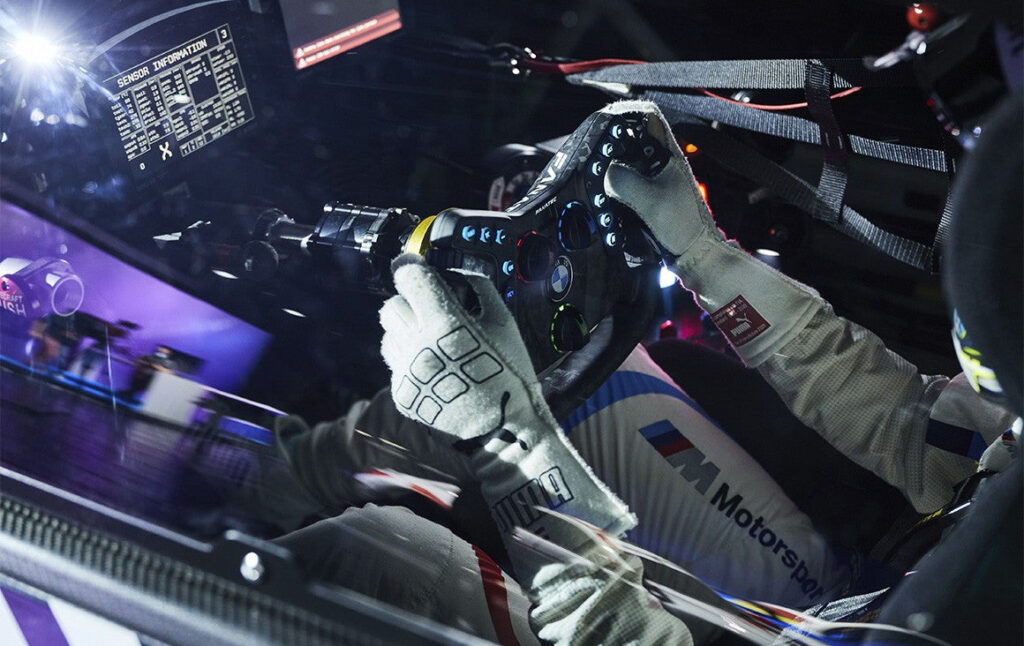
In terms of immersion, the effect is real. Having a replica of a GT3 steering wheel changes the perception of driving, especially if you drive this type of car a lot. The coherence between what's in front of your eyes, in your hands and on the screen gives you the impression of sitting in a real racing car. It's not magic that saves you seconds for free, but it does help you concentrate and get into the rhythm faster.
Compared with a wheel mounted on a less powerful base (entry/mid-range), you gain in finesse and signal continuity. Small track and chassis details come out better, and the rim transmits them without crushing them. Faced with an even more powerful base, the steering wheel follows without flinching and never becomes a weak point. The real limiting factor is the base and cockpit settings, not the rim itself.
All in all, this steering wheel brings a real plus in terms of control, grip and readability of the car's behavior. It's not just an aesthetic change, it's a tool that clearly helps you feel the limit better. This is where the product justifies its positioning.
Who's it for? What we like / What we don't like
This steering wheel is clearly aimed at an advanced profile: intermediate to advanced sim racers, who race mainly GT3 / GT4 / closed protos, with a Fanatec Direct Drive base and rigid cockpit. A highly motivated beginner may be interested if he's planning a high-end setup and wants to avoid buying several successive steering wheels, but it's not the most rational choice for a first set-up.
What I find particularly successful is the overall sense of seriousness. The steering wheel immediately inspires confidence, both in its rigidity and in the quality of its controls. Secondly, the racing ergonomics are really well thought-out: everything is at your fingertips, and you can adjust everything in full stint without looking for the buttons. Finally, immersion is above average. For a GT3 fan, finding the same geometry and layout of controls makes all the difference on a daily basis.
On the other hand, there are limits to keep in mind. The substantial weight requires a solid base to keep the FFB lively and detailed. On a more modest base, you lose some of its potential. The price, inevitably, places it in the "serious investment" category: you have to be willing to pay for the license, the finish and the GT3 niche. And the closed Fanatec ecosystem can also be a brake for those who like to change their base or mix brands. This steering wheel only makes sense if you are already, or intend to remain, in the Fanatec universe.
When it comes to perceived value, everything depends on the context. For an occasional sim racer, the price/use ratio will be hard to justify. For someone who drives a lot in GT, leagues or endurance, and who is looking for both performance and immersion, the investment becomes more logical. We're talking about a product that can remain the main steering wheel for a long time, without the impression of rapid obsolescence. It's a long-term purchase, rather than an impulsive pleasure.
Verdict
The Fanatec Podium Racing Wheel BMW M4 GT3 clearly changes the dimension of a GT-oriented setup. It doesn't transform an average base into a war machine, but it does allow a good Direct Drive base to express itself fully, with a level of precision, comfort and immersion difficult to find on more generalist steering wheels.
On the market, it's positioned as an assertive premium product, halfway between consumer accessory and quasi-professional equipment. It's not an all-purpose steering wheel, but a highly specialized tool, designed for serious GT3 / GT drivers who want to get as close as possible to a real car environment.
I'd recommend it to sim racers already equipped with a Fanatec Direct Drive base, with a rigid cockpit, who drive mostly GT and are looking for a steering wheel that's both high-performance and ultra-immersive. For a more casual player, or someone who often changes platforms and brands, it's not the most logical choice.
If you're looking for an ultra-faithful, solid, immersive GT3 steering wheel, and you're already in the Fanatec ecosystem, this product can clearly make the difference in your setup.

Reviews