
Fanatec Clubsport GT Cockpit : Test & Reviews | What it's really worth in 2026
Fanatec Clubsport GT Cockpit: My quick review
This cockpit brings a real stable block feel that clarifies riding sensations and makes long sessions more comfortable. It makes sense for sim racers already committed, equipped or aiming for a powerful base, who want to get out of the office or entry-level rack for good. The investment makes sense if you ride often and are looking for a lasting position.
When you buy through our links, we may earn an affiliate commission.
Fanatec Clubsport GT Cockpit: my opinion after use
The Fanatec Clubsport GT Cockpit arrives in a segment already crowded with "serious" sim racing chassis, but it's aimed at a very specific niche: a rigid cockpit, designed for powerful Direct Drive bases, that remains relatively compact and visually "cleaner" than a raw profile. It's clearly a mid-range/high-end model, targeting gamers who want to move away from the entry-level desktop or playseat to something stable and upgradeable.
What Fanatec promises here is a cockpit capable of handling a DD-type base, a beefy pedalboard and hours of riding, while remaining relatively simple to integrate into a living space. Not a monster made of industrial profiles, but not a folding toy either. On paper, it's the "serious GT" chassis for those who want to take things to the next level, but don't want to embark on a bespoke project.
My angle of analysis is simple: rigidity, comfort over time, ease of adjustment, and overall consistency in a Fanatec (or mixed) setup. Basically: does this Clubsport GT Cockpit justify its price compared with other aluminum chassis, and does it really change the way you play when you come from a lighter stand or a classic canvas cockpit?
Design and manufacture: serious, modern, with a few compromises
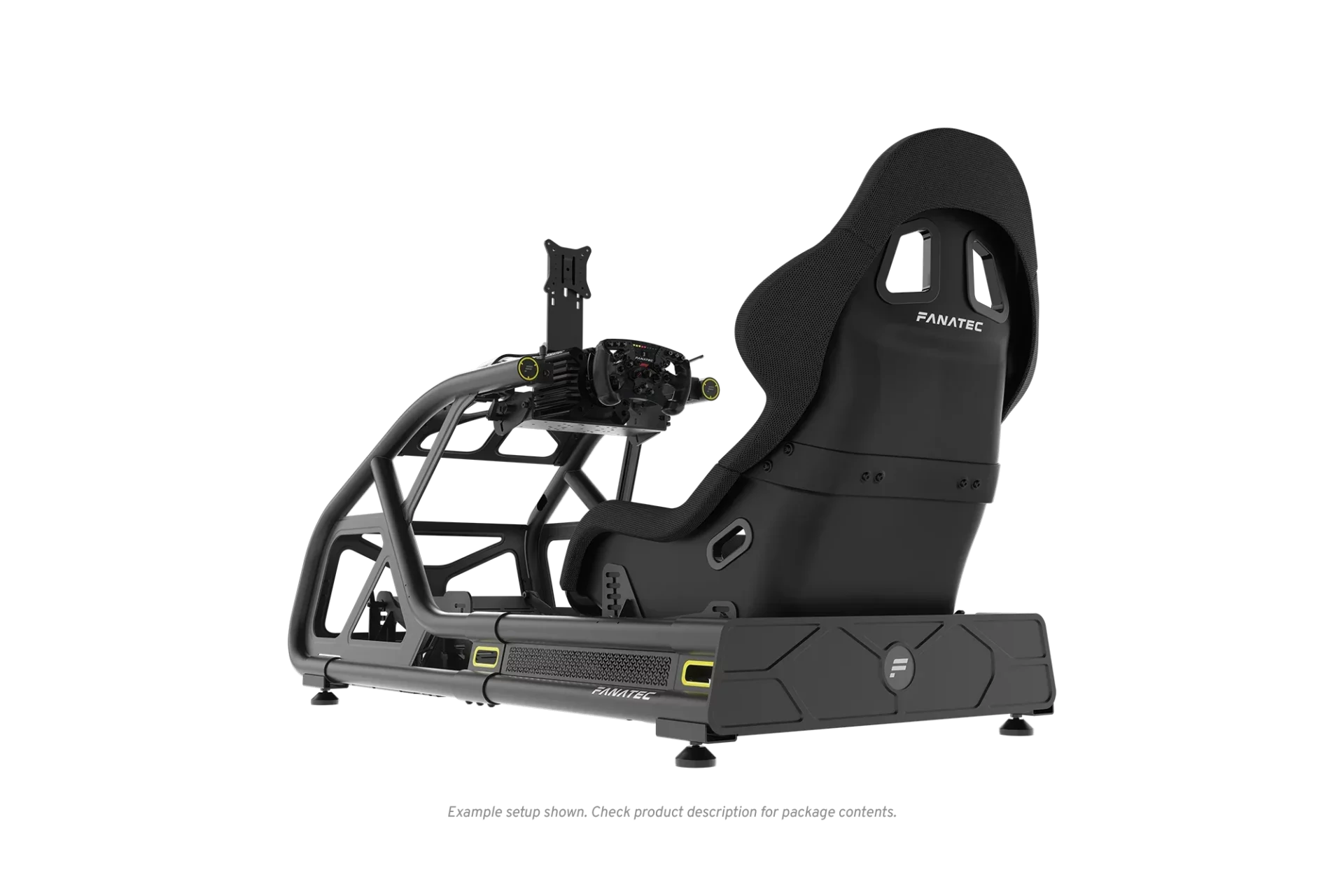
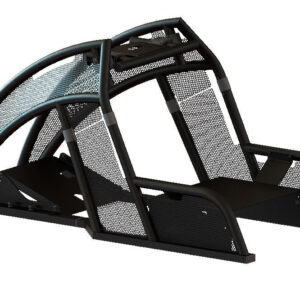
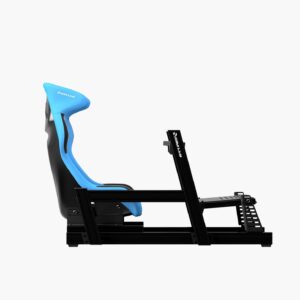
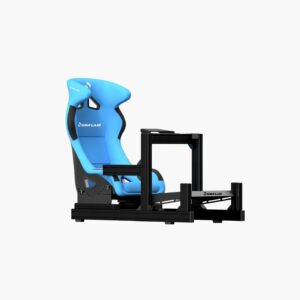
Visually, the Clubsport GT Cockpit has a real identity. It's a far cry from the simple, unfinished profile frame. The side panels, worked metal plates and dark paint give it a premium look. Once assembled, it has that compact "cockpit" feel that fits better in a living room than a big open-frame chassis.
The main structure is based on steel and aluminum, with a combination of plates and sections that give a good impression of density. Handling the components, you get the feeling that this is no lightweight tubing: there's weight, the parts don't sound hollow, and the fasteners are well thought-out overall. Once everything is seriously tightened, the chassis exudes rigidity.
What quickly struck me was the solidity of the flywheel chainring and bottom bracket. With a sturdy Direct Drive base, the cockpit doesn't vibrate, the column doesn't pump with every turn of the wheel, and the bottom bracket doesn't tip over as soon as you step on the brake. It feels like a compact block, which is exactly what we're looking for at this level of the range.
The overall finish is clean, but not "absolute luxury". The paintwork is decent, the cut-outs are clean, but some of the inner edges are a little sharp, and some of the plastic covers and caps look a little less high-end than the rest. Nothing dramatic, but when you look at the overall price of a Clubsport setup, you'd think Fanatec could have gone a little further on the little aesthetic details.
Compared to full aluminum section cockpits, the feel is more "finished product" than "industrial kit", which will please many. On the other hand, a good, well-assembled profile chassis may appear slightly more modular, and sometimes even stiffer on certain extreme axes. The Clubsport GT aims for balance: serious, clean, and less "rail factory" in a living room.
Settings, customization and compatibility
The Clubsport GT Cockpit offers a good range of adjustments, but it's not the ultimate tool for the tinkerer who changes his position every other day. You can adjust the distance between the steering wheel and pedals, the height and angle of the steering wheel plate, the inclination and position of the pedals, as well as the position of the seat on its slides and supports. This more than covers the needs of most morphologies for a comfortable GT position.
Mounting points are generous on the flywheel plate: the Fanatec ecosystem is obviously covered, but so are the standard center distances of other bases. Ditto for the pedalboard: the main models on the market can be attached, even if the platform is naturally optimized for Fanatec pedalboards. Compatibility isn't an issue in itself: PC or console, as long as your hardware fits rigidly, the cockpit does the rest.
The learning curve is particularly steep during assembly. You have to be willing to spend time assembling, aligning, tightening, testing and then readjusting the position. It's not complicated, but it requires patience and a minimum of method. Once you've found the right position, you don't touch it much more, and that's where this cockpit really comes into its own: you assemble it, adjust it once, and you're on your way.
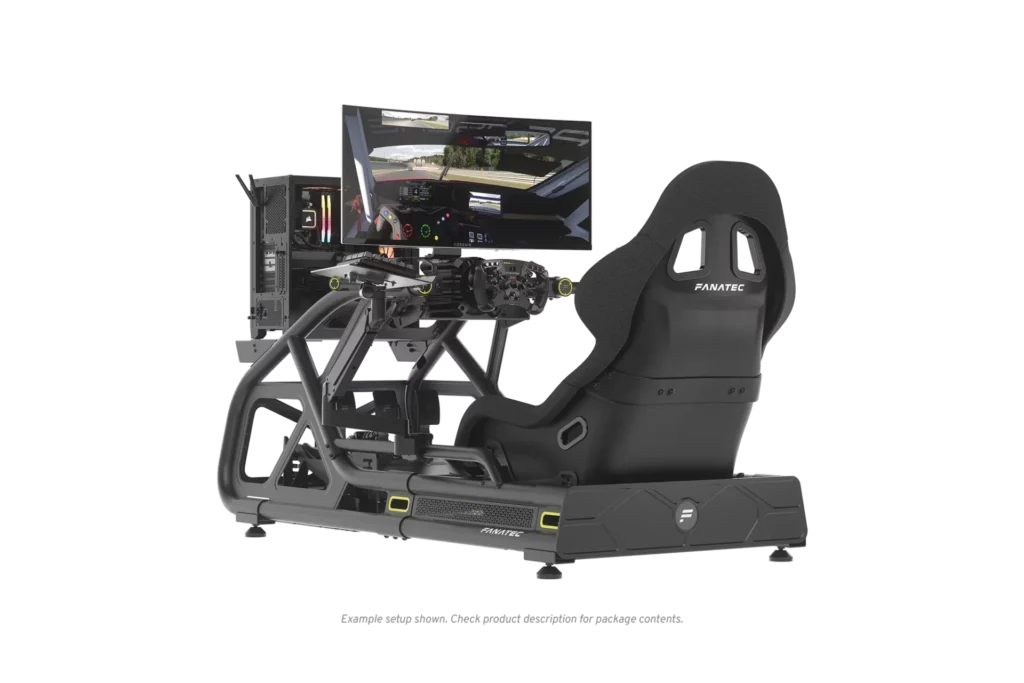
In terms of customization, you can add brackets for shifter, handbrake, screen(s), PC, etc., via the Fanatec ecosystem or third-party accessories, thanks to the holes and mounting surfaces available. You get the impression that this is a durable base on which to build a complete riding position, not a simple steering wheel/pedal bracket.
Sensations in play: stiffness that changes everything
Where the Clubsport GT Cockpit really comes into its own is on the track. When you come from a conventional desk, a folding playseat or a fairly light stand, the first sensation is simple: everything becomes sharper. The Direct Drive base, or even a mid-range belt base, expresses itself without being filtered by chassis flex.
On the force feedback, the difference is felt above all in the precision around the center and in the phases where the car moves a lot: compressions, aggressive vibrators, quick corrections. The steering wheel doesn't "float", the chainring doesn't twist. You immediately understand what the car is doing, even when the FFB is loaded.
In fast corners, the cockpit absorbs the load transfers felt in the steering wheel. You can hold the steering wheel with strong downforce without feeling the chassis pump or wobble. On more powerful underpinnings, this point is crucial: if the structure bends, you immediately lose confidence and precision. With the Clubsport GT, the reference points remain stable. You can really concentrate on the track.
When it comes to reading grip, it's not the cockpit that creates the sensations, but the absence of play and parasitic vibrations means you can take better advantage of force feedback and pedal feedback. Compared with a steering-wheel support on a desk, we gain a great deal of finesse: the micro-loss of grip, the rear end starting to move, wheel lock-ups become much clearer.
The vibrators are a good test: on circuits with well-marked edges, the cockpit remains compact, with no audible creaking or twisting as soon as you ride a little aggressively. You can feel the impact in the steering wheel, and if you've got a high-performance crankset, you'll also get that dry feedback in the foot. It hits, but the structure doesn't flinch. You can feel that the chassis can take it.
Over long sessions, what stands out is postural comfort. The GT position is natural, especially with a good bucket or semi-bucket seat. You don't tire as much because you're not trying to compensate for parasite cockpit movements or a crankset that moves backwards. Hard braking becomes more repeatable: you know exactly where the pedal is, session after session.
In fast corrections, especially in rallying, drifting or on nervous cars, cockpit stability plays a major role. The steering wheel does exactly what it's told, the seat doesn't wobble, and the feet stay put. The steering wheel does exactly what it's told, the seat doesn't wobble, and the feet stay put. This is where the chassis really changes the experience.
Compared with a lighter cockpit or an "entry-level" flying stand, you feel as if you've removed a physical filter between you and the car. Compared to a large, full-profile, high-end chassis, the Clubsport GT holds its own very well. Some extreme aluminum profiles will remain tankier over the very, very long term, but in pure sensations, the Clubsport GT offers an excellent balance between rigidity, comfort and integration into a realistic play area.
Who's it for? What we like / What we don't like
The Fanatec Clubsport GT Cockpit is clearly aimed at committed sim racers: intermediate to advanced players who ride regularly and who already have or are planning a rather muscular base, such as a Direct Drive or high load cell crankset. For motivated beginners who know they'll be investing in the long term, it can also be a very good starting point, but you'll need to accept a more substantial budget from the outset.
What I particularly like is the rigidity/compactness combo. The cockpit can handle heavy setups without flinching, while remaining visually more discreet than a huge streamlined chassis. The single-block feel when you're riding is really pleasant: you feel like you're in a real cockpit, not a rickety compromise. Consistency with the Fanatec ecosystem is also a real plus: everything attaches neatly, positions are natural, and there's no sense of tinkering.
Another positive point is the cockpit's ability to evolve: you can start with a simple steering wheel + pedals combo, then add a shifter, a handbrake, a screen support, and so on. You build up your cockpit over time. The basic structure is solid enough to keep up with these evolutions without having to change everything.
On the downside, the price, once you add up the cockpit and accessories, clearly makes it an investment. You don't buy a chassis "just to try sim racing". You already have to be convinced by the discipline. Assembly also requires time and rigor: if you botch assembly or leave screws half-tightened, you lose some of the benefits of rigidity, and risk judging the product on a distorted experience.
Finally, modularity doesn't reach the level of a big cockpit made of industrial profiles. If you like ultra-exotic configurations (extreme F1 position, millimetric adjustments everywhere), you'll find more freedom elsewhere. The Clubsport GT is designed to be a very good all-round GT chassis, not an experimental platform.
In terms of perceived value, this is a real medium- to long-term investment. For someone who rides often and wants to stabilize his setup for good, the cost is justified. For the occasional player or those on a limited budget, it will be difficult to make a return on investment compared with simpler solutions.
Verdict: a real pivot to "serious sim rig".
The Fanatec Clubsport GT Cockpit changes one thing above all else in a setup: it finally freezes the base, pedals and seat into a coherent, rigid whole. You don't have to fight with a desk that moves, a stand that slips or a seat that wanders. You gain in stability, precision and repeatability. It doesn't make you more talented, but it does allow you to make the most of the equipment you already own.
On the market, it's clearly positioned in the mid/high-end segment, opposite sturdy metal and profile cockpits. It's not low-cost, and it's not a product for "testing" sim racing. It's a chassis for someone who already knows they want a serious, clean cockpit that will last for years.
I'd recommend it to sim racers who already have a good steering wheel (ideally Direct Drive) and a decent pedalboard, and who are beginning to feel the limits of their desktop or lightweight chassis. For those who ride occasionally, lack space or want to keep a very versatile desktop/game setup, it won't be the best choice.
If you're looking for a rigid, clean cockpit, designed for a true modern sim racing setup without going for an industrial monster, this product can clearly make the difference in your setup.</final




Reviews