MOZA HBP Handbrake : Test & Review | What it's really worth in 2026
MOZA HBP Handbrake: My quick review
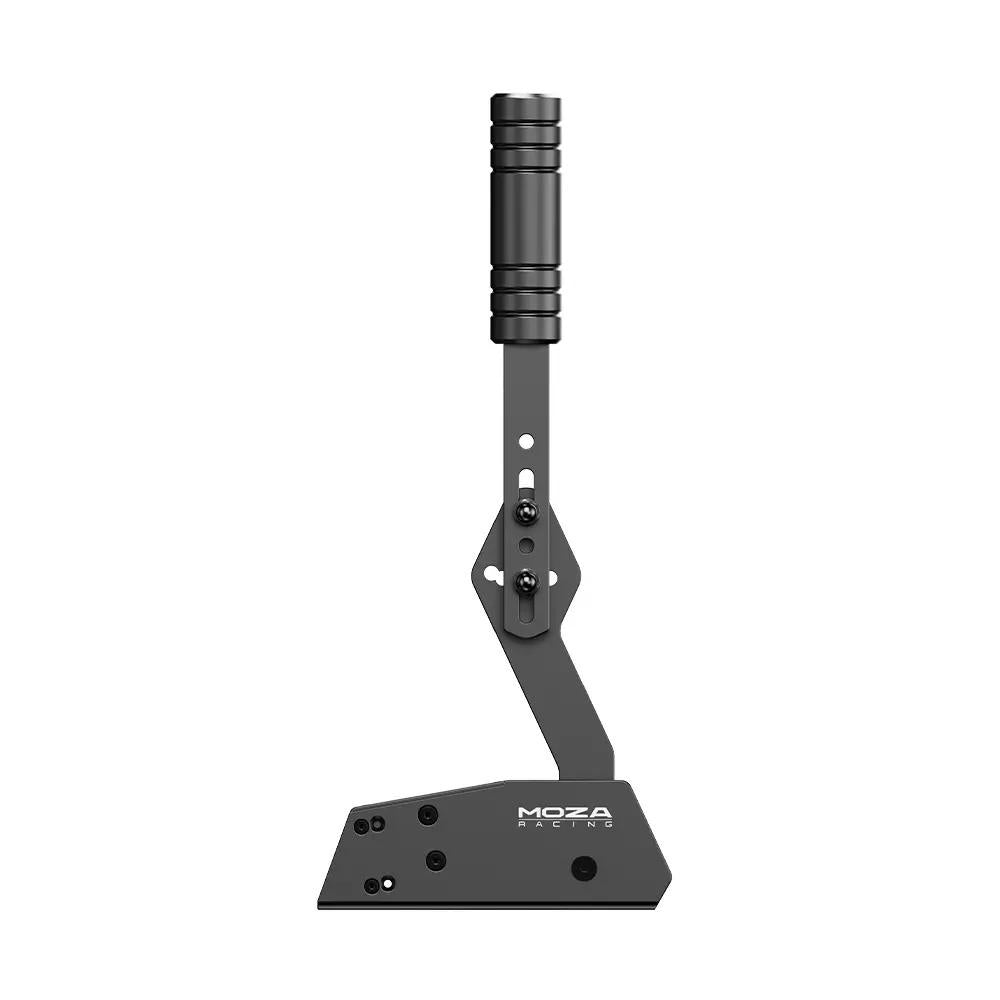
The HBP is MOZA’s all-aluminum handbrake, designed for rally, rallycross, and drifting. It uses a contactless position sensor instead of a load cell, and its travel can be adjusted using springs, elastomers, and the Pit House software. We put it to the test to evaluate its mechanism, feel, and versatility. Verdict: one of the best values in its category—provided you’re using a PC.
When you buy through our links, we may earn an affiliate commission.
What We Liked
- Made entirely of CNC-machined aluminum, with a high-quality anodized finish
- Very smooth mechanism, with no side play, featuring a cushioned, silent stop
- 16-bit non-contact position sensor, wear-free and maintenance-free
- Advanced adjustment via springs, progressive elastomer, and lever length
- Response Curves and Axis or Button Modes in Pit House
- Horizontal or vertical installation
- Standalone USB connection to a PC, or connection to a MOZA base station
- One of the best values in its class
Reserves
- T-nuts for aluminum profiles not included
- Mechanical adjustment of stroke and resistance is a bit tedious (many screws)
- PC-oriented device; no console compatibility announced
- Operates based on the lever's position, not on force (not a load cell)
Technical Specifications
| Type | handbrake for sim racing (rally, rallycross, drift) |
| Sensor | 16-bit non-contact angle sensor (65,536 points) |
| Material | CNC-machined aluminum, black anodized finish |
| Assembly | horizontal or vertical, adjustable angle |
| Resistance | yellow spring (light linear), blue spring (firmer linear), black elastomer (progressive) |
| Settings | lever length (short/long), stroke between two stop positions |
| Modes | (analog) stick or button |
| Software | MOZA Pit House (output curves, calibration) |
| Connectivity | USB (PC) and RJ-type port to MOZA base |
| Compatibility | PC (no console compatibility announced) |
| Dimensions | 153 x 68.3 x 365.5 mm |
| Weight | 0.7 kg |
| Included | base, lever, replacement spring, elastomer, toolkit |
A parking brake that competes with the big players without costing a fortune
At MOZA, we’re used to gear that hits the mark, and the HBP Handbrake is no exception. It’s a handbrake designed entirely for disciplines where we love to make the rear of the car slide out: rally, rallycross, and drifting. The moment you take it out of the box, the tone is set. The unit is made almost entirely of CNC-machined aluminum, with a thick, black anodized finish that feels substantial to the touch; only the housing that contains the electronics is made of plastic. You’re holding a solid, serious piece of equipment that makes no compromises on materials, even though it ranks among the most affordable options on the market. It’s precisely this wide gap between price and perceived quality that makes the HBP so appealing.
Position Sensor vs. Load Cell: What You Need to Know
The first point to clarify, because it completely changes how it feels. The HBP doesn’t use a load cell like a high-end pedal brake would. Instead, it uses a 16-bit contactless angle sensor—with 65,536 resolution points—that reads the lever’s position rather than the force applied to it. In practical terms, the game reacts to the lever’s travel, not to the pressure applied. The contactless design has a real advantage: no mechanical wear on the sensor over time, so no maintenance or loss of precision to worry about. For a handbrake, this choice makes sense, since in rally or drifting, the priority is a quick, repeatable motion rather than precise, millimeter-level pressure control.
The mechanism in action: smooth operation, crisp stop, and zero play
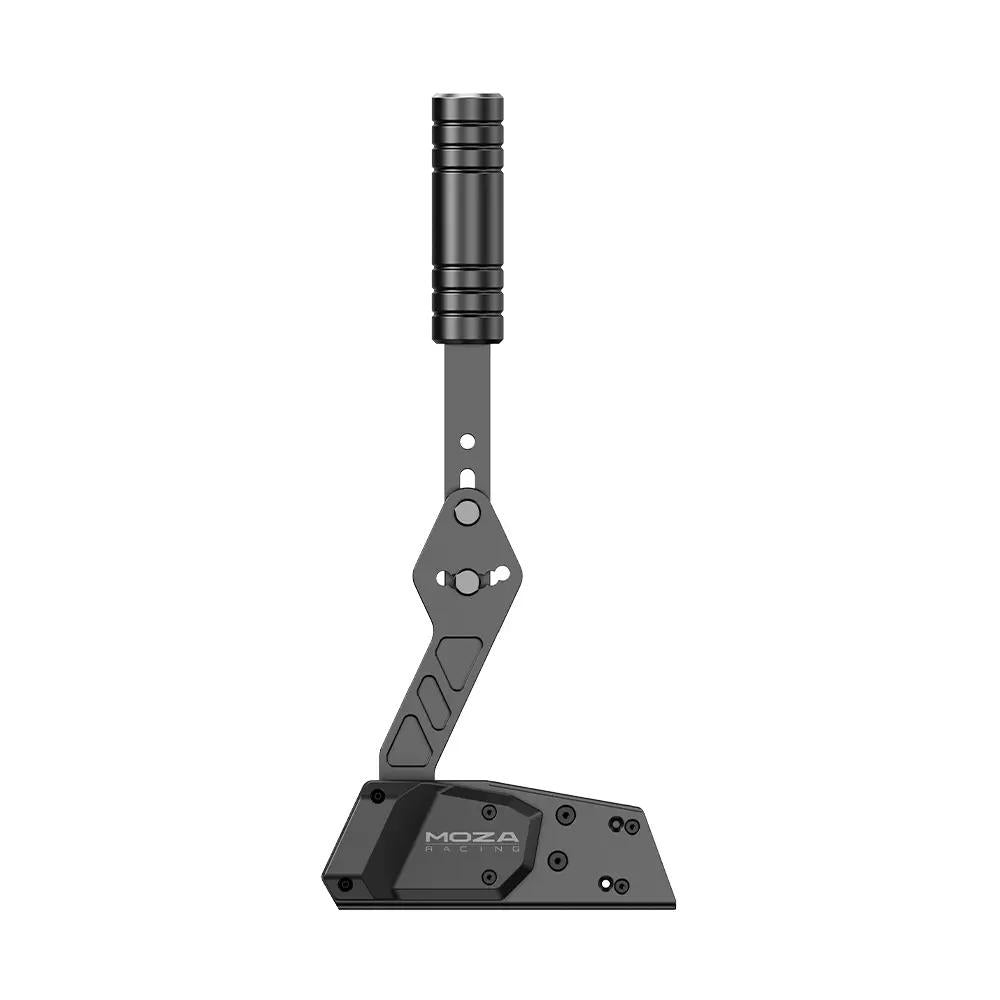
That’s where the HBP surprised us the most. The lever’s movement is remarkably smooth, with absolutely no side play, and you can feel that lack of wobble immediately when you fire off a series of shots. You position it on a rally hairpin turn, pull sharply to initiate the rotation, and the travel remains crisp from start to finish. At the end of the travel, a rubberized stop absorbs the impact and dampens the noise: the motion ends with a soft, silent contact, without the unpleasant metallic clack found on more basic models. When released, the lever returns to its original position with well-balanced damping, never abruptly. During long drifting sessions, where you repeatedly engage the handbrake dozens of times per lap, this combination of smooth travel and cushioned return prevents wrist fatigue and ensures that every pull feels exactly like the last. It’s the kind of mechanical detail you don’t notice on a spec sheet but that makes all the difference when you’re holding the controller.
Springs, elastomer, and lever length: you can adjust it to fit your hand
MOZA ships the HBP with everything you need to customize it to your style. For resistance, you can adjust the spring and an elastomer: the yellow spring installed at the factory provides linear, relatively light resistance; the included blue spring takes it up a notch while remaining linear; and the black elastomer offers a progressive response that increases in stiffness as you press the lever down. This last option is what truly sets the HBP apart from its direct competitors: the progressive response provides a very pleasant, natural feel for controlling the slide. You can also adjust the lever length (short or long position) and the effective travel via two stop positions. One honest caveat regarding the adjustment: you have to loosen quite a few screws to change the travel or resistance, which isn’t a thirty-second job. Once you’ve found the right setting, you won’t need to adjust it again anyway, but the initial setup does require a bit of patience.
Horizontal or vertical installation: Don't forget your T-nuts
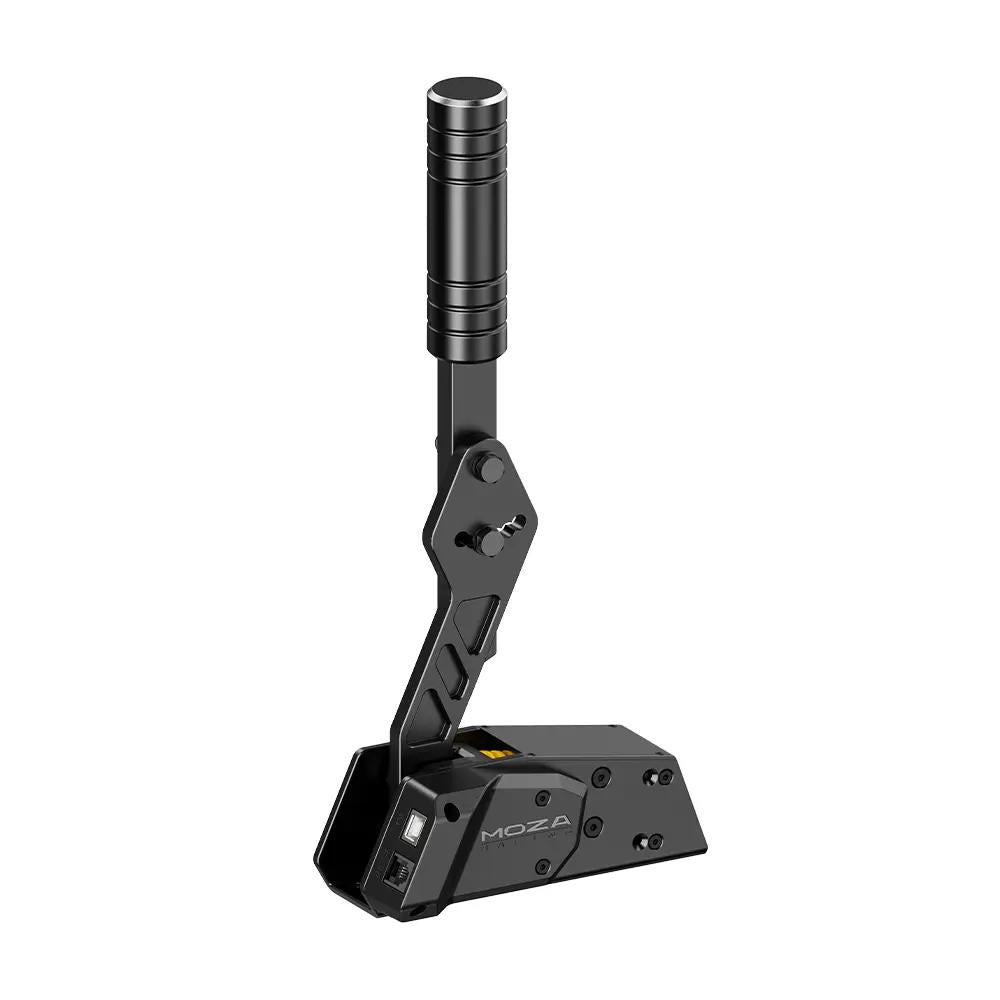
The HBP can be mounted in two orientations—horizontal or vertical—allowing it to replicate both a road car's handbrake and a configuration more typical of a race car. The body features generously spaced mounting holes to fit most cockpits, and the angle is adjustable so it sits comfortably within easy reach. One thing to watch out for during installation: the box does not include the T-nuts needed to screw the unit onto an aluminum rail. If your rig uses aluminum rails, be sure to purchase the compatible hardware separately, or you’ll be stuck on installation day. The hardware for a standard bottom-mount installation is included, as is a small toolkit.
Pit House and Connectivity: A Device Designed for the PC
On the software side, the HBP is controlled via Pit House, MOZA’s in-house app. There, you can adjust the output curve across the entire lever travel, choosing between a linear response or more pronounced curves—which are very useful for drifting, where you want an aggressive build-up of braking force. You can also choose the operating mode: in axis mode, the handbrake is continuously monitored for full control over braking force; in button mode, it functions as a simple on/off switch. Calibration is simple and well-documented. In terms of connectivity, the HBP is a true standalone USB device that plugs directly into the PC without a hub or dongle, and it also features an RJ-type port for connecting to a MOZA base if you’re already part of the brand’s ecosystem. Important note: this is a PC-oriented accessory. We haven’t seen any announcements regarding console compatibility (neither Xbox nor PlayStation), so if you play on a console, you’ll want to look elsewhere or check with MOZA beforehand. One final detail we noticed during use: the RJ cable is used to connect the handbrake to the base and doesn’t necessarily allow you to daisy-chain it with other accessories, so it’s best to rely on the direct USB connection.
Who is it for, and how highly do we recommend it?
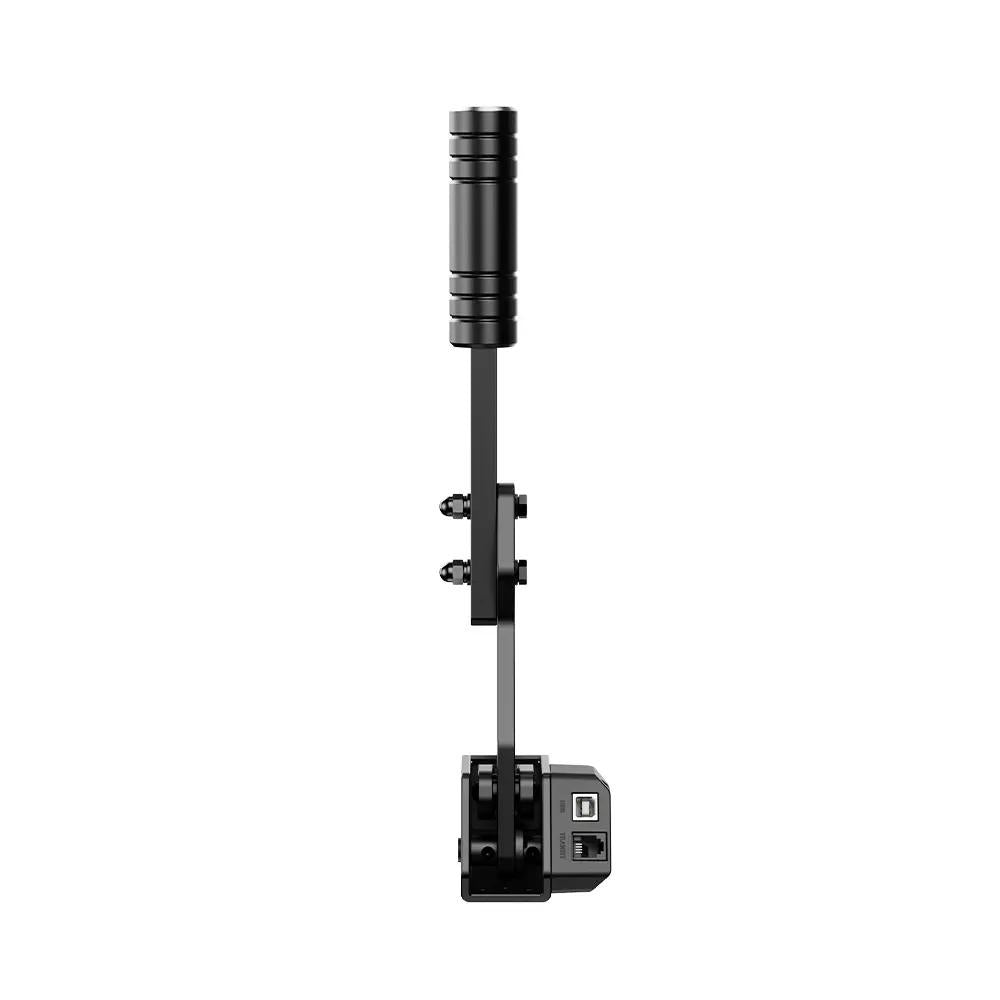
The HBP is primarily aimed at rally, rallycross, and drift enthusiasts who want a sturdy and precise parking brake without breaking the bank. Its all-aluminum construction, smooth mechanism, and cushioned stop make it feel far superior to its price point. The progressive elastomer option and the flexibility of adjustment via Pit House make it a versatile tool that adapts just as well to the sharp, abrupt movements of rally driving as it does to the finer control required for a controlled drift. Its few limitations—no T-nuts, slightly cumbersome mechanical adjustment, and PC-only compatibility—are minor compared to what it offers. Whether as your first real handbrake or to complete a MOZA cockpit, it’s a sure bet.


Reviews