
MME Motorsport handbrake : Test & Review | What it's really worth in 2026
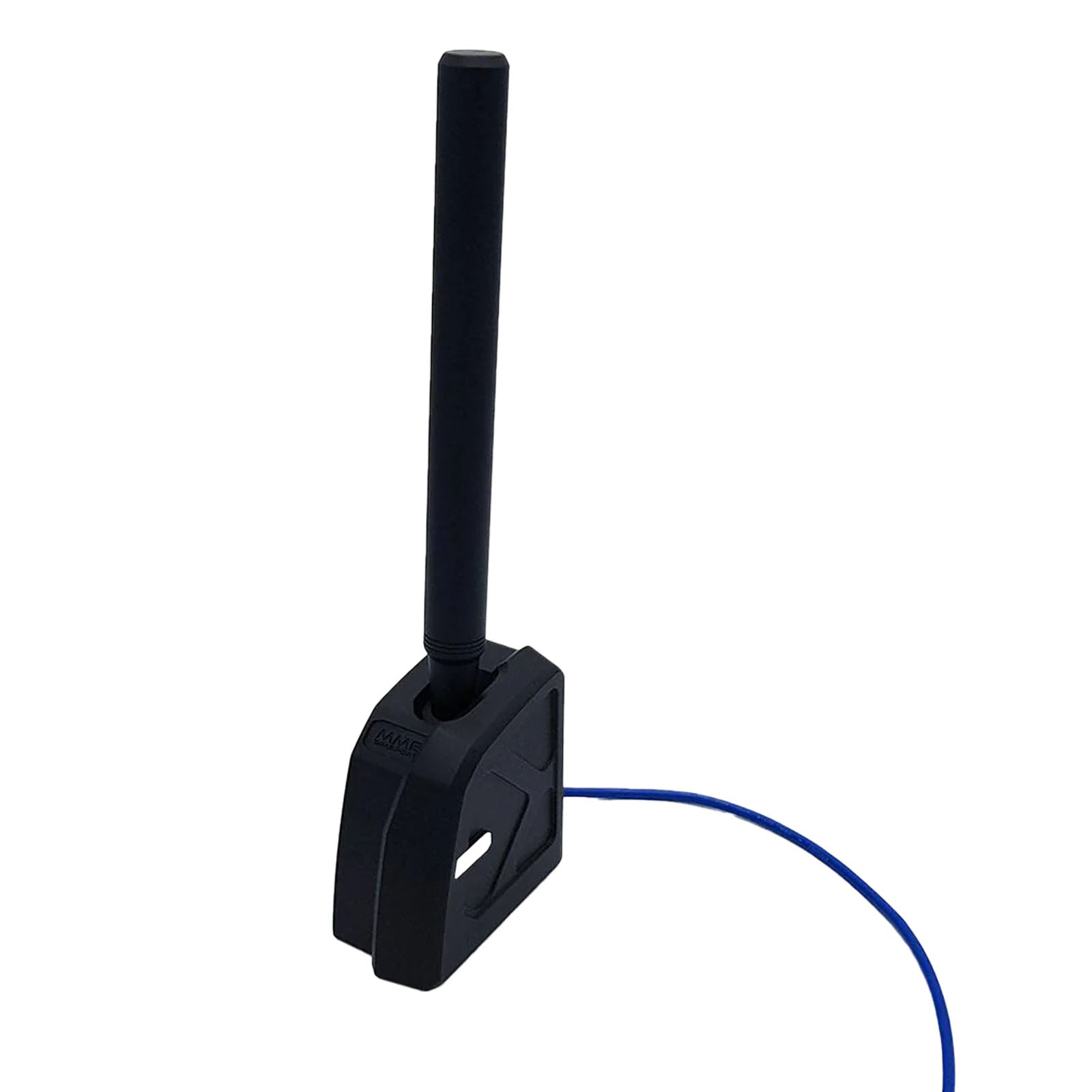
MME Motorsport handbrake: My brief review
The MME Motorsport handbrake is a high-end unit machined from 7075 aluminum, designed for rally, rallycross, and drifting. Its progressive travel and Hall-effect sensor provide intuitive control and a clean analog signal. We particularly appreciate its total rigidity and consistency, session after session. It’s a PC peripheral aimed at intermediate to advanced drivers.
When you buy through our links, we may earn an affiliate commission.
What We Liked
- CNC-machined from 7075 aluminum, no play, and a lifetime warranty
- Progressive stroke with highly intuitive adjustment
- Consistent performance, session after session
- Clean, adjustable analog signal in the simulator
- Built-in USB cable, right- or left-side mounting
Reserves
- A Hall-effect sensor thinner than a load cell—for purists
- PC-only; not compatible with consoles
- Premium pricing strategy
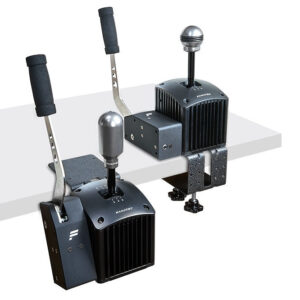
- Tandem mount for optional combo shifter
Technical Specifications
| Material | anodized 7075 aerospace-grade aluminum |
| Sensor | Hall effect (position) |
| Lever | 24 mm |
| Race | adjustable via calibration |
| Connectivity | 1.5-meter built-in USB cable |
| Assembly | 8-screw base plate, right or left |
| Compatibility | PC |
| Warranty | for life |
A parking brake designed for drifting and rallying
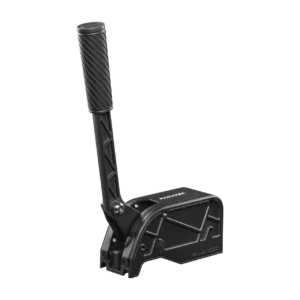
When tackling a WRC special stage or stringing together drift transfers, the parking brake becomes a control element in its own right. The MME Motorsport model is clearly designed to meet this demand. This is a heavy, rigid unit with no compromises in its construction, designed by a shop with a background in true automotive mechanics. From the moment you grip it, the 24-mm lever exudes seriousness and makes you want to pull hard.
Uncompromising CNC Manufacturing
Everything is machined from 7075 aerospace-grade aluminum, with a hard-anodized blue finish on all parts. On our test bench, there is no unwanted play: the only movement present is the intended mechanical travel; nothing wobbles, nothing squeaks. Once the lever is properly secured, it doesn’t budge a millimeter. MME backs the entire product with a lifetime warranty and fully replaceable parts, which speaks volumes about the confidence they have in their in-house assembly.
A Hall-effect sensor with a clean readout
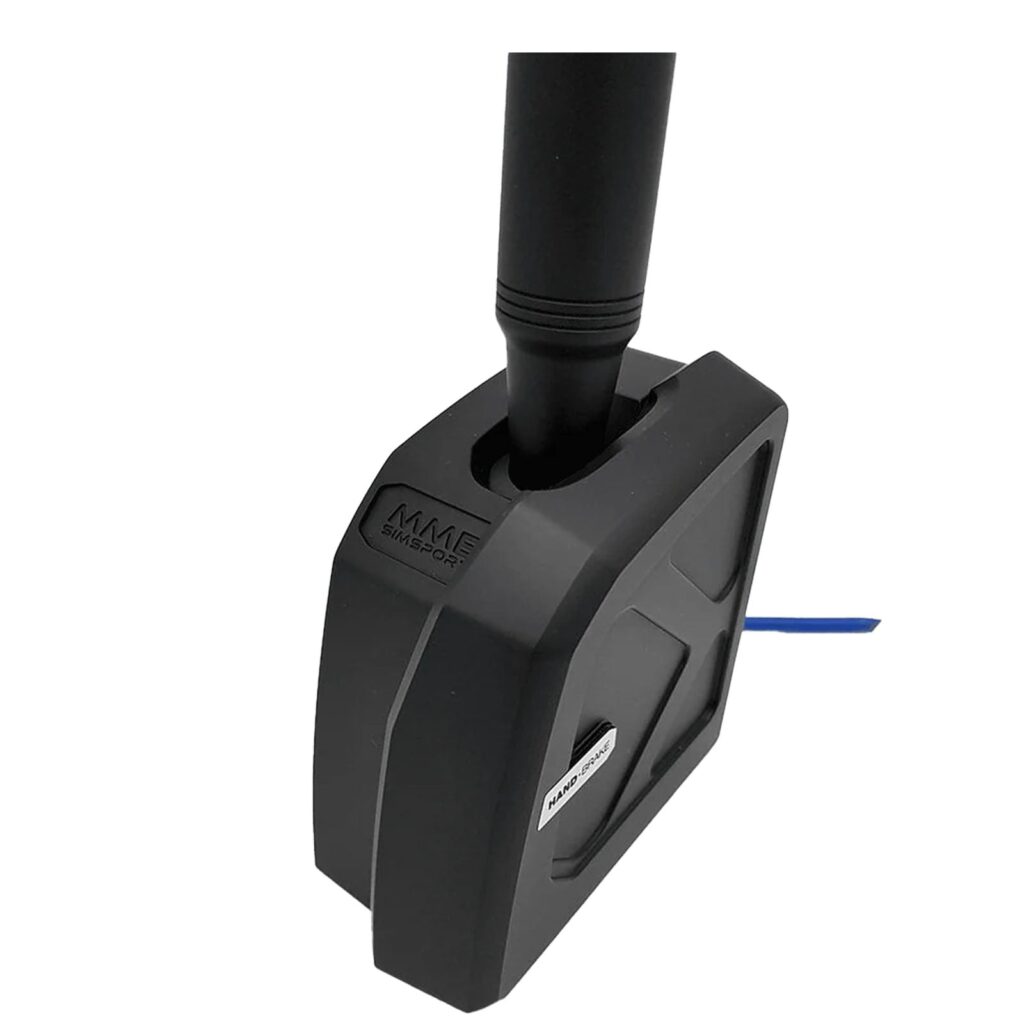
Instead of a load cell, MME opted for a Hall-effect sensor: a magnet housed within the lever’s axis, with the magnetic field read by the printed circuit board. In practice, the analog signal is clear, with no hidden dead zones, and you get a usable curve that can be fine-tuned in the simulator’s menus (saturation, sensitivity, trigger point). Purists accustomed to the ultra-fine modulation of a load cell will notice the difference in micro-measurements, but for the vast majority, the accuracy is more than sufficient.
The In-Game Experience
It’s only when you have the controller in your hand that the device really comes into its own. The resistance is progressive: you can feel the force gradually increase under your palm, which makes it intuitive to control right from the first few turns. When entering a tight turn in EA Sports WRC, a sharp tug cleanly breaks the rear end loose; when drifting, you quickly learn to control the movement to maintain your line without spinning out. The resistance comes from an internal spring, and a simple calibration procedure lets you adjust the travel stiffness without taking anything apart. We drove with the pull set to maximum, and the feedback remained firm and consistent. That’s the real advantage: consistency. Session after session, the performance doesn’t drift; you can build your driving style around this brake without having to readjust every time. On long, back-to-back special stages, this stability makes all the difference compared to simpler solutions that become too soft or develop play.
Installation and Compatibility
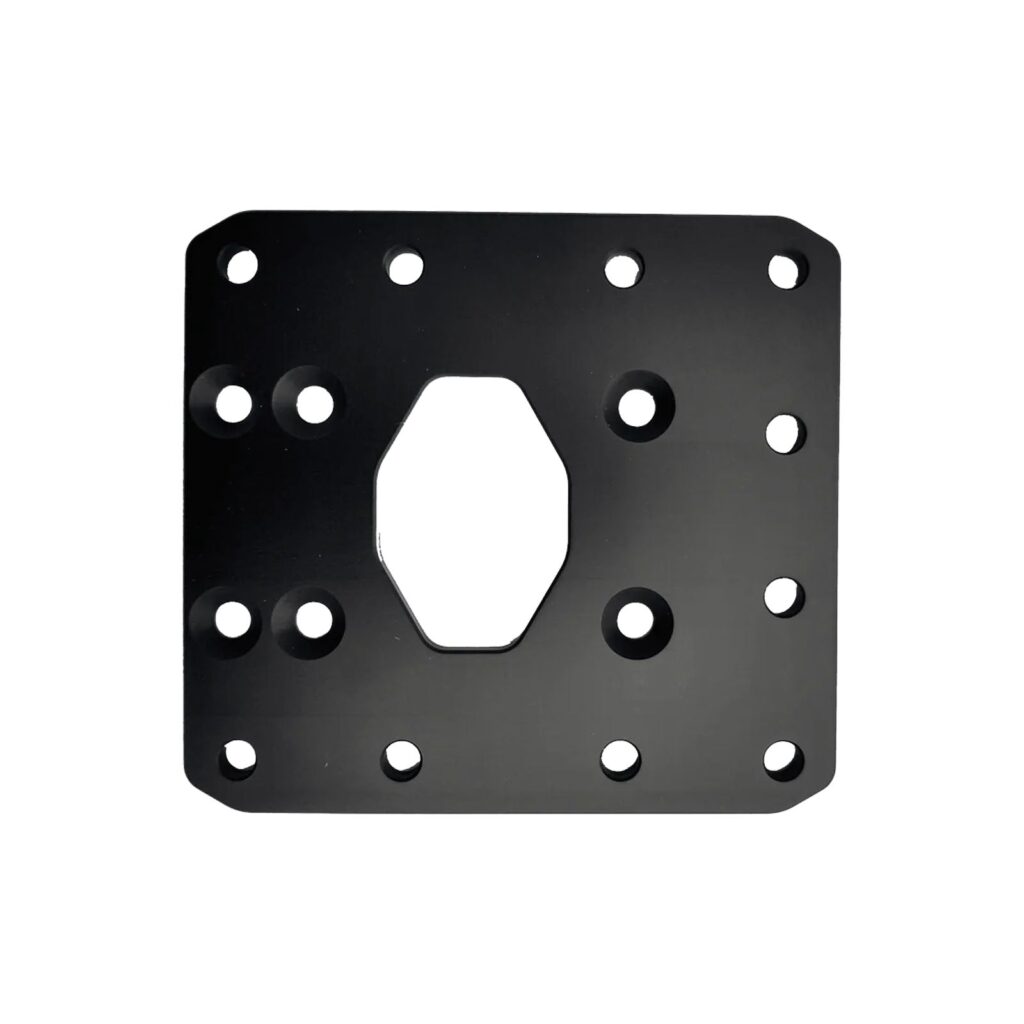
The aluminum mounting plate and its eight screws allow for direct installation on an aluminum rail or a sturdy steel cockpit. It can be mounted on the right or left, in a vertical or horizontal position, depending on the desired ergonomics. An optional tandem mount allows you to attach it to a gearshift lever, with a clever angle design that’s well-suited for hand positioning. As for connectivity, the built-in 1.5-meter USB cable eliminates the need for questionable adapters. Be aware, however: this is a PC peripheral. It connects via USB and works with PC simulators (EA Sports WRC, Dirt Rally, Assetto Corsa), but it is not compatible with consoles.
Who is it for?
This handbrake is designed for intermediate to advanced drivers who spend time rallying, rallycrossing, or drifting and who want equipment that will last. It’s positioned as a high-end, semi-pro-oriented product, with a design very similar to that of a real race car. If you’re looking for the part that completes your PC setup, the investment is well worth it thanks to its durability and reliability.


Reviews