
MOZA R16 Wheel Base : Test & Reviews | What it's really worth in 2026
MOZA R16 Wheel Base: My quick review
The MOZA R16 really gives the impression of taking immersion and car legibility to a new level, without going overboard with unnecessary power. It makes sense for regular to committed PC simracers, ready to invest in a consistent setup over the long term. In this context, the overall value seems solid and well justified.
When you buy through our links, we may earn an affiliate commission.
In the world of Direct Drive bases, the MOZA R16 occupies an interesting place: a powerful block, designed for the demanding simracer, but without falling into elitist extremes. It's clearly aimed at those who want to take a serious step forward in immersion and precision, without necessarily going for the most violent base on the market.
On paper, the R16 promises generous torque, detailed feedback and build quality worthy of a high-end setup. In reality, it's aimed above all at PC gamers who want a durable base, capable of following a progression over several years, while remaining within the MOZA ecosystem.
My angle with the R16 is simple: driving feel, smooth power feedback, comfort over long sessions, and the ability to adapt to different riding styles. It's not a question of whether it can take your arms off, but whether it really helps you to feel the car better and drive cleaner, smoother and with more pleasure.
We're talking about a product that appeals because it promises to transform a "serious" setup into an "advanced simracing" one. The question, above all, is: does this base justify the investment compared to an R9 or a more modest base, and how relevant is it in the face of even more powerful models?
Design and manufacturing
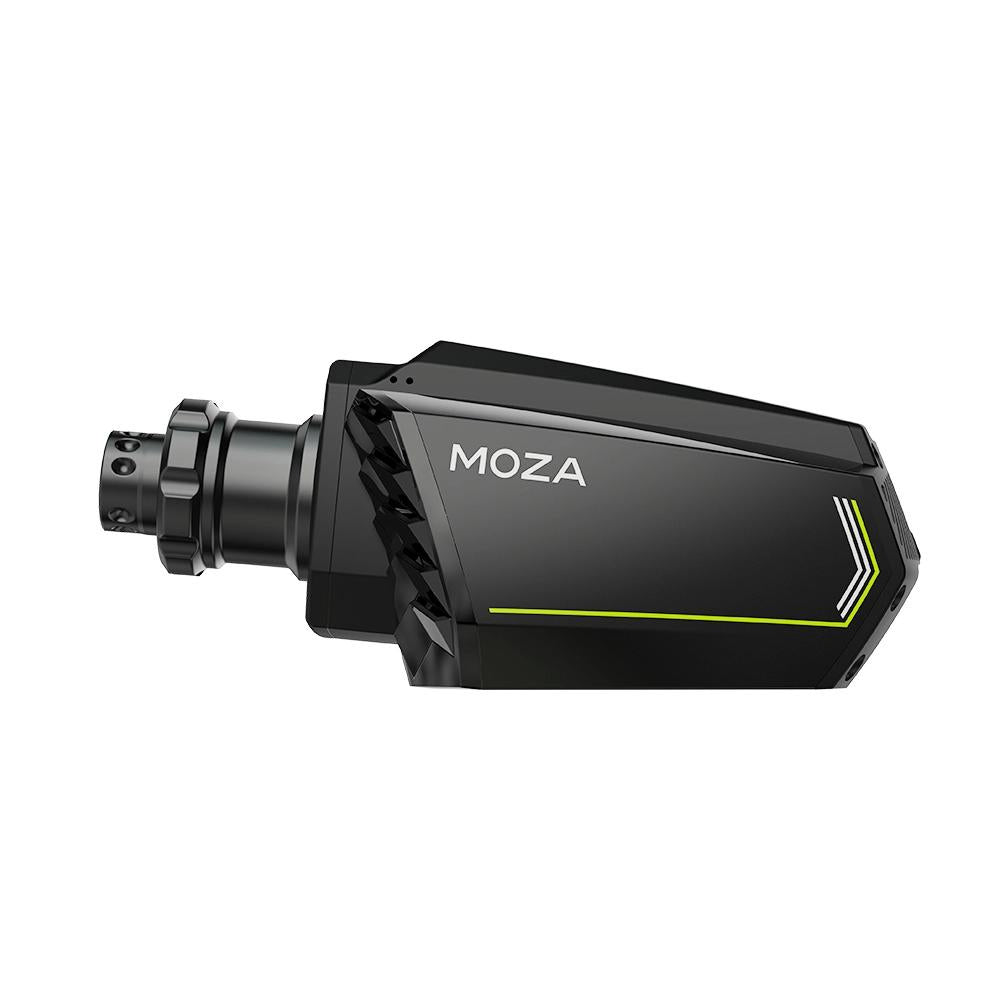
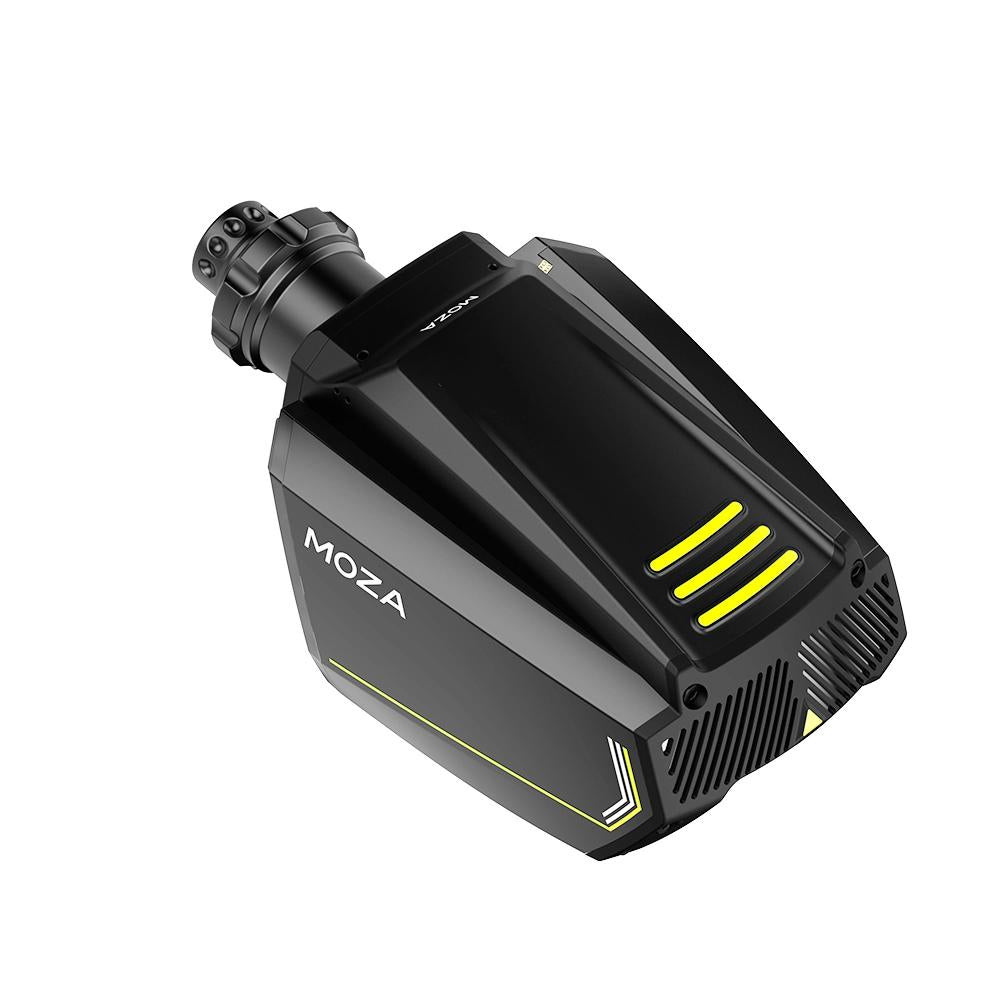
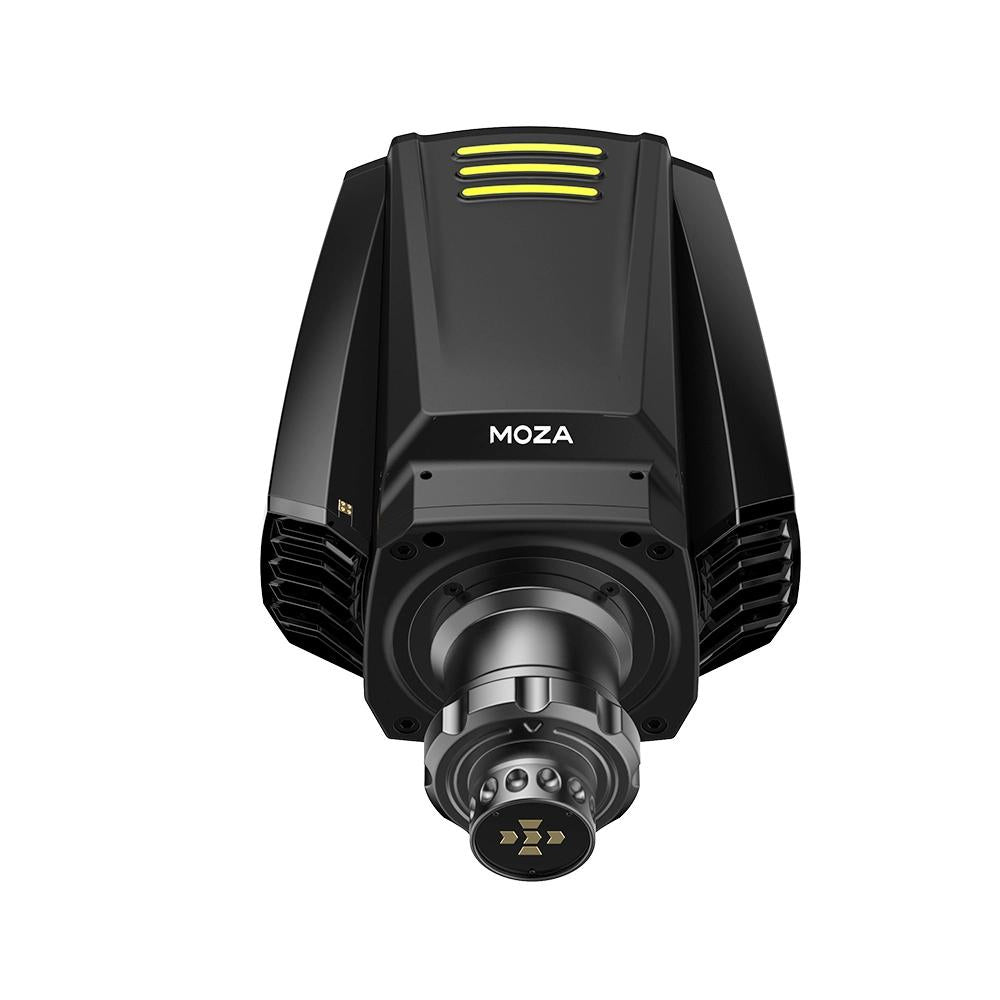
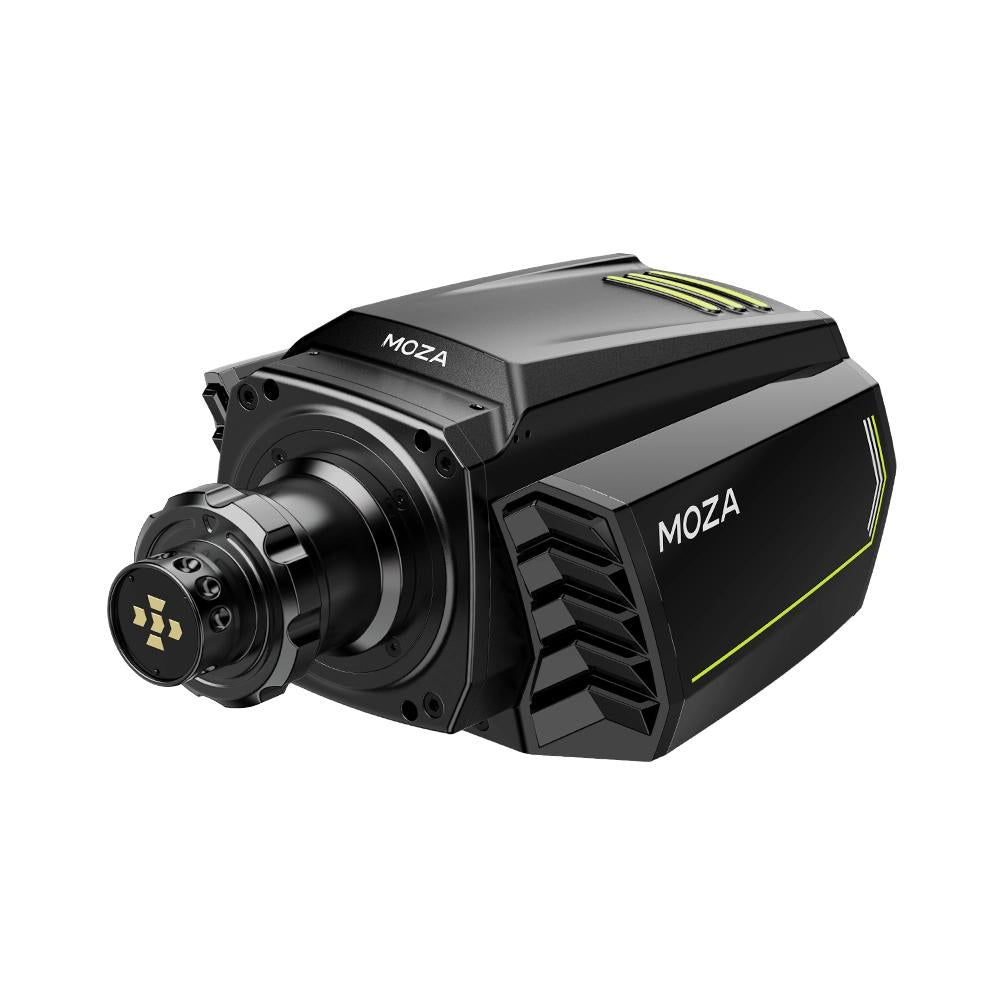
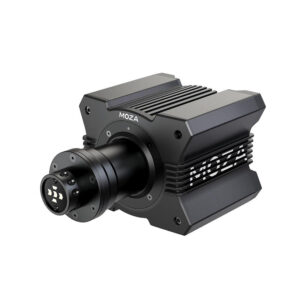
The MOZA R16 immediately imposes a real sense of density. The body is made of metal, with a machined shell that inspires confidence. In hand, you get the sensation of a compact, rigid block, without the slightest flex. It's the kind of base you don't hesitate to squeeze hard against a cockpit without fear of damaging it.
The finish is clean and unadorned: clean edges, uniform coating, serious assembly. Edges are well worked, surfaces don't look cheap, and the whole gives off a very "industrial" feel in the good sense of the word. It's a far cry from the plastic or lightweight shells of old-fashioned belt-driven steering wheels. Here, it exudes durability.
The steering wheel attachment system, with its typical MOZA quick release, gives an immediate impression of solidity. The engagement is firm, with no perceptible play once the steering wheel is in place. It's immediately clear that the base is designed to withstand side loads, dry corrections and hours of intense riding.
What may come as a surprise is its size in relation to its claimed power. It's not a bulky monster, but the block remains imposing enough to remind us that we're no longer in the world of small office bases. You need a proper, rigid cockpit to operate it serenely.
As for minor disappointments, we're not at the ultra-luxury level of some very high-end bases, where every design detail exudes "made-to-measure". The R16 remains an efficiency-oriented product rather than an aesthetic "wow effect". Compared to more affordable bases, the move upmarket is clearly evident in terms of construction, but we also feel that MOZA has sought a balance between cost and finish.
Settings, customization and compatibility
When it comes to settings, the R16 uses MOZA's in-house software. The interface is clear overall, with presets for each set and the possibility of fine-tuning the FFB's behavior. You'll find the main settings: overall force, filtering, inertia, damper, friction, and so on. The idea is to be able to make the base either very lively and direct, or softer and filtered if you prefer something more "comfortable".
The learning curve remains reasonable. An intermediate user will quickly find a satisfactory profile based on the presets provided. To get a truly customized feel, you'll need to spend some time testing and fine-tuning. But we're not faced with an unmanageable monster, and the software ergonomics are fairly modern and accessible.
Compatibility is clearly PC-oriented. This is where the base comes into its own, with proper integration on today's leading simracing titles. For consoles, the situation depends on steering wheels and peripherals, and above all on the limitations imposed by console manufacturers, so the R16 should be considered above all as a base designed for a PC environment. This is an important point if you play mainly on consoles.
The MOZA ecosystem around the R16 is a real selling point: several compatible steering wheels, cranksets, shifters, handbrakes, dashboards... Everything integrates rather well, with the quick release encouraging you to change steering wheel according to the discipline. It's a base that can become the center of a complete setup, without the need for DIY adaptations.
In terms of upgradeability, the R16 is anything but a simple entry point. It's more of a medium- to long-term investment for a simracer who wants a base capable of accompanying his progression. It's easy to start with a simple MOZA setup based on the R16, then upgrade the cockpit, pedals and steering wheels without ever feeling that the base is limiting your potential.
Sensations in play
On the virtual track, the MOZA R16 stands out for the overall precision of its force feedback. The first thing that strikes you is the way it delivers information from the road without appearing sloppy. The available torque is more than enough to provide a firm, consistent steering wheel, but the real interest lies in the finesse of the micro-variations of force.
When cornering, the grip reading is very clear. It's easy to feel when the front end starts to saturate, and then the transition to understeer or glide. Where a more modest base can smooth out these transitions a little, the R16 retains a progressive yet precise character. You can feel the car loading and unloading without having to over-interpret what the steering wheel is doing.
On vibrators, the base does a good job. Classic kerbs are well felt, with credible granularity. You don't get the impression that everything is transformed into artificial vibrations. Depending on the settings, these effects can be accentuated or smoothed out, but even with a fairly filtered profile, there's still a clear difference between an aggressive and a softer vibrator. It's the kind of detail that helps you position the car to the centimetre without having to look too hard at the visual cues.
In fast corrections, the R16 shows its true potential. When the rear stalls or the car goes into oversteer, the base reacts quickly, with no perceptible latency, and sends back to the driver what he needs to feel to make a clean catch. You don't get that feeling of heaviness or inertia that some less responsive bases can have. You can really let the reflex do the talking, without fighting against the material.
Over long sessions, the FFB's consistency is good. The base doesn't feel so hot that its behavior changes. Strength remains stable, and details remain present. This is important for endurance relays or long evenings of league racing: you keep the same feeling from the first to the last lap. Comfort then comes from the ability to customize maximum force: the R16 can be set to be physical, but it can also be calmed to avoid excessive fatigue without losing all the finesse of information.
In terms of immersion, we're clearly a step above a belt-driven base or a small entry-level Direct Drive. The steering wheel feels "linked" to the car in a more natural way. You immediately understand what the front axle is doing. You get a better feel for the structure of the virtual chassis, the bumps and surface changes. This is where the base really changes the experience: you drive more with your hands and body, less with your eyes.
Compared to a less powerful base, the gain is mainly in torque reserve, and the ability to retain detail even when the car puts a lot of load on the steering wheel. Where a small base can saturate and give a uniform block of resistance, the R16 continues to offer nuances in the midst of brute force. Compared with even more powerful bases, the difference is less in quality than in the extreme limit of available torque. Some very demanding riders, looking for an ultra-heavy feel, may prefer an even higher base. But for most advanced simracers, the R16 is already in a zone where power is no longer an obstacle to performance.
Who's it for? What we like, what we don't like
The MOZA R16 is aimed primarily at intermediate to advanced simracers, mainly PC-based, who want a serious or semi-pro setup. Motivated beginners may also find something to like in it, but it will clearly be an ambitious investment from the outset. If you're mainly a console rider, or looking for a base to put on a simple desk, this profile won't fit quite so well.
What I appreciate most is the quality of the force feedback: precise, clean, usable. You get the impression that every Newton-meter is used for something, not just to twist your arms. Second strong point: the solid, reassuring construction, which gives you the feeling of having a real pro block in your cockpit. Third asset: the coherent, practical MOZA ecosystem, which allows you to build a homogeneous environment around the base, with well-integrated steering wheels and accessories. You really get the feeling of a setup that "makes a whole".
As for limitations, PC dependency is the first point to consider. If you often switch between console and PC, the R16 isn't the most flexible base on the market. Secondly, the power available, while ample, may be a little over-dimensioned for the occasional simracer. You're paying for a margin that not everyone will exploit. Finally, the closed ecosystem can be seen as a disadvantage for those who like to mix and match a wide variety of brands and accessories: MOZA offers many things, but we remain within a rather marked "family" logic.
In terms of investment, the R16 is positioned as a value base for users who know they'll be staying in the simracing game for the long term. It's clearly a purchase for enthusiasts or committed players, rather than a simple upgrade. The perceived value is high if you really exploit its potential and build your setup around it, a little less so if you're just looking for "a little better" than an entry-level base.
Verdict
The MOZA R16 clearly transforms a setup, giving the feeling of moving into another category of force feedback. It provides a solid, precise and powerful base that becomes the heart of the cockpit, around which everything else is grafted. When you drive over it, you're no longer talking about a gadget or a simple "gaming wheel", but a credible piloting tool for those who take simracing seriously.
On the market, it's in the premium segment, without being the absolute extreme. It's a mid/high-end base in the Direct Drive universe, with a very clear orientation towards the PC and the MOZA ecosystem. It makes a lot of sense for someone who wants a coherent, powerful and durable solution, without blowing the budget on ultra-pro setups.
I'd recommend it to those who ride regularly, who like to fine-tune their settings and who see simracing as a long-term hobby. For a very casual, console-oriented gamer, or one with a light cockpit, other more modest options will be more rational. If you're looking for a serious Direct Drive base, capable of offering rich, clean and immersive force feedback, the MOZA R16 can clearly make the difference in your setup.



Reviews