
Fanatec ClubSport Steering Wheel Formula V2.5 : Test & Review | What it's really worth in 2026

Fanatec ClubSport Steering Wheel Formula V2.5: My quick review
This steering wheel gave me the sensation of really clarifying the car's information and making driving more instinctive, especially in single-seaters and protos. It makes sense for simracers who are already involved, who drive often and want to structure a performance-oriented Fanatec setup. The investment remains coherent in view of the gain in feel and ergonomics.
When you buy through our links, we may earn an affiliate commission.
Fanatec ClubSport Steering Wheel Formula V2.5: the "F1" steering wheel that structures a setup
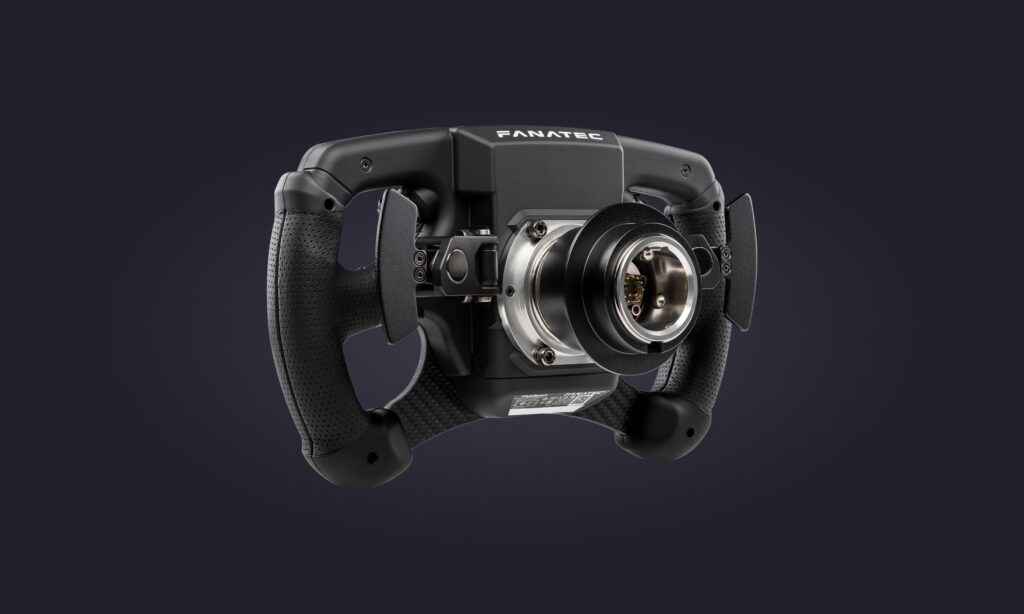
The Fanatec ClubSport Steering Wheel Formula V2.5 is the F1 reference for many simracers. A compact, button-loaded steering wheel designed for single-seater and proto racing, it's clearly aimed at the intermediate/high-end of the Fanatec market. It doesn't promise a technological revolution, but a real leap forward in terms of feel, ergonomics and finish compared to entry-level steering wheels.
This steering wheel is attractive because it ticks a number of boxes at once: an assertive F1 look, serious materials, great tuning potential and broad compatibility with Fanatec bases. It's positioned as the "sweet spot" for those who want to move up a gear without going for even more exclusive and much more expensive wheels.
My angle here is simple: does this Formula V2.5 really offer anything more in terms of precision, feel in the hand and comfort of use than the more basic steering wheels in the ecosystem? Does it remain versatile beyond F1 and protos? And above all, does it justify its price as a real investment in a performance-oriented setup?
Design and manufacture: a real simracing steering wheel
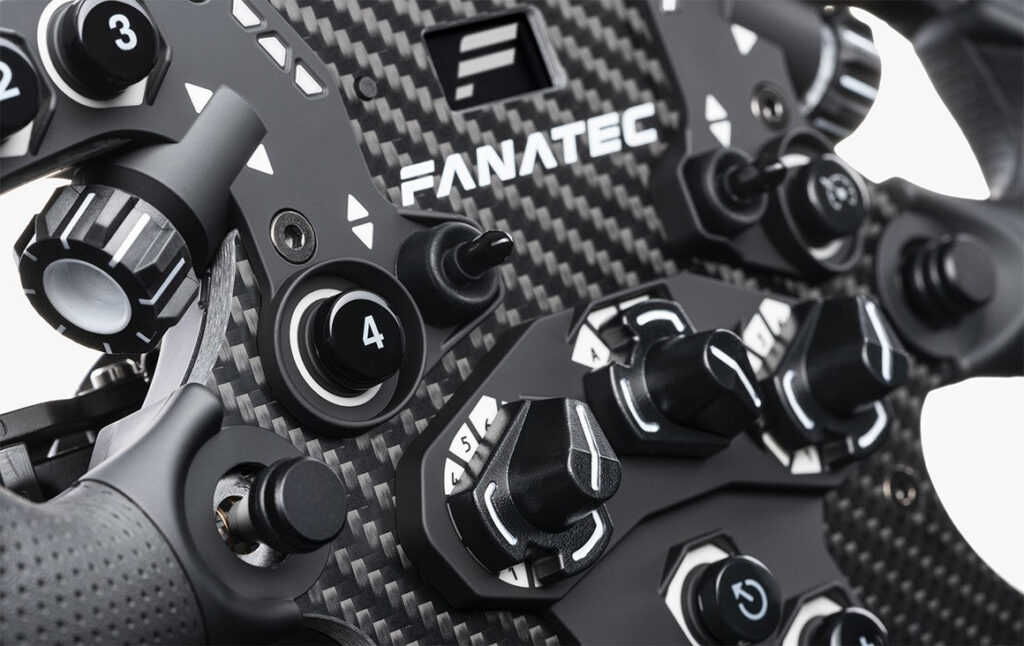
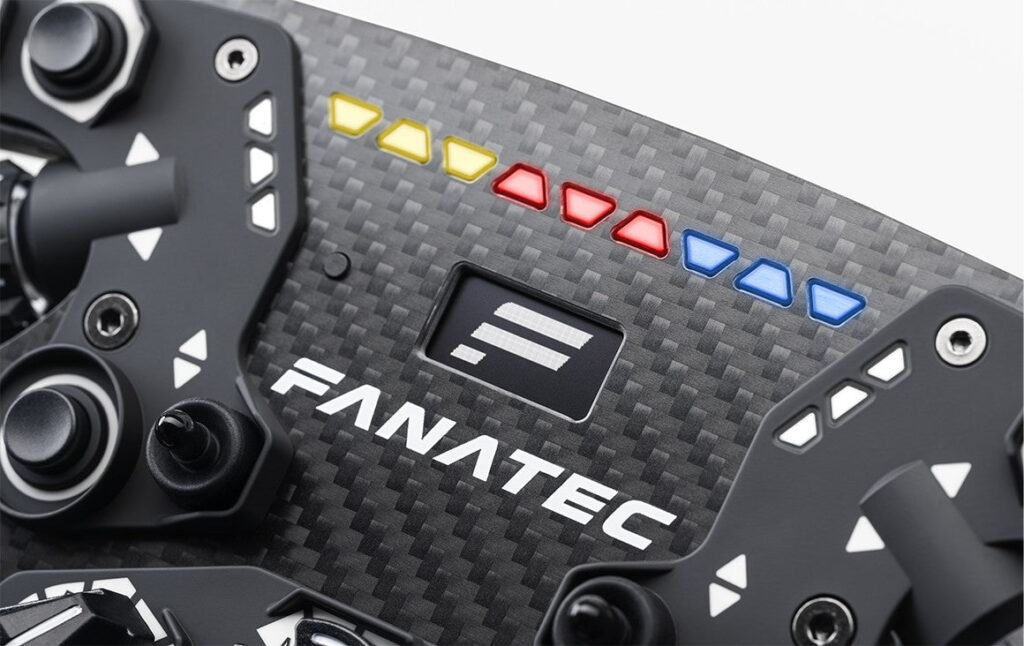
In the hand, the Formula V2.5 gives an immediate impression of density. The metal faceplate, rigid shell and alcantara or leather-covered grips (depending on version) convey a sense of distinct solidity. You can feel that this is no toy: the whole thing is compact, with no creaking, no visible flex. If you dare to bend it slightly, nothing moves. This rigidity changes everything with a Direct Drive base.
Overall, the materials chosen are top-notch for this range. The metal front panel inspires confidence, the buttons click cleanly, neither too hard nor too soft, and the encoders rotate with well-marked detents. You can switch from one setting to another without looking, just by touch, which is a real plus when you're in the middle of a race.
What's surprising is the level of detail on the controls: multiple buttons, rotaries, analog sticks, adjustable paddles... It's immediately clear that this steering wheel is designed to manage a modern, complex car, without touching the keyboard. It's like having a real dashboard in your hands.
Where I have a few reservations is on two counts. Firstly, the alcantara-type covering requires care: without gloves, it can wear out more quickly, especially with longer sessions. Secondly, some will find that the rather small diameter and flattened shape of the steering wheel make it very typical, and less comfortable for large hands or for "relaxed" driving in a traditional GT car.
Qualitatively, compared to a simpler steering wheel from the same brand, we're clearly a step up in manufacturing precision and density of physical sensations. Compared with even more high-end steering wheels, it remains a little more "industrial" in the feel of buttons and paddles, but for the price, the balance is very coherent.
Settings, customization and compatibility: a true control center
Formula V2.5 really comes into its own once integrated into the Fanatec ecosystem. Between the base tuning menu and the encoders directly on the steering wheel, you can adjust a huge number of parameters without leaving the track. FFB strength, filtering, rotation angle, sensitivity, effects on/off, all these options quickly become reflexes.
The presets integrated in the Fanatec databases help you get started. You can start with a standard setting and refine it according to the track. The learning curve isn't complicated, but it does take a little time to get to grips with the multitude of buttons and rotaries. At first, you search and grope, then your fingers memorize the location of key functions. When it clicks, ergonomics become a real asset.
Customization is particularly interesting in the management of in-game functions: brake mix, differential, ABS, traction control, ERS deployment, engine maps... Everything is controlled by buttons, rotaries and small joysticks. You can really adapt the steering wheel to your driving style and type of car, without having to go through cumbersome menus.
In terms of compatibility, the steering wheel is designed for both PC and console users, as long as the Fanatec base supports the platform. On PC, maximum flexibility is obviously guaranteed. On consoles, the steering wheel remains fully functional, even if some titles handle certain advanced assignments differently.
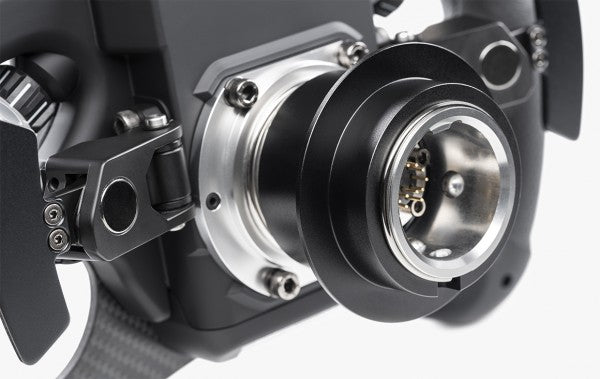
In the ecosystem, it integrates perfectly with ClubSport or CSL cranksets, shifters and handbrakes. It's clearly a product that fits in with an evolutionary setup logic: you can start with a more affordable base, then upgrade to a more powerful Direct Drive without changing the wheel. In this sense, the Formula V2.5 acts as a lasting anchor in a Fanatec setup.
Sensations in play: where Formula V2.5 shows its true colours
On the track, the first thing that stands out is the precision of the message the steering wheel sends out. With a good Direct Drive base, every micro-variation in grip, every load transfer is translated into a very clear reaction in the hands. We're not necessarily talking about brute force, but clarity. You quickly understand what the front axle is doing.
In fast corners, the steering wheel gives particularly clean feedback. You can feel the point of load on the tires, the moment when you start to overload the front end, the exact timing to ease off slightly and maintain speed. The compact "F1" format helps a great deal: hands stay close, corrections are natural and quick, without large gestures.
In terms of grip, the Formula V2.5 takes a real step forward compared to a more basic steering wheel. The beginnings of slippage are easier to read, especially when braking hard or entering aggressive corners. You're more aware of the limit you're approaching, rather than having to accept it at the last moment. This is invaluable for working on your consistency. You drive more on anticipation than on reaction.
Vibrations are well reproduced, with enough detail to distinguish a simple flat vibrator from an aggressive "sausage" vibrator. The rigidity of the structure avoids parasitic vibrations or hull noise. You feel the impact, then the stabilization. It's clean, crisp and, above all, consistent, even when the FFB's force is pushed.
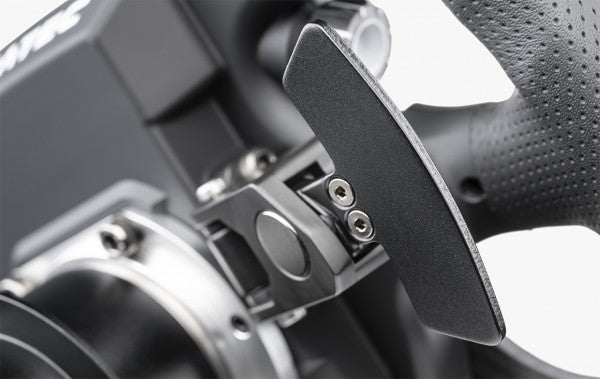
In long sessions, comfort comes as a positive surprise. The steering wheel's grip holds up well over time, provided you wear gloves if you're using alcantara. The shape of the grips allows you to change hand position slightly without losing control. The well-placed gearshift paddles are easy on the fingers. You can turn for a long time without feeling any particular tension, which is far from being the case with all compact steering wheels.
On fast corrections, especially on nervous single-seaters or prototypes, this steering wheel really comes into its own. The low inertia associated with its compact size allows very rapid movements, and the precision of the ergonomics means that you won't get lost on the buttons by mistake. You can catch up on oversteer, trigger an engine map change or adjust the braking balance, all while keeping your hands firmly planted on the steering wheel. Controlling the car becomes more instinctive.
Compared with a simpler, less rigid and less dense steering wheel, the difference lies less in the power felt than in readability. Where an entry/mid-range steering wheel sometimes feels like a "mush" of high-intensity effects, the Formula V2.5 maintains a clear hierarchy of information. It's easier to see what's coming from the grip, the track surface and the steering system.
Compared to even more high-end steering wheels, we lose a little in terms of ultimate finesse and mechanical customization, but the precision/price ratio remains largely to the advantage of this model. For most simracers, the perceived leap in quality is already enormous. You get the feeling of having a working tool, not just a peripheral.
Who's it for? What we like, what we don't like
The Formula V2.5 is clearly aimed at the motivated simracer at intermediate level and above. Those who drive regularly, who are starting to get to grips with advanced settings, and who want a modern racing-type steering wheel. It's particularly suited to fans of F1, open-wheel racing in general, LMP prototypes and virtual hypercars. On PC, it's a real Swiss Army knife for modern racing. On consoles, it remains an excellent choice if you play mainly competition-oriented titles.
What I appreciate most is the combination of finish, feel and ergonomics. The steering wheel gives a real impression of seriousness as soon as you hold it. The sensations transmitted are clean and consistent with a Direct Drive base. And the number of controls available means you can really drive from the wheel, which changes the way you handle a long race or stints.
Another positive point: it's a durable product in a setup. You can upgrade the base, the pedals or the rest of the equipment without having the impression that this wheel becomes the weak link. It's well-suited to upmarket FFB use, which isn't always the case with lighter or more flexible wheels.
In terms of limitations, the first is obvious: the single-seater's very typical shape makes it less versatile for those who drive mainly "classic" GTs, rallies or open roads. You can do anything with it, but it's not the most natural format for these disciplines. Second point: alcantara or similar coatings require gloves or a minimum of care, otherwise the aesthetic lifespan takes a hit. Finally, the price clearly places it in the considered investment category. This is no longer a trial purchase, but a structuring setup choice.
In terms of perceived value, for a simracer that takes its hobby seriously, the equation remains interesting. You pay for a real increase in sensations, an above-average finish and ergonomics that support rather than complicate riding. For a complete beginner, this may be overkill. For a gamer already hooked, the cost/experience ratio makes sense.
Verdict: a solid pillar for a performance-oriented setup
The Fanatec ClubSport Steering Wheel Formula V2.5 is not just another gadget in an already vast ecosystem. It's a structuring element of a modern simracing-oriented setup. It brings rigidity, precision and ergonomics that transform the relationship between virtual driver and car, especially with a Direct Drive base.
On the market, it's positioned at the top end of the mid-range, and even at the entry-level of premium F1-type steering wheels. It doesn't aim for ultra-custom at a crazy price, but offers an experience very close to what demanding simracers expect, without totally blowing the budget.
I'd recommend it without hesitation to those who mainly race single-seaters, prototypes or modern GTs, on PC or console, and who already have a Fanatec base or are seriously considering getting one. For the more casual gamer, who prefers round wheels and multi-discipline use, it's not necessarily the best first purchase.
If you're looking for a compact, precise, rigid steering wheel designed to get the most out of a Fanatec base in modern racing, this product can clearly make the difference in your setup.
Other products we have tested
-
Fanatec ClubSport BMW M4 GT3
-
Fanatec ClubSport Formula V2.5 X
-
Fanatec ClubSport Steering Wheel F1 Esports V2
-
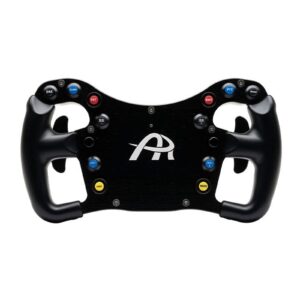
Ascher Racing F28-SC V2
-
Fanatec ClubSport Steering Wheel Classic 2 V2
-
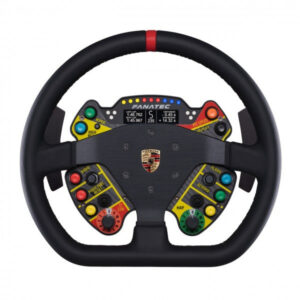
Fanatec ClubSport Steering Wheel Porsche 911 GT3 R V2 for Xbox (Leather)
-
Fanatec ClubSport RS
-
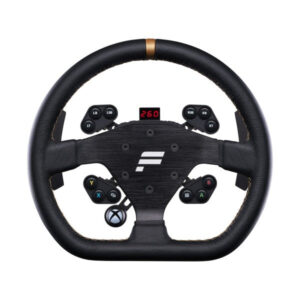
Fanatec ClubSport Steering Wheel R300 V2 for Xbox



Reviews