MOZA R12 Wheel Base : Test & Reviews | What it's really worth in 2026
MOZA R12 Wheel Base: My quick review
This MOZA R12 really gives you the feeling of turning a corner: the steering wheel becomes easier to read and more precise, without becoming exhausting to use on a daily basis. It will appeal above all to intermediate to advanced PC simracers who want a durable, serious and upgradeable setup center. For this price segment, the balance between performance, comfort and ecosystem coherence is very solid.
When you buy through our links, we may earn an affiliate commission.
The MOZA R12 Wheel Base is positioned in the hotly contested "mid-range" Direct Drive base segment. More powerful than an entry-level model, less extreme than a torque monster, it's clearly aimed at the heart of the market: demanding simracers who want serious torque and fine force feedback, without blowing the budget or the installation. On paper, it promises a good balance between power, compactness and FFB refinement.
What's immediately appealing is the promise of accessible realism: a Direct Drive strong enough to make you forget about belt-driven bases, but still manageable for a reinforced desk or a standard aluminum cockpit. For my part, I approached the R12 mainly from the angle of pure sensations and software ergonomics: do we really gain in steering precision, grip reading, comfort on long stints, compared to more modest bases? And above all: does this base hold up as the center of an evolving ecosystem (steering wheels, pedals, shifters) without giving the impression of a shaky compromise?
Design & manufacturing
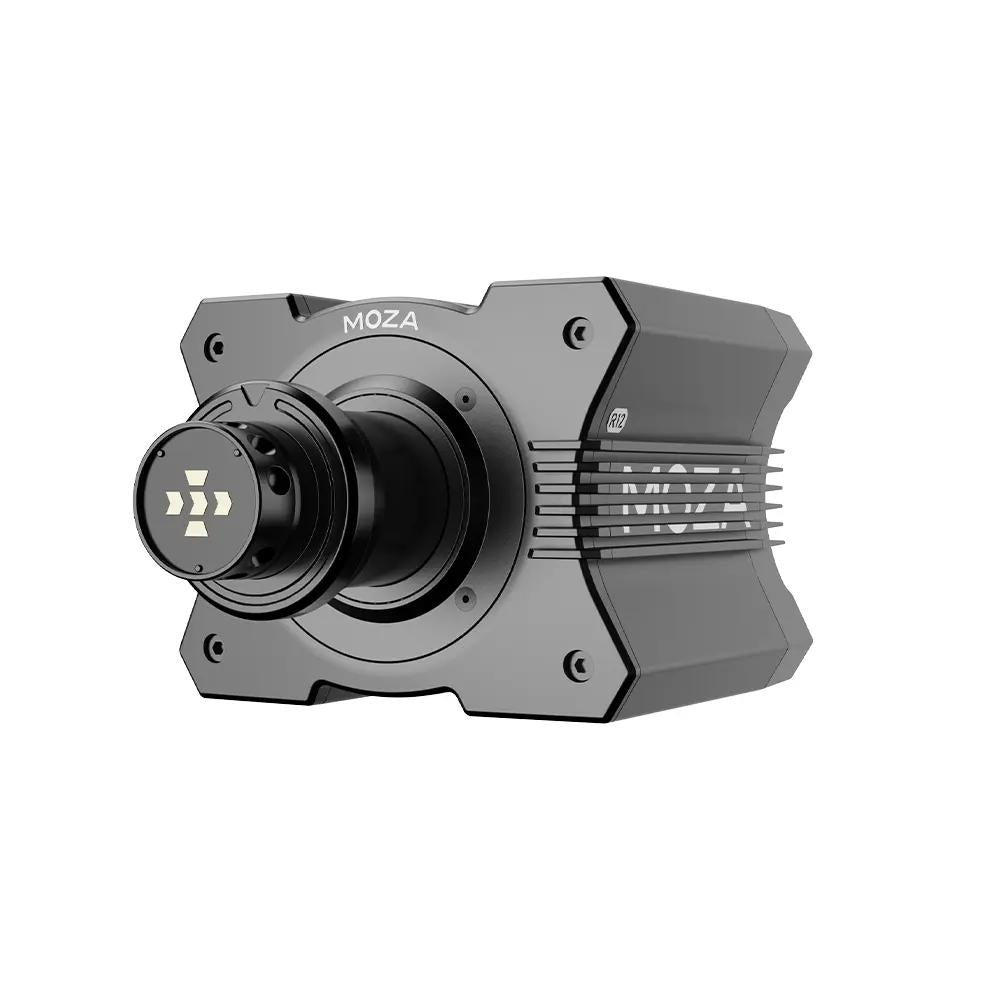
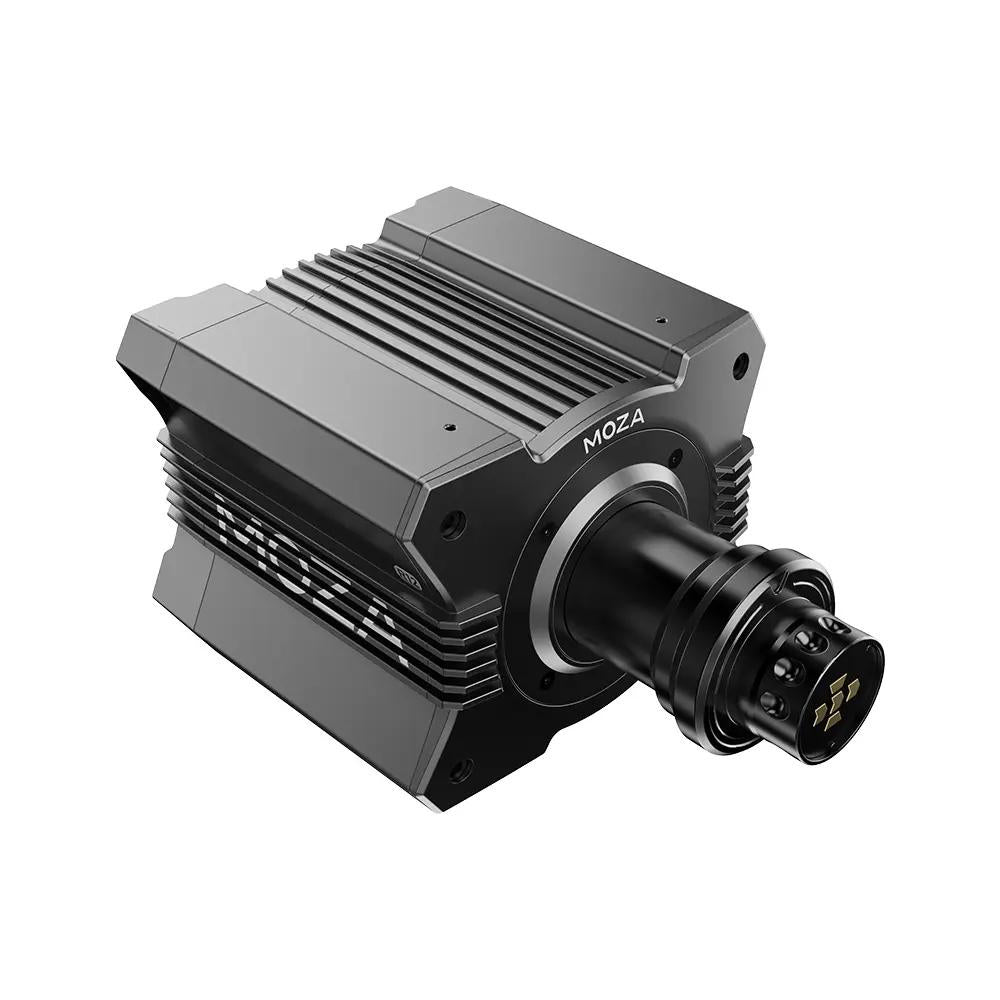
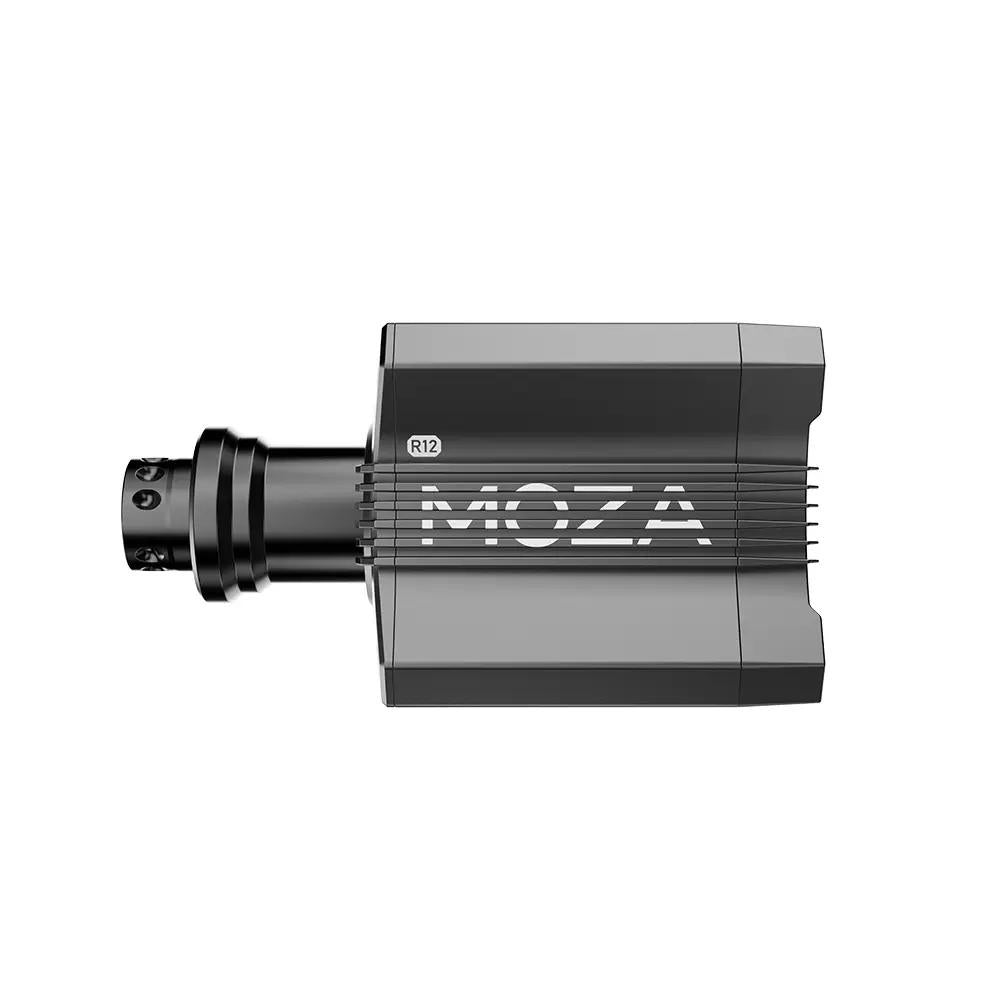
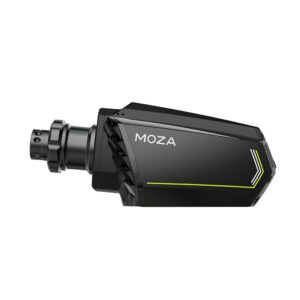
The MOZA R12 immediately gives the impression of a compact, dense block. This is a metal chassis, with a meticulous finish, well-machined edges and an overall feeling of rigidity. In hand, the base feels serious, with no play or hollow-sounding elements. It really feels like an "engine block" designed to withstand hours of riding without flinching. Visually, it's sober, rather modern, with that angular aesthetic typical of the brand.
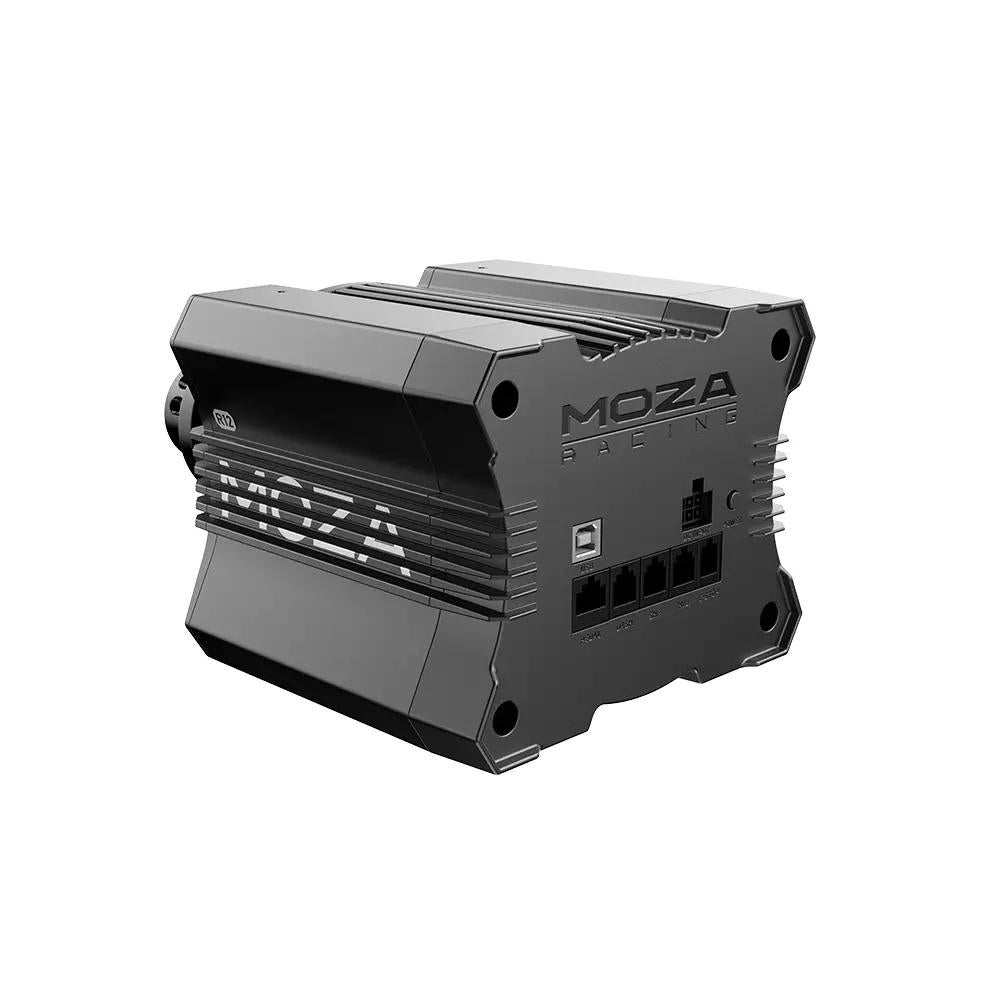
In terms of manufacturing, the adjustments are clean: no visible flex on the fixing points, no parasitic vibrations coming from the casing. The rear connectors are well integrated, even if the overall layout remains rather dense; you need to organize yourself a little to manage cables and accessories. Ventilation is discreet, and noise remains contained during play: you can hear a murmur, but nothing disturbing once headphones or sound are activated.
What's surprising at first glance is the size/power ratio. For a base model in this segment, the R12 remains relatively compact, making it easy to integrate into an aluminum cockpit or a sturdy desk. On the other hand, those expecting an ultra-luxury premium object may be a little disappointed by certain details: the design is clean but not particularly high-end, and the finish remains very decent for the price, without any wow factor. Compared to direct competitors, we're in the same league in terms of perceived solidity, with a slight impression of a product optimized for functionality rather than showmanship.
Settings, customization & compatibility
Software plays a key role on a Direct Drive base, and the R12 is no exception. The MOZA interface (via the dedicated software) offers predefined profiles for the main games, plus a series of sliders for adjusting FFB intensity, filtration, damping, friction, inertia, etc. The advantage is that you're not swamped by obscure terms: the settings remain comprehensive. The advantage is that you're not drowned in obscure terms: the settings are easy to understand, and you quickly feel their effects on the track. You can switch from a very raw, nervous FFB to a more filtered, more comfortable feedback, without totally losing the fine-grained information.
The learning curve remains reasonable. A motivated beginner can get by with the presets and a few simple adjustments (overall force, filter, friction). A more advanced user will find sufficient depth to refine the feel game by game, car by car. Profiles can be easily saved and recalled, allowing you to alternate between a clean asphalt GT3 and a livelier proto or lighter formula without starting from scratch.
In terms of compatibility, the R12 is clearly aimed primarily at the PC. Some console uses are possible via specific solutions or compatible steering wheels, but this is not its most natural territory: if your priority is pure and simple console use, other ecosystems remain more plug and play. Where the R12 really comes into its own is in a PC setup with a wider MOZA ecosystem: steering wheels of different diameters, pedalboards, shifters, handbrakes. The whole thing works coherently, with a single software layer.
In terms of scalability, I clearly see the R12 as a durable central base for most drivers. It's not a "little" Direct Drive that you'll burn out in two years before upgrading to a much beefier model. For an intermediate to advanced simracer, there's plenty to do, even as you progress in level. You can move upmarket in terms of cockpit and pedals, and add more distinctive steering wheels, without feeling that the base immediately limits the rest of the setup.
Sensations in play
It's on the track that the MOZA R12 really comes into its own. The first thing that stands out is the precision of the force feedback. You can clearly feel the tire structure, the shifting load, the transition between grip and glide. The base doesn't just give a lot of raw torque; it also transmits micro-variations useful for anticipating stalling. It's easy to understand what the car is doing, especially under prolonged downforce.
In medium to fast bends, the R12 gives a good feel for steering and front-end load. The torque available keeps a credible resistance to the steering wheel even with fairly high forces at play. There's none of the "soft" feel sometimes found on weaker underpinnings, where you have to push the software force to the limit to compensate for the lack of physical torque, at the cost of a saturated FFB. Here, there's still plenty of margin. The steering wheel remains easy to read, even when you turn up the intensity.
On the vibrators, behavior depends very much on the settings chosen. With a fairly direct profile, the edges stand out clearly, with impacts that are clean but not brittle. You can feel the difference between a flat vibrator and an aggressive one, without everything turning into coarse vibrations. By adding a little filtering, you can make the whole thing smoother for longer sessions, while keeping the vibrator structure in the flywheel. For my part, I found the base most expressive on technical circuits with lots of kerbs.
Grip reading is one of our real strengths. At the start of a curve, you quickly sense whether the front end is floating or anchored correctly. On exit, you can feel whether traction is increasing or saturating. To correct slippage, the R12 reacts quickly, without excessive drag or artificial inertia. Quick corrections with the steering wheel (counter-steering, small adjustments in the middle of a bend) remain clean, with no marked elastic effect. You can really "catch" the car by feel, without fighting against the base.
Compared with a less powerful base (entry-level Direct Drive or large belt base), we gain in headroom and control. You can use slightly higher forces while retaining good FFB nuance. Effects don't turn into a compact block; the base retains its dynamic range. Compared to much more powerful bases, the R12 is physically more accessible: your forearms don't tire as quickly, and you don't need a 40x120 aluminum cockpit to keep everything in place. For regular use, it's a good compromise between realism and comfort.
Over long sessions, consistency is good. Torque remains stable, warm-up doesn't interfere with behavior, and fan noise remains discreet. You can rev it up and down without feeling the base weaken or change character. This is where the base really changes the experience: you concentrate on driving, not on the hardware. Immersion is solid, especially with a good steering wheel and coherent pedals. You quickly feel "connected" to the car, which helps you to drive more smoothly and cleanly.
Who's it for? What we like / What we don't like
The MOZA R12 is clearly aimed at a motivated, rather PC-oriented simracer profile, who wants to take a serious step up from a belt-driven base or a small entry-level Direct Drive. Intermediate riders will find it an excellent area for progression. Experienced riders who are not looking for maximum torque will be able to live with it for a long time without frustration. For a complete beginner, it's already a big investment, but not unreasonable if the aim is to build a lasting setup from the outset.
What I like most is the power/control ratio: enough torque to make the steering wheel credible in the downforce phases, while remaining controllable on a well-mounted cockpit. Then there's the cleanliness of the FFB: information is clear, grip reading is natural, and quick corrections are easy to make. Last but not least, integration into the MOZA ecosystem gives a real sense of coherence: a single software environment, accessories that plug in neatly, and the possibility of evolving the rest of the setup around this base.
On the other hand, there are several limitations to bear in mind. The first is the PC priority: on consoles, the experience is less obvious, less universal. If you play almost exclusively on console, it's not the easiest option. Secondly, the finish is serious but not ultra-premium. Those who attach great importance to aesthetics and design may find some competitors more visually flattering. Finally, the software, while clear overall, may take a little time to fully exploit: for a user who wants 100 % plug and play without ever touching a setting, it's a little more demanding than a mass-market solution.
In terms of investment, the R12 is positioned as a product with high perceived value for those who want a setup to evolve over the long term. You pay more than for a basic setup, but in exchange you get a real center of gravity for your installation, capable of withstanding the first few years of progress without showing its limits too quickly.
Verdict
The MOZA R12 Wheel Base has a concrete impact on a sim racing setup. It takes you from a steering wheel that "moves hard" to one that informs and structures your driving. The gain is not just in raw power, but above all in feedback quality: better grip reading, sharper corrections, more credible sensations in corners and on vibrators. You get the feeling that the base is designed for the everyday life of a simracer that rides a lot, not just to impress on paper.
On the market, the R12 is clearly positioned in the Direct Drive mid-range, but rather at the top end of this segment. It's neither an entry-level product, nor an extreme base reserved for ultra-rigid cockpits and advanced tuning enthusiasts. I'd recommend it above all to intermediate to advanced PC users, who want a serious, upgradeable HDD without getting into the race for absolute torque.
If you're looking for a powerful but manageable Direct Drive base, with a clean FFB, good grip reading and real potential for progression over time, this product can clearly make the difference in your setup.


Reviews