
Fanatec CSL Pedals LC : Test & Review | What it's really worth in 2026
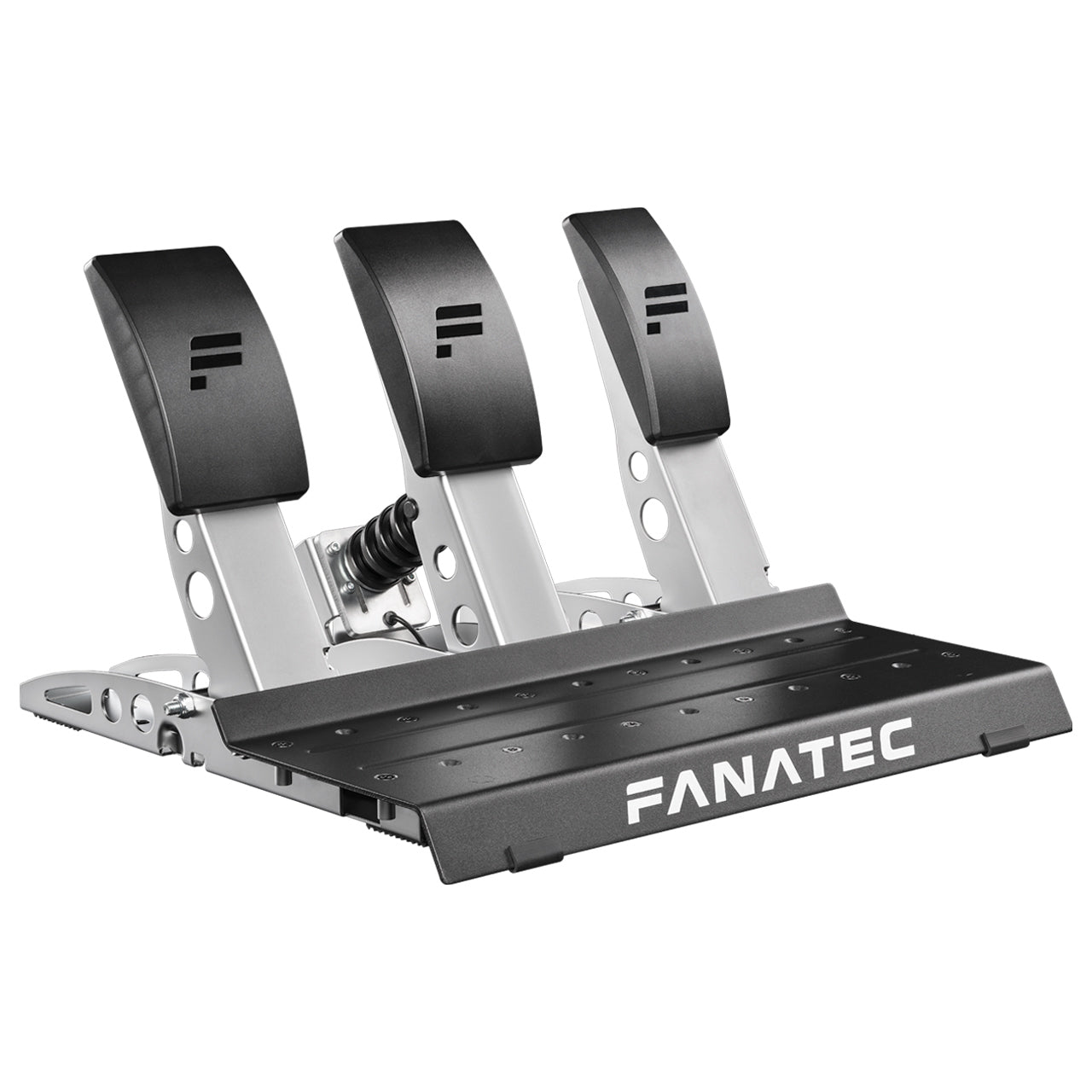
Fanatec CSL Pedals LC: My quick review
The CSL Pedals LC brings true load-cell braking down to under 200 euros. You get a set of three all-steel pedals, a powerful brake, and adjustable braking force up to 60 kg. It’s the package that transforms the way you control your braking—without breaking the bank.
When you buy through our links, we may earn an affiliate commission.
What We Liked
- True load-cell braking at an entry-level price
- Sturdy, all-steel construction with a high-quality finish
- Braking force adjustable up to 60 kg via the software
- Non-contact Hall-effect sensors on the throttle and clutch
- Compatible with PCs via direct USB connection and with consoles via a Fanatec base
- Three-year warranty
Reserves
- Unique, non-interchangeable elastomer
- Single-stage braking, hard from the very first millimeters
- Hardness adjustment is limited to the software
- A rigid mount is practically essential to get the most out of it
Technical Specifications
| Type | Set of three pedals (accelerator, load-cell brake, clutch) |
| Brake | custom 12-bit load cell |
| Braking force | up to 60 kg, adjustable |
| Elastomer | 65 Shore stacking, non-interchangeable |
| Throttle and Clutch Sensors | Hall effect, non-contact |
| Materials | steel, pearl chrome plating, powder-coated heel rest |
| Pedal plates | optional anodized aluminum |
| Brake load cell weight | about 1.8 kg |
| Connectivity | USB (PC) or RJ12 to Fanatec base |
| Settings | side-by-side configuration, plate height, inverted mounting |
| Compatible bases | CSL Elite, CSL DD, GT DD Pro, ClubSport, Podium |
| Warranty | 3 years |
A genuine load cell for under 200 euros
Fanatec has long reserved load cells for its high-end lines. With the CSL Pedals LC, the brand is bringing this technology down to the entry-level segment, and that’s the whole point of this bundle. It starts with the steel CSL Pedals set, to which the Load Cell Kit is added—completely replacing the brake pedal and upgrading the electronics. The old brake pedal then becomes the clutch pedal, so you end up with a true three-pedal setup: accelerator, load-cell brake, and clutch. For those just starting out or coming from a spring-loaded or potentiometer-based system, this is a huge leap forward.
Steel, pearl chrome plating, and a sturdy pedal
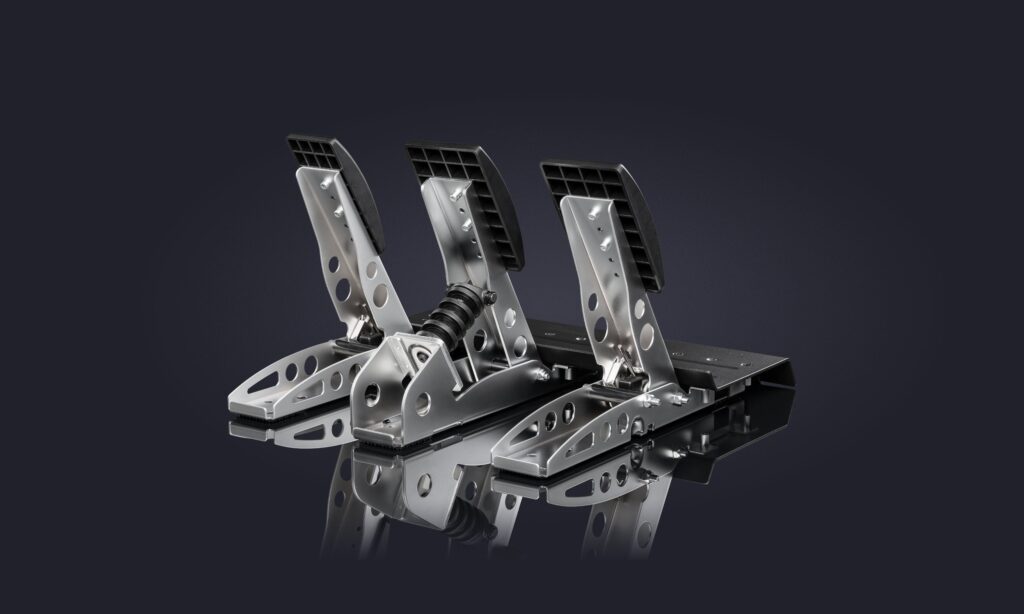
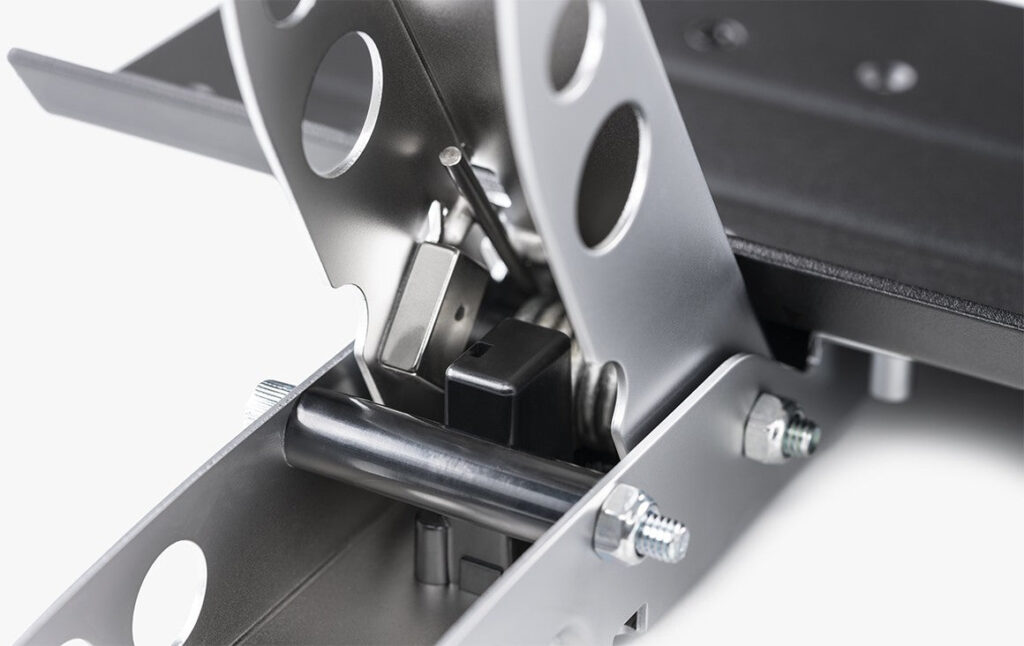
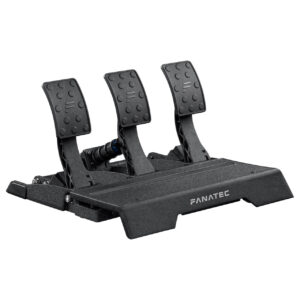
When you take it out of the box, the first thing that strikes you is the metal. Aside from the footplates, everything is made of heavy-duty steel, with a pearl chrome finish on the arms and bases, and a black powder-coated heel rest. The finish is clean, with no suspicious play, and the load-cell brake pedal weighs only about 1.8 kg while remaining very rigid under load. You can feel that the structure withstands the pressure without flexing, which is exactly what you want from a load cell, since the frame mustn’t move—only the elastomer should do the work. Anodized aluminum pedal plates are available as an option for those who want to enhance both the look and the grip.
Underfoot, a brake that bites hard right from the start
That’s where the CSL Pedals LC changes the game. The load cell measures the pressure applied, not the travel—just like the hydraulic system in a real car. You no longer brake by pressing down on a pedal; you brake by pushing against a wall that pushes back. The stack of elastomer, with a hardness of 65 Shore, provides firm resistance and short compression that quickly feels like a real racing pedal. When entering a turn, this firmness is a real advantage, because you modulate the braking with the force of your calf rather than the position of your foot, which makes braking at the limit much more repeatable once you’ve mastered the technique.
However, you have to get used to its feel. This brake is single-piston, so it’s stiff right from the first few millimeters, without the initial smooth phase found on higher-end dual-piston systems. The first few sessions require some adjustment, as your calf learns to find the engagement point rather than just slamming the brake all the way down. During long endurance sessions, this stiffness eventually takes a toll on your leg, but that’s the price you pay for a responsive feel. Our tip, based on our testing, is to lower the pressure setting in the software for 100 percent braking to around 80 percent of the range, so you can achieve maximum braking without straining your ankle.
Adjust the force without changing the elastomer
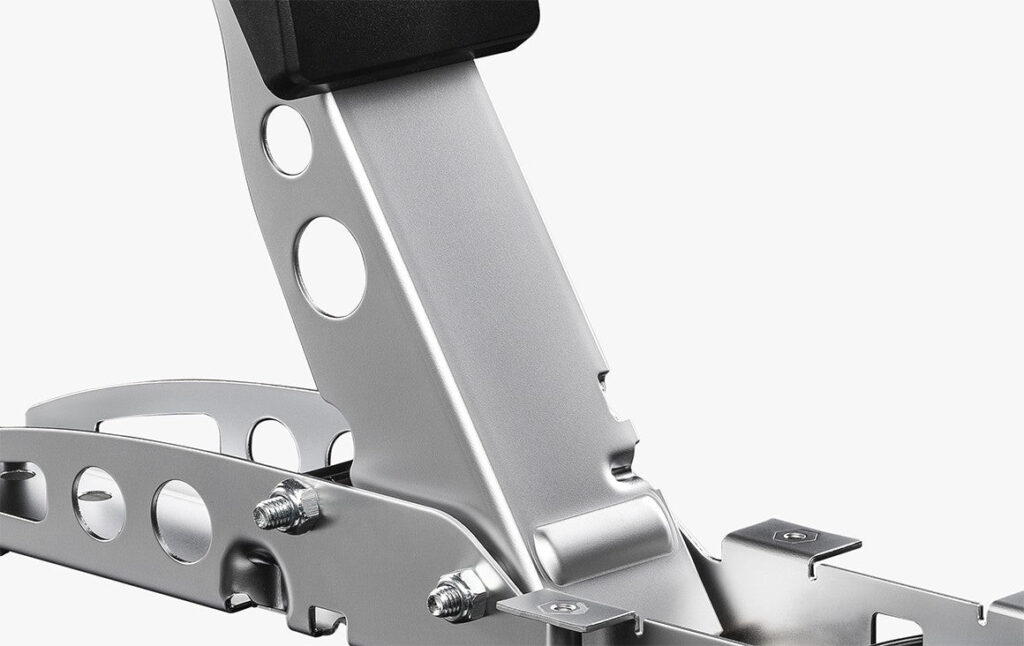
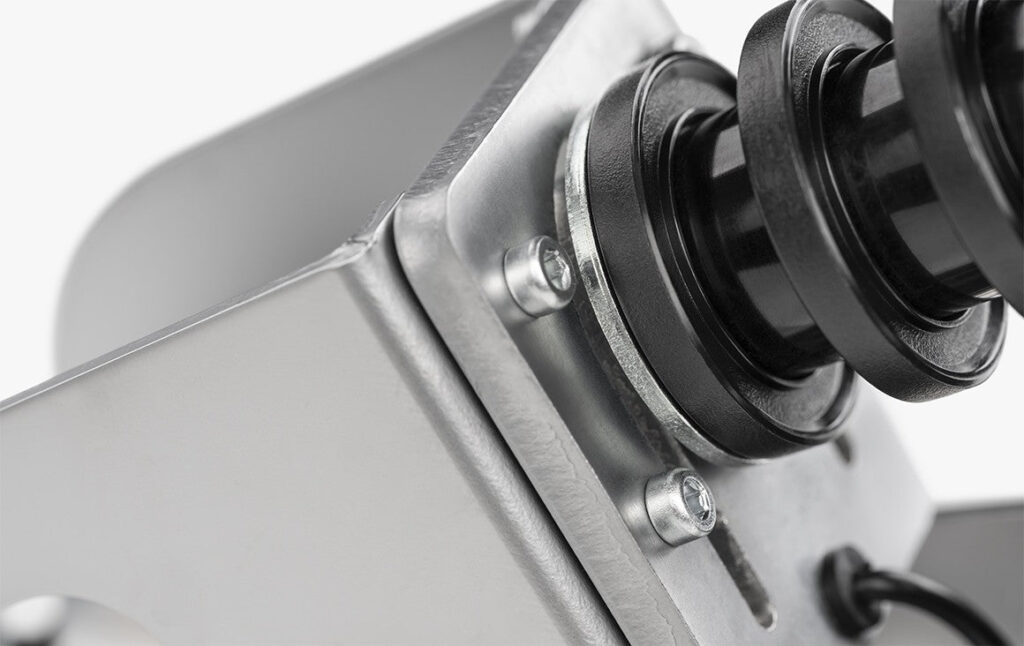
When it comes to customization, the electronics do most of the work. Using the PC driver or the Fanatec Control Panel, you can adjust the sensitivity of the brake pedal, set the pressure that triggers full braking, and fine-tune the response curve. The force range extends up to 60 kg, which provides plenty of leeway to make the feel stiffer or softer depending on the car and racing discipline. The well-known drawback is that the elastomer isn’t interchangeable, unlike other kits that come with multiple rubber pads to adjust the progressive feel. Here, the response is adjusted via software, not mechanically. Physically, the lateral position of the pedals slides along the heel rest, the height of the plates is adjustable, and reverse mounting is possible, which greatly helps in finding the right ergonomic setup.
The throttle and clutch, on the other hand, rely on Hall-effect sensors, which are contactless and wear-free. They operate based on position rather than pressure—which makes sense for these two controls—and provide accurate, consistent readings session after session. They aren’t load cells, but their consistency is a real advantage over potentiometers, which tend to drift over time.
Connect the PC via USB; connect the console via the Fanatec base station
Connectivity remains flexible. On a PC, you can connect the pedals directly via USB as a standalone device, or via RJ12 to a compatible Fanatec base. On a console, everything goes through the base, so the supported platform depends on that base and not on the pedals themselves. In practice, the CSL Pedals LC is compatible with the CSL Elite, CSL DD, Gran Turismo DD Pro, ClubSport, and Podium bases, covering most of the company’s ecosystem. The kit comes with its cables, a Torx wrench, M4 hardware, rigid mounting spacers, and replacement pads. We also recommend rigid mounting on a cockpit, as being able to push hard without the assembly moving is what really brings out the load cell’s performance. The three-year warranty provides added peace of mind regarding durability.
Who Should Consider This Bundle?
The CSL Pedals LC is clearly aimed at drivers who want to switch to load-cell braking without paying the price of a high-end model. You get a firm, responsive, and durable pedal, braking that’s far more consistent than a spring-loaded system, and seamless integration into the Fanatec ecosystem. You just have to accept its character—namely, a hard, direct brake where you can’t change the pads. For most sim racers looking to improve, it’s a very smart compromise.




Reviews